A terrific presentation by Nokia's internal group that studies consumer behavior -- these guys have done an amazing amount of research and have developed a really compelling model for thinking about how people use mobile devices. They have a number of "dimensions" that they use to segment different people's behavior around the use of mobile technologies. The devices that they introduce, like the 6800 that I wrote about yesterday, are defined by analyzing the intersections of these dimensions and identifying clusters of consumers that behave in certain ways and have certain needs for mobile devices. I can't possibly do justice to the full model and Nokia has in any case promised to put this presentation on the web -- so I will link to it when it is available. In the meantime, here are some of the dimension characteristics as a teaser:
Open vs. Controlling
Receptive and Belonging vs. Individual and self esteem
"Mind styles" that these two dimensions produce -- enjoying, exploring, managing, exploiting, controlling, defending, bonding...
Style dimension -- appearance -- premium vs. fun vs. active vs. fashion
functional dimension -- writing vs. reading vs. relationship management vs. talking...
capabilities dimension -- amount of memory, screen size, user interface, programmability...
Phone Categories that these dimensions produce -- Imaging, Gaming, Classic...
The future vision of Nokia is that "...I will have my phone with my set of applications and you will have yours and they will really be entirely personalized to each of our needs and will look nothing like each other..."
This creative segmentation which allows for devices which will become completely personlized is a tremendously powerful vision. One interesting aspect to me is what a sharp contrast it is to the way in which Microsoft has guided the evolution of the PC -- narrowing down the possibilities to a single, fairly uniform platform. One Nokia person commented to me that he and his colleagues were discussing the issue of the PC volume having plateaued at 400 million devices and why this was -- perhaps if Microsoft had adopted this experimental and fully open and configurable approach that Nokia has adopted, that the PC world would look quite different, with a much wider array of solutions adapted to different requirements...
Wednesday, November 06, 2002
Tuesday, November 05, 2002
NMIC Day 2 -- Coolest new gadget...
Nokia has rolled out an amazing number of new products today -- all extremely cool. How about a video survelliance camera that is also a GSM/GPRS phone and can transmit images directly to your phone using MMS? How about a "music stand" which has speakers built into a phone recharging station... Here is a link to Nokia's site to look at their new gadgets. But my award for the coolest new gadget goes to the Nokia 6800 -- a phone with a full keyboard like you have never seen before! Here are pictures that I took with my Nokia 7650 camera phone... 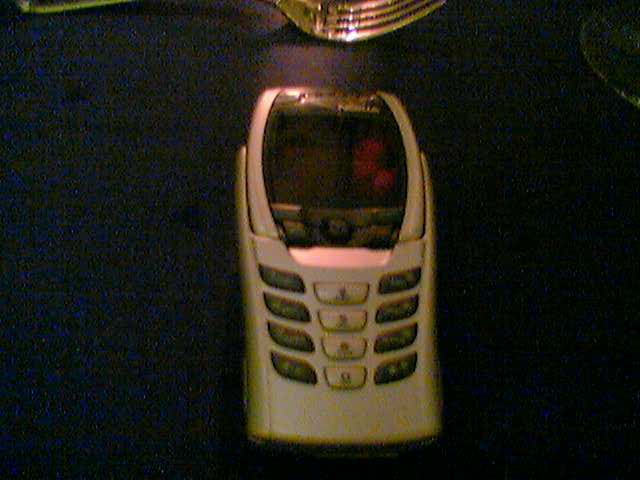 First you can see the phone in its "one hand" mode -- looks like a normal phone, right? But then it OPENS...
 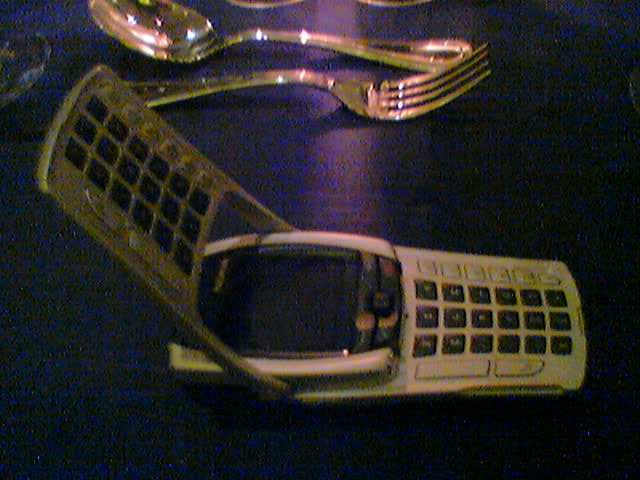 with a section lifting up from the keyboard area. This section continues to open up until it flips all the way over the top, allowing you to turn the device into a horizontal position and use a full QWERTY keyboard with two hands...
 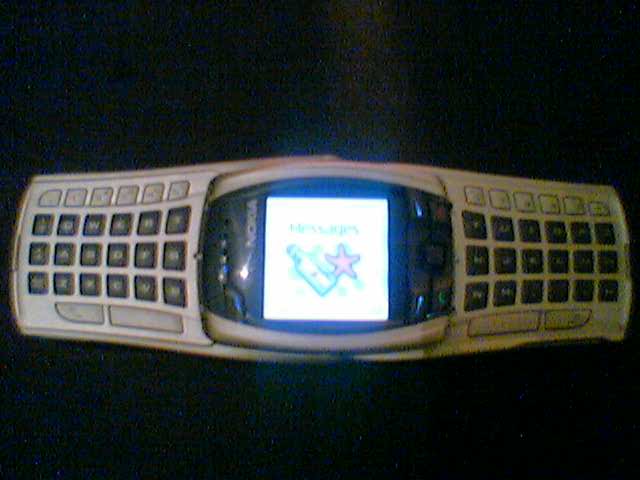 The screen automatically flips orientation when the keyboard is opened.
Very cool phone. Also has a color screen... MMS capable of course. Java... And this is just one of a whole group of new phones that they introduced.
First you can see the phone in its "one hand" mode -- looks like a normal phone, right? But then it OPENS... with a section lifting up from the keyboard area. This section continues to open up until it flips all the way over the top, allowing you to turn the device into a horizontal position and use a full QWERTY keyboard with two hands... The screen automatically flips orientation when the keyboard is opened.
Very cool phone. Also has a color screen... MMS capable of course. Java... And this is just one of a whole group of new phones that they introduced.
Monday, November 04, 2002
Coolest demo of the day
Reporting to you from the Nokia Mobile Internet Conference here in Munich -- the coolest demo of the day was live television playing on a Nokia 7650 over a roaming GPRS data connection! I am not kidding. The crazy engineers at Nokia hooked up a server in Helsinki with a TV tuner card and put TV1 from Finland onto the mobile network! From a 7650 here in Munich we tuned in to watch daytime Finnish television. Video and sound quality was amazing. This is what high speed data connectivity is capable of already today, without 3G -- although I would hate to get that GPRS bill at current rates!
Also, suggestion to Nokia for future demos -- daytime Finnish television is not a killer application... how about a sports channel? I guess TV1 probably wouldn't complain about being pirated though...
Also, suggestion to Nokia for future demos -- daytime Finnish television is not a killer application... how about a sports channel? I guess TV1 probably wouldn't complain about being pirated though...
UK blocks international calling as well...
Jeremy McGee (an ex-Borlander) writes that:
- To be fair to T-Mobile this isn't a situation that's exclusive to the US. Over here in the UK we, too, have to have the call bar lifted on international roaming and international calls.
- This is partly because the international rates are (usually) stupidly expensive. For some reason this is especially the case for US mobile carriers. So with debt at the level that it is with mobile telcos I'm not surprised they want to do an extra credit check.
- 87% of US citizens don't have passports.
Sunday, November 03, 2002
T-Mobile -- when will the US think globally?
I have been a T-Mobile customer since Friday and I am already frustrated with them. And I haven't even made a call yet. But the problem I am having with T-Mobile is also a problem with every other carrier in the US. There are smart people at T-Mobile, but when it comes to thinking Globally, despite being a division of a German company, they get mired in the same bad logic that slows down the rest of the US mobile market.
Here is what happened: On Friday I set up a new T-Mobile account so that I could test the new Microsoft "Pocket PC Phone Edition" and compare it to Nokia's and Sony-Ericsson's Symbian based phones (more on that later). On Saturday I boarded a plane for Munich, where I am now -- for the Nokia Mobile Internet Conference. So I arrive in Munich on Sunday night (local time) and turn on my new phone. But I am unable to get a service provider connection. After I arrive at my hotel, I call T-Mobile's customer support in the US.
It turns out that, even though T-Mobile is a German company and even though the phone they sold me was a dual-band GSM phone, I can't use my US T-Mobile account in Europe. In fact I can't even call Europe from the US.
You see, if you are a US citizen and you want to call internationally, they assume that you must be a criminal. This is the only explanation that I can come up with. I had the same problem a few years ago when I was a Sprint PCS customer, and again when I set up my Cingular account (which I use for work). By default when you get a phone in the US you can only use that account in the US and you can only call people in the US. In order to get this changed, you have to petition an International department which, after an investigation, will decide whether or not an account can be approved for international use.
I guess the theory is that the US is such a large country and market that we can grow up and live out our entire lives without ever needing or wanting to call someone outside the US and without ever needing to use our mobile phones from outside the US.
Unfortunately isolationism leads again and again to a rude awakening when some external event provides a reminder that we are part of a global economy and a worldwide society. Not activating mobile phones for international use is just a symptom of the larger problem. Eventually we are going to have to start training our children to look at the world outside our borders -- and to think about themselves as part of a global civilization.
Here is what happened: On Friday I set up a new T-Mobile account so that I could test the new Microsoft "Pocket PC Phone Edition" and compare it to Nokia's and Sony-Ericsson's Symbian based phones (more on that later). On Saturday I boarded a plane for Munich, where I am now -- for the Nokia Mobile Internet Conference. So I arrive in Munich on Sunday night (local time) and turn on my new phone. But I am unable to get a service provider connection. After I arrive at my hotel, I call T-Mobile's customer support in the US.
It turns out that, even though T-Mobile is a German company and even though the phone they sold me was a dual-band GSM phone, I can't use my US T-Mobile account in Europe. In fact I can't even call Europe from the US.
You see, if you are a US citizen and you want to call internationally, they assume that you must be a criminal. This is the only explanation that I can come up with. I had the same problem a few years ago when I was a Sprint PCS customer, and again when I set up my Cingular account (which I use for work). By default when you get a phone in the US you can only use that account in the US and you can only call people in the US. In order to get this changed, you have to petition an International department which, after an investigation, will decide whether or not an account can be approved for international use.
I guess the theory is that the US is such a large country and market that we can grow up and live out our entire lives without ever needing or wanting to call someone outside the US and without ever needing to use our mobile phones from outside the US.
Unfortunately isolationism leads again and again to a rude awakening when some external event provides a reminder that we are part of a global economy and a worldwide society. Not activating mobile phones for international use is just a symptom of the larger problem. Eventually we are going to have to start training our children to look at the world outside our borders -- and to think about themselves as part of a global civilization.
Friday, November 01, 2002
The Hype Backlash -- Web Services' Turn...
The articles are beginning to appear, like this one at Business 2.0. Entitled "Still Waiting for the Web Services Miracle" the article is a fair complaint that the hype got out of control. And the author even writes that
- If you forget the grandiose promises, there are some things Web services are good for right now...
Time to move on... (Re: Microsoft)
Well, it isn't actually possible to download the court's opinion from their website -- I am guessing due to the large number of download requests... It was heartening however to see (using this nifty tool at Netcraft) that the court is running Linux... But in any case the news is out and the court is allowing the Justice department's settlement with Microsoft to stand. So I guess its time to move on to the next issue...
Thursday, October 31, 2002
.NET vs J2EE -- The PetStore Debate
Wouldn't it be wonderful to have an independent party create a comparison of J2EE and .NET in order to demonstrate the benefits and issues with each of these two frameworks? The Middleware Company had said that they had created just such a comparison using the PetStore demonstration application. But now Rickard Öberg provides a devastating critique of this effort and others have stepped forward to claim that Microsoft paid TMC for the report...
Microsoft News Flash!
Just received a PDF from the United States District Court announcing that Judge Colleen Kollar-Kotelly will issue "Opinions in the Microsoft cases" at approximately 4:30 p.m. on Friday, November 1, 2002. Should be downloadable tomorrow from the court's website.
The real debate
I am beginning to feel a little guilty about the time that Lawrence Lessig is spending with me in conversation about his concept of "opaque creativity." But I continue to believe that this is an important issue, and that Lessig is a person in a position to have a significant influence over the way in which the marketplace thinks about this idea. So I was gratified by the continued seriousness with which Lessig has addressed my concerns in his latest reply.
Lessig returns to the fundamental issue, why should software (or really any kind of opaque creativity) be treated differently from other types of creativity? Why shouldn't all types of creativity receive the same copyright protection under the law? The argument has two parts:
95 Years
Lessig writes that at 95 years, copyrights for software do not provide a balance for the public good -- in 95 years software will have no value, in fact the software product will probably not be able to run on any available hardware. If I can summarize the argument, 95 years might as well be forever. This is the same argument which I agree with that Lessig has been making about copyright generally. Copyright should be for a "limited term." This is true whether the copyright is for a book or a film or a software program. I think there is an interesting argument in saying that different types of creative output should have different lengths of time of protection, because of the inherent "shelf life" of the material. But this is a very different argument than that of saying that software should be escrowed and source code should be released. One is an economic argument about the value that the public enjoys in exchange for copyright protection. The other is an argument about what the public should be allowed to do with the property once it is in the public domain.
Opacity vs. Transparency
This then is Lessig's primary argument. Works of opaque creativity are fundamentally different from works of transparent creativity. With a book, I have all of the "code" before me, transparently. I can reproduce all or part of a manuscript and I can embed any part in a new work. With software, or other works of "opaque" creativity, it is very difficult for me to do anything other than reproduce the product in its entirety. And if the manufacturer has included security elements which require a licensing key to activate the software, reproduction of the product may not provide me with the use of the product. This is a reasonable objection, but the solution need not be Lessig's proposed source code escrow scheme. Consider the three most common uses of copyrighted material that has passed into the public domain -- duplication, derivation, and partial use.
Duplication
In the case of duplication, software can clearly be duplicated in its entirety whether or not the duplicator has access to the source code. An issue remains in that mere duplication of a software program may not be sufficient to allow for use of the software. Thus some system should be in place to provide the public with access to a version of the software that does not require a security key to unlock functionality, or some ability to generate such keys once the software has passed into the public domain. This is not unlike the problem that Lessig mentions regarding the film industry -- how does one make sure that some copy of a film is available to be duplicated at the point when that film passes into the public domain. I would suggest that this problem should be solved for all categories of copyrighted material, not just such works of "opaque creativity."
Derivation
In the case of derivation, the concern is more complex. I submit that the process of creating a derivative work from what Lessig calls "opaque creativity" is no different from that in creating a derivative work from a book or other example of "transparent creativity." Furthermore, these derivative works are being created all the time, and software companies have been unable to protect themselves from this type of derivation (see the supreme court case Lotus v. Borland).
Take for example the works of Mario Puzo, since I recently read that Random House is seeking an author to write a sequel to The Godfather. What would this new author have to go on to create this derivative work? The author could read the previous novels, learn about the characters and their motivations, get a feel for the dialog, understand the plot... but the author wouldn't have Puzo. Thus the author would have to "reverse-engineer" the thinking process needed to construct a believable set of characters, plot, dialog, etc.
The authors of Lindows did the same thing -- they looked at how other operating systems displayed icons, user menus, startup and shutdown scripts... and they created a new user environment for the Linux operating system. Would having access to the Windows or Macintosh source code have made their job easier? Yes, just as having access to Puzo as a collaborator on a new novel would make it easier for the new author to create a sequel.
There is a "means of production" for every creative work. In the case of The Godfather it was the mind of Mario Puzo. In the case of many modern "romance" novels, it is an automated book generating computer program. In the case of Toy Story it is a set of algorithms for rendering 3D graphics. In the case of a software program it is the source code. Software should be treated the same as any other creative work -- the resulting work should be made public when the copyright term expires. But the government should not create a system which compels artists, writers, movie producers, and software programmers to make public their means of production.
Partial Use
It is this last category of use that is certainly the most difficult to answer. For a book this might mean reproducing a single chapter. For a film it might mean showing a scene. For a software program it might mean using one function. In the case of the book or the film, I might have trouble getting a hold of the source material, and there may be some technical skill required in copying a film scene, for example. But once I have the source material it is possible to make this partial use of a creative work. With software, this is not a straightforward proposition. I take this then to be the real center of Lessig's case that software escrow is necessary to protect the public good.
The interesting problem with software is that this is exactly where the rules of copyright and the rules of patents/trade secrets intersect. No one will be interested in duplicating trivial functions, such as the way a window is displayed. The interesting functions to reuse from one software application to another will be those that do real work. For example, if I wanted to produce a photo editing application, I would be very interested in taking filters from Adobe's Photoshop and including them in my application. But this represents the core know-how of the Photoshop team, the proprietary algorithms that are the magic that makes Adobe a leader in digital photo manipulation. Furthermore, these algorithms may be the basis of not just one program, but many different programs and indeed, for some companies, an entire business.
To my mind, this is where software patents come into play. If Adobe wants to protect this core knowledge, they have two choices. One is to file a patent, describing the key algorithm. While this would give them protection from competitors for some period of time, it would also put the algorithm into the public domain once that time has expired. At that point, I can write my own software that implements Adobe's algorithm. Alternatively, Adobe can keep their algorithm secret -- BUT then they have no avenue for complaint if I am able to figure out how they achieve a given effect and duplicate this filter in my competing software.
So to summarize this argument -- there are two kinds of features that one could extract from a software program. The first is so trivial that there is no economic value in creating a system which provides for its use. The second is so crucial to a software company's business -- in a sense it IS their business -- that it should remain in the realm of patents and trade secrets and not be subjected to disclosure simply to receive copyright protection for a given specific product.
A few nits...
To respond to Lessig's two final points in his reply:
(1) I don't agree that "we've converged" -- only that I understand a little more clearly what is proposed. I agree that the state should provide protection commensurate with the economic value that is derived by the public after the limited time of such protection. I believe that I addressed this issue above under the heading "95 years" and I believe that we are both in agreement that copyright terms for all works should be shorter. I continue to believe that software should not be treated differently from other creative works.
(2) I am happy to agree to disagree on the (not mystical) difference between atoms and bits as I don't believe it is fundamental to the issue of real importance. The cost of digital duplication rapidly approaches zero, and I would argue is zero from an economic perspective. How much did it "cost" to copy this document to your computer? However the cost of physical duplication of any object will never approach zero. This creates a key economic difference.
Non Nits
I entirely agree that the US Congress has enacted copyright laws which are not in the best interests of our Republic but are instead designed to serve the financial objectives of a small number of powerful companies.
I entirely agree that the protections that our government provides to creators of intellectual property should be commensurate with the benefits that the public ultimately enjoys once those works enter the public domain.
I firmly reject the notion that software developers should be singled out amongst all creators of intellectual property and forced to divulge the means of production and the algorithms which enable them to practice their craft.
I also reject the application of this principal to all creative works -- I do not want to live in a society which compels me to register the contents of my brain with the federal government, in a "secure" escrow agreement which enables future members of the public to create, for example, articles like this one -- the rough equivalent for a writer to the demand on software programmers that their means of production and algorithms be placed in escrow.
I hope that together we will come to a clearer agreement on "opaque creativity" and why it is or is not different from other types of creativity. And more importantly, what should be advocated for the protection of each category of creativity.
Lessig returns to the fundamental issue, why should software (or really any kind of opaque creativity) be treated differently from other types of creativity? Why shouldn't all types of creativity receive the same copyright protection under the law? The argument has two parts:
95 Years
Lessig writes that at 95 years, copyrights for software do not provide a balance for the public good -- in 95 years software will have no value, in fact the software product will probably not be able to run on any available hardware. If I can summarize the argument, 95 years might as well be forever. This is the same argument which I agree with that Lessig has been making about copyright generally. Copyright should be for a "limited term." This is true whether the copyright is for a book or a film or a software program. I think there is an interesting argument in saying that different types of creative output should have different lengths of time of protection, because of the inherent "shelf life" of the material. But this is a very different argument than that of saying that software should be escrowed and source code should be released. One is an economic argument about the value that the public enjoys in exchange for copyright protection. The other is an argument about what the public should be allowed to do with the property once it is in the public domain.
Opacity vs. Transparency
This then is Lessig's primary argument. Works of opaque creativity are fundamentally different from works of transparent creativity. With a book, I have all of the "code" before me, transparently. I can reproduce all or part of a manuscript and I can embed any part in a new work. With software, or other works of "opaque" creativity, it is very difficult for me to do anything other than reproduce the product in its entirety. And if the manufacturer has included security elements which require a licensing key to activate the software, reproduction of the product may not provide me with the use of the product. This is a reasonable objection, but the solution need not be Lessig's proposed source code escrow scheme. Consider the three most common uses of copyrighted material that has passed into the public domain -- duplication, derivation, and partial use.
Duplication
In the case of duplication, software can clearly be duplicated in its entirety whether or not the duplicator has access to the source code. An issue remains in that mere duplication of a software program may not be sufficient to allow for use of the software. Thus some system should be in place to provide the public with access to a version of the software that does not require a security key to unlock functionality, or some ability to generate such keys once the software has passed into the public domain. This is not unlike the problem that Lessig mentions regarding the film industry -- how does one make sure that some copy of a film is available to be duplicated at the point when that film passes into the public domain. I would suggest that this problem should be solved for all categories of copyrighted material, not just such works of "opaque creativity."
Derivation
In the case of derivation, the concern is more complex. I submit that the process of creating a derivative work from what Lessig calls "opaque creativity" is no different from that in creating a derivative work from a book or other example of "transparent creativity." Furthermore, these derivative works are being created all the time, and software companies have been unable to protect themselves from this type of derivation (see the supreme court case Lotus v. Borland).
Take for example the works of Mario Puzo, since I recently read that Random House is seeking an author to write a sequel to The Godfather. What would this new author have to go on to create this derivative work? The author could read the previous novels, learn about the characters and their motivations, get a feel for the dialog, understand the plot... but the author wouldn't have Puzo. Thus the author would have to "reverse-engineer" the thinking process needed to construct a believable set of characters, plot, dialog, etc.
The authors of Lindows did the same thing -- they looked at how other operating systems displayed icons, user menus, startup and shutdown scripts... and they created a new user environment for the Linux operating system. Would having access to the Windows or Macintosh source code have made their job easier? Yes, just as having access to Puzo as a collaborator on a new novel would make it easier for the new author to create a sequel.
There is a "means of production" for every creative work. In the case of The Godfather it was the mind of Mario Puzo. In the case of many modern "romance" novels, it is an automated book generating computer program. In the case of Toy Story it is a set of algorithms for rendering 3D graphics. In the case of a software program it is the source code. Software should be treated the same as any other creative work -- the resulting work should be made public when the copyright term expires. But the government should not create a system which compels artists, writers, movie producers, and software programmers to make public their means of production.
Partial Use
It is this last category of use that is certainly the most difficult to answer. For a book this might mean reproducing a single chapter. For a film it might mean showing a scene. For a software program it might mean using one function. In the case of the book or the film, I might have trouble getting a hold of the source material, and there may be some technical skill required in copying a film scene, for example. But once I have the source material it is possible to make this partial use of a creative work. With software, this is not a straightforward proposition. I take this then to be the real center of Lessig's case that software escrow is necessary to protect the public good.
The interesting problem with software is that this is exactly where the rules of copyright and the rules of patents/trade secrets intersect. No one will be interested in duplicating trivial functions, such as the way a window is displayed. The interesting functions to reuse from one software application to another will be those that do real work. For example, if I wanted to produce a photo editing application, I would be very interested in taking filters from Adobe's Photoshop and including them in my application. But this represents the core know-how of the Photoshop team, the proprietary algorithms that are the magic that makes Adobe a leader in digital photo manipulation. Furthermore, these algorithms may be the basis of not just one program, but many different programs and indeed, for some companies, an entire business.
To my mind, this is where software patents come into play. If Adobe wants to protect this core knowledge, they have two choices. One is to file a patent, describing the key algorithm. While this would give them protection from competitors for some period of time, it would also put the algorithm into the public domain once that time has expired. At that point, I can write my own software that implements Adobe's algorithm. Alternatively, Adobe can keep their algorithm secret -- BUT then they have no avenue for complaint if I am able to figure out how they achieve a given effect and duplicate this filter in my competing software.
So to summarize this argument -- there are two kinds of features that one could extract from a software program. The first is so trivial that there is no economic value in creating a system which provides for its use. The second is so crucial to a software company's business -- in a sense it IS their business -- that it should remain in the realm of patents and trade secrets and not be subjected to disclosure simply to receive copyright protection for a given specific product.
A few nits...
To respond to Lessig's two final points in his reply:
(1) I don't agree that "we've converged" -- only that I understand a little more clearly what is proposed. I agree that the state should provide protection commensurate with the economic value that is derived by the public after the limited time of such protection. I believe that I addressed this issue above under the heading "95 years" and I believe that we are both in agreement that copyright terms for all works should be shorter. I continue to believe that software should not be treated differently from other creative works.
(2) I am happy to agree to disagree on the (not mystical) difference between atoms and bits as I don't believe it is fundamental to the issue of real importance. The cost of digital duplication rapidly approaches zero, and I would argue is zero from an economic perspective. How much did it "cost" to copy this document to your computer? However the cost of physical duplication of any object will never approach zero. This creates a key economic difference.
Non Nits
I entirely agree that the US Congress has enacted copyright laws which are not in the best interests of our Republic but are instead designed to serve the financial objectives of a small number of powerful companies.
I entirely agree that the protections that our government provides to creators of intellectual property should be commensurate with the benefits that the public ultimately enjoys once those works enter the public domain.
I firmly reject the notion that software developers should be singled out amongst all creators of intellectual property and forced to divulge the means of production and the algorithms which enable them to practice their craft.
I also reject the application of this principal to all creative works -- I do not want to live in a society which compels me to register the contents of my brain with the federal government, in a "secure" escrow agreement which enables future members of the public to create, for example, articles like this one -- the rough equivalent for a writer to the demand on software programmers that their means of production and algorithms be placed in escrow.
I hope that together we will come to a clearer agreement on "opaque creativity" and why it is or is not different from other types of creativity. And more importantly, what should be advocated for the protection of each category of creativity.
Wednesday, October 30, 2002
Thinking in exponentials
Ed Felten did the hard math and came up with a figure of a 7% annual growth rate as the answer to the math problem posed by Ray Kurzweil, namely:
The rate of change ... is accelerating exponentially. We are "doubling the paradigm shift rate" on a constant basis. This century will be the equivalent to 20,000 years of progress at today's rate...>
OK - have to think about this some more. Maybe Kurzweil can weigh in and offer some explanation of his numbers?? You out there Ray?
The rate of change ... is accelerating exponentially. We are "doubling the paradigm shift rate" on a constant basis. This century will be the equivalent to 20,000 years of progress at today's rate...>
OK - have to think about this some more. Maybe Kurzweil can weigh in and offer some explanation of his numbers?? You out there Ray?
Open Letter to Jeremy Wagstaff
Jeremy:
After what I thought was a promising start, our conversation on SMS vs. MMS has gone nowhere. To my mind, there is an interesting difference between being a columnist for the WSJ and being a blogger, participant in the world wide conversation. As columnist you can be abstract and anonymous -- the idea of a person, but with the mighty reputation of the WSJ to stand behind you and give your words meaning and importance. As a blogger you are only as good as you give -- what you post, how you respond to readers, how you participate in the conversation of the marketplace.
To me, this is the fundamental difference between old media and new media -- the relationship between author and reader. In the old "mass" media, journalists have to be anonymous. If you are Walter Cronkite, you simply can't be expected to respond to the millions of viewers who tune into your program. And you rely upon CBS to provide you with the gravitas that will cause those millions to trust your reporting of the news.
But as a blogger, as with your loose wire blog your relationship as author to your readers changes. Readers expect to interact with authors out here in this new place called the web. We expect that authors are real people, not representatives of huge media conglomerates. We expect a conversation to take place.
I am not suggesting that every author has to respond to every reader. But when, as you did in responding to my September comments on your article on MMS, you write:
Interesting letter on this from Ted Shelton, with some fair points. I'll respond when I have a moment. Keep 'em coming. JW
there is a reasonable expectation on the part of the reader that a conversation will occur.
Ultimately, although I am passionate about the issues surrounding mobile devices, I don't care if you decide to respond to that particular thread. My point in writing this email is to observe that there is a fundamental difference between the way you think about yourself, and your relationship to your readers when you enter the web. Re-posting columns from the WSJ to a blog does not take advantage of this new rich medium that is developing and you are short-changing yourself by not participating in this new kind of conversation with the marketplace.
yours,
Ted Shelton
After what I thought was a promising start, our conversation on SMS vs. MMS has gone nowhere. To my mind, there is an interesting difference between being a columnist for the WSJ and being a blogger, participant in the world wide conversation. As columnist you can be abstract and anonymous -- the idea of a person, but with the mighty reputation of the WSJ to stand behind you and give your words meaning and importance. As a blogger you are only as good as you give -- what you post, how you respond to readers, how you participate in the conversation of the marketplace.
To me, this is the fundamental difference between old media and new media -- the relationship between author and reader. In the old "mass" media, journalists have to be anonymous. If you are Walter Cronkite, you simply can't be expected to respond to the millions of viewers who tune into your program. And you rely upon CBS to provide you with the gravitas that will cause those millions to trust your reporting of the news.
But as a blogger, as with your loose wire blog your relationship as author to your readers changes. Readers expect to interact with authors out here in this new place called the web. We expect that authors are real people, not representatives of huge media conglomerates. We expect a conversation to take place.
I am not suggesting that every author has to respond to every reader. But when, as you did in responding to my September comments on your article on MMS, you write:
Interesting letter on this from Ted Shelton, with some fair points. I'll respond when I have a moment. Keep 'em coming. JW
there is a reasonable expectation on the part of the reader that a conversation will occur.
Ultimately, although I am passionate about the issues surrounding mobile devices, I don't care if you decide to respond to that particular thread. My point in writing this email is to observe that there is a fundamental difference between the way you think about yourself, and your relationship to your readers when you enter the web. Re-posting columns from the WSJ to a blog does not take advantage of this new rich medium that is developing and you are short-changing yourself by not participating in this new kind of conversation with the marketplace.
yours,
Ted Shelton
Tuesday, October 29, 2002
Blogger Code of Ethics?
Thanks to Doc Searls for pointing me at the latest take (and a thoughtful one) on the invitation by Microsoft of bloggers to the Mobius 2002 conference. This entry in the debate is from Sheila Lennon. So much has been written on the topic that I really think there is little more to say... on the topic itself. But it is interesting that there is so much debate about whether or not bloggers should follow a "journalistic code of ethics" -- in other words, what I think is interesting is the meta-issue...
The medium of the web has become an important source of information. I was reading J.D. Lasica's article on where "Net Luminaries Turn for News" and realizing how fundamental the Net has become as a news source. Jaron Lanier answers,
Apart from my time driving in my car, the Internet is my only source of news...
I wonder how many people can say the same? I still like the feel of paper and magazines -- and I spend a lot of time on airplanes -- so I haven't become as extreme as Jaron. But the Net is one of my primary sources. And I have to admit that blogs have become an increasingly important way for me to filter that news. If bloggers are going to serve as the front line for filtering news, we have to have some sense of where their allegiences are. In the Microsoft case, people complained that by accepting Microsoft's gifts, and the all-expense-paid trip to Mobius 2002, that the bloggers would be biased. Or at least would have the appearance of being biased. I submit that this is an OLD MEDIA issue.
Reader and Author
I am not, by the way, saying that the bloggers were not influenced by Microsoft. In fact, reading accounts from the events that occured, I can only conclude that many were influenced. However, I say this is an old media issue because of the difference in the relationship between reader and author in the old media vs. the new media.
In the old media world the the relationship between reader and author is anonymous and abstract. I am aware that there is an individual named Walt Mossberg at the Wall Street Journal, but I will never interact with Walt. I won't meet him, I won't speak with him, I won't exchange email, and he won't respond to anything in my blog, even if my blog is about something in his. Now this says something about mass markets, but it also says something about the assumption that mass media makes about its relationship to its readers. In this abstract and anonymous world of mass media, the only thing that I have to go on in trusting that Walt Mossberg is not a shill for Microsoft is the reputation of the publication and the journalistic code of ethics that I expect them to follow.
However in the new media I can have a very different kind of relationship with authors. I can expect to meet them in real life. I can expect them to respond to my email. I can even expect that they will respond to something I have written in my blog. Even if none of these things happen, my expectation about the relationship is different -- there is a conversation and we are both part of it and I have as much right to be heard as they do. Because my information is not filtered by a small number of mass media outlets, I also have the right to decide whether or not I will hear them. This means that I can make a decision about whether or not I believe that a given blogger is a shill for Microsoft based on my personal relationship with that individual blogger -- not an evaluation of the reputation of that blogger's parent organization and its journalistic code of ethics.
Scalability
Some may answer that this model is not scalable -- that it is simply not possible for bloggers to know everyone that reads their blogs. Or even for every reader to know every person whose blog they read. I agree with this but at the same time I believe that trust networks naturally evolve, and that these networks will allow certain bloggers to reach much broader audiences -- but still because of a personal relationship. Doc Searls is a good example of this. I have had the pleasure of getting to know Doc, and I believe I have a good understanding of his strong personal sense of justice and honor. There are people reading my blog who know me, but may never know Doc. The fact that I vouch for Doc will, over time, cause those people to accept my trust in Doc as their own.
Trust each other, not institutions...
People are already building web based systems to support the development of these trust networks, and some of these will prove to be useful formulations in the digital world of the basic mechanism that has worked for human beings since we began our long path toward "civilization." Ultimately trust in each other as people is so much more powerful than our trust in institutions and rules that the call for bloggers to follow some journalistic code of ethics will appear humorous to future generations of netizens.
The medium of the web has become an important source of information. I was reading J.D. Lasica's article on where "Net Luminaries Turn for News" and realizing how fundamental the Net has become as a news source. Jaron Lanier answers,
Apart from my time driving in my car, the Internet is my only source of news...
I wonder how many people can say the same? I still like the feel of paper and magazines -- and I spend a lot of time on airplanes -- so I haven't become as extreme as Jaron. But the Net is one of my primary sources. And I have to admit that blogs have become an increasingly important way for me to filter that news. If bloggers are going to serve as the front line for filtering news, we have to have some sense of where their allegiences are. In the Microsoft case, people complained that by accepting Microsoft's gifts, and the all-expense-paid trip to Mobius 2002, that the bloggers would be biased. Or at least would have the appearance of being biased. I submit that this is an OLD MEDIA issue.
Reader and Author
I am not, by the way, saying that the bloggers were not influenced by Microsoft. In fact, reading accounts from the events that occured, I can only conclude that many were influenced. However, I say this is an old media issue because of the difference in the relationship between reader and author in the old media vs. the new media.
In the old media world the the relationship between reader and author is anonymous and abstract. I am aware that there is an individual named Walt Mossberg at the Wall Street Journal, but I will never interact with Walt. I won't meet him, I won't speak with him, I won't exchange email, and he won't respond to anything in my blog, even if my blog is about something in his. Now this says something about mass markets, but it also says something about the assumption that mass media makes about its relationship to its readers. In this abstract and anonymous world of mass media, the only thing that I have to go on in trusting that Walt Mossberg is not a shill for Microsoft is the reputation of the publication and the journalistic code of ethics that I expect them to follow.
However in the new media I can have a very different kind of relationship with authors. I can expect to meet them in real life. I can expect them to respond to my email. I can even expect that they will respond to something I have written in my blog. Even if none of these things happen, my expectation about the relationship is different -- there is a conversation and we are both part of it and I have as much right to be heard as they do. Because my information is not filtered by a small number of mass media outlets, I also have the right to decide whether or not I will hear them. This means that I can make a decision about whether or not I believe that a given blogger is a shill for Microsoft based on my personal relationship with that individual blogger -- not an evaluation of the reputation of that blogger's parent organization and its journalistic code of ethics.
Scalability
Some may answer that this model is not scalable -- that it is simply not possible for bloggers to know everyone that reads their blogs. Or even for every reader to know every person whose blog they read. I agree with this but at the same time I believe that trust networks naturally evolve, and that these networks will allow certain bloggers to reach much broader audiences -- but still because of a personal relationship. Doc Searls is a good example of this. I have had the pleasure of getting to know Doc, and I believe I have a good understanding of his strong personal sense of justice and honor. There are people reading my blog who know me, but may never know Doc. The fact that I vouch for Doc will, over time, cause those people to accept my trust in Doc as their own.
Trust each other, not institutions...
People are already building web based systems to support the development of these trust networks, and some of these will prove to be useful formulations in the digital world of the basic mechanism that has worked for human beings since we began our long path toward "civilization." Ultimately trust in each other as people is so much more powerful than our trust in institutions and rules that the call for bloggers to follow some journalistic code of ethics will appear humorous to future generations of netizens.
Ray Kurzweil
Dan Gillmor, writing in his weblog "eJournal" about attending PopTech has a number of interesting observations about the speakers. I was particularly interested in his comments about Ray Kurzweil as his most recent book, The Age of Spiritual Machines has given me a lot to think about. I take Dan to be skeptical about Kurzweil's vision of the future, but you can draw your own conclusions by reading his comments. I was particular interested in this reminder from Kurzweil's book:
(Kurzweil's) ...into implications of things, besides his inventions. The rate of change, he notes, is accelerating exponentially. We are "doubling the paradigm shift rate" on a constant basis. This century will be the equivalent to 20,000 years of progress at today's rate, and people don't appreciate the implications of this.
Testing the Hypothesis
It seems to me that a reasonable test for this hypothesis would be, what happened during the last century? If the rate of change has been accelerating smoothly, were there 20,000 years of progress, at the 1900 rate? Kurzweil answers this question by drawing graphs of the number of inventions, changes in certain key technologies, etc.
However I, like Gillmor, am not satisfied with the graphs -- I want to answer this at a more basic gut level. How fast did things seem to be changing in 1900? At that rate did 20,000 years of "progress" occur over the past 100? Since I am only 36 years old, it occurs to me that I cannot have a very good gut instinct about the rate of change in 1900. So I re-ask the question in a way I can comprehend -- How much has changed in the past 10 years vs. the previous 10 years?
The past 20 years
The past two decades can be, from my experience of the world, defined by two distinct seminal events. In the past decade, the emergence of the world wide web. In the previous decade, the personal computer. Each of these technologies changed MY world, and I would argue the whole world, an enormous amount. My gut feeling is that the Internet has changed the world a lot more. And even within each of these two trends, I can see that the early stages started out slowly, and then accelerated.
Thus my gut evaluation of Kurzweil's hypothesis is that it is roughly accurate. At the rate of change of the year 2000, over the course of the first century of this new millenium, 20,000 years of progress will take place. No wonder we increasingly feel out of touch as we age.
The next 20 years...
So how much progress will there be in the next 20 years at the rate I am comfortable with in 2000? At some point I stop being able to adjust my "comfort" with the rate of change. Then the world pulls away from me... How do you stay comfortable with the world's rate of change for a longer period of time?
(Kurzweil's) ...into implications of things, besides his inventions. The rate of change, he notes, is accelerating exponentially. We are "doubling the paradigm shift rate" on a constant basis. This century will be the equivalent to 20,000 years of progress at today's rate, and people don't appreciate the implications of this.
Testing the Hypothesis
It seems to me that a reasonable test for this hypothesis would be, what happened during the last century? If the rate of change has been accelerating smoothly, were there 20,000 years of progress, at the 1900 rate? Kurzweil answers this question by drawing graphs of the number of inventions, changes in certain key technologies, etc.
However I, like Gillmor, am not satisfied with the graphs -- I want to answer this at a more basic gut level. How fast did things seem to be changing in 1900? At that rate did 20,000 years of "progress" occur over the past 100? Since I am only 36 years old, it occurs to me that I cannot have a very good gut instinct about the rate of change in 1900. So I re-ask the question in a way I can comprehend -- How much has changed in the past 10 years vs. the previous 10 years?
The past 20 years
The past two decades can be, from my experience of the world, defined by two distinct seminal events. In the past decade, the emergence of the world wide web. In the previous decade, the personal computer. Each of these technologies changed MY world, and I would argue the whole world, an enormous amount. My gut feeling is that the Internet has changed the world a lot more. And even within each of these two trends, I can see that the early stages started out slowly, and then accelerated.
Thus my gut evaluation of Kurzweil's hypothesis is that it is roughly accurate. At the rate of change of the year 2000, over the course of the first century of this new millenium, 20,000 years of progress will take place. No wonder we increasingly feel out of touch as we age.
The next 20 years...
So how much progress will there be in the next 20 years at the rate I am comfortable with in 2000? At some point I stop being able to adjust my "comfort" with the rate of change. Then the world pulls away from me... How do you stay comfortable with the world's rate of change for a longer period of time?
Monday, October 28, 2002
News Is Free
Here it is, the next stage in the reinvention of how you consume information, and what better name than News Is Free. Blogging is becoming a way of life for some -- to my mind though it represents just the tip of a major socio-cultural-media-iceberg which is going to create an entirely new category of occupation and will transform how we consume news and information.
Individuals will develop net-reputations as experts in specific fields. Products like "New Is Free" will then aggregate the work of these individuals in a form which consumers can customize. The result will force traditional information outlets to transform how they think about the news, and how the filter and present information. This is the next revolution of the Internet -- using the power of all these connected people to make sense of all this connected information.
Individuals will develop net-reputations as experts in specific fields. Products like "New Is Free" will then aggregate the work of these individuals in a form which consumers can customize. The result will force traditional information outlets to transform how they think about the news, and how the filter and present information. This is the next revolution of the Internet -- using the power of all these connected people to make sense of all this connected information.
Friday, October 25, 2002
Multiplying threads in the Lessig blogversation
Lawrence Lessig replied earlier this week with his latest entry in our long running blogversation on his concept of "opaque creativity." In his response, Lessig identifies a couple of separate threads of discussion and so I will, in my reply, try to organize my thoughts under each of these separate topics:
1. Economic Objective
Lessig starts his response on this issue "...let's get rid of a point on which there is absolutely no disagreement." Agreed, point dispatched. And no I won't go "pinko" on you :-) Read Lessig's post if you don't know what I am talking about.
2. The Regime
Regime is Lessig's word, not mine. I am more than happy to give up the word "property," although the convention is to call such things "intellectual property and I am not sure what value there is in simply changing the name which we give to IP. I do agree with Lessig's point that it is useful to differentiate between types of property. So for the purpose of this discussion, let's use the phrase "copyright property" vs. "opaque creativity property" or just OC property for which Lessig is proposing to have a different set of rights.
In this new response, Lessig has for the first time created a new category of intellectual property law, which shall apply only to opaque creativity. If I understand the proposal correctly, this new law shall provide for a "secret" deposit of the means of creation (source code in the case of software) and will provide for this material to remain secret for 10 years. Thus a creator of an article of opaque creativity would have protection for his/her work for 10 years -- significantly less even then in the original copyright law, much less the laws which Lessig has currently argued against that extend copyright to 70+ years. This then is the definition, in Lessig's argument, for what rights a creator would receive for OC property.
Lessig then misunderstood my next point. My proposition was that in Lessig's formulation of the problem, articles of opaque creativity did not seem to have ANY legal standing without the creator complying with Lessig's escrow program. Lessig writes:
Ted replies that "without the legal status of property," however, this is no real option, because the code protected by trade secret law could still be "endlessly copied ... with no need for access to the" source code. And hence, even if the source code were protected, there would be no protection for the real value of the program.
My concern about the lack of legal status is NOT in the case in which a creator participates in Lessig's scheme and therefore has the "source code" protected, but rather in a case in which the creator decided not to participate in the escrow program. I agree that if a creator participated in the escrow they would have their creation considered under the law as OC property which would receive the 10 years protection that Lessig proposes or whatever Congress and the courts deem appropriate. But the problem comes in when a creator does not escrow the source. In this scenario, as I understand Lessig's proposal, the article would not be considered copyright property, and would not be considered OC property. To solve this dilemma, Lessig introduces another new category of intellectual property law, which I have assigned its own topic. But I am also adding the tangential topic of the definition of property...
3. Property
I am not an expert in intellectual property law. Lessig asks to hammer out an agreement on the word property -- and I agree that this is very much at the crux of our disagreement. Lessig states that rights to different types of property differ radically across "properties." I agree entirely to this. However, there is one right which is uniform in my layman's use of the word property (although the length of time that this right is valid may differ based on which type of property). That right is ownership. When I call something a property, I expect that one or more people will have the right to own the property and the rest of the people will not. My complaint with Lessig's "regime" is that he would appear to take away my right of ownership over my creative activity if I do not consent to submit the work product of my creativity to a federal escrow program.
In the case of software, by the way, I am not certain that I agree with Lessig's statement that there are a "bundle of rights" beyond that right of ownership -- as the 1996 Supreme Court case between Lotus and Borland demonstrated. In that case, Lotus tried to sue Borland for infringing the "look and feel" of the Lotus spreadsheet. While the decision of the court did not become a binding precedent, it was a clear demonstration of how difficult it is for a software company to protect any other right than that of directly copying the software.
4. Not copyright protection, not OC property protection but...
Lessig goes on to state that he would consider giving "...the coder the protection of trade secret law, and it may well make sense to supplement that protection with a protection against mechanical reproduction of the digital object... As I have argued above, the only practical protection that the owner of opaque creativity has under current copyright law is the protection against reproduction of the digital object. I am not certain what Lessig may mean when he modifies reproduction with the word "mechanical" -- I guess this is a legal term, but hopefully we are talking about any means of reproduction, digital or physical.
My argument in comparing Lessig's proposal to "trade secret" vs. "patent" protection was this:
a) If I choose to protect my invention via a patent, I agree to have my methodology published but I receive a limited time monopoly for my product.
b) If I choose to protect my invention via a trade secret, I receive no monopoly -- meaning that anyone can attempt to reverse engineer my product and manufacture a competing product -- but I also do not have to publish my methodology.
There are two differences between this kind of law and that of "opaque creativity" as we have been discussing it:
1. In the case of a material product, one made of atoms and not bits, it is impossible for a competitor to make an exact duplicate of my product, for free. However, in this strange new world of bits, competitors can duplicate my product exactly and at no cost. Thus "trade secret" protection is really no protection at all.
2. In the case of a patent, I am being asked to divulge a "methodology" -- albeit one sufficient for an expert of my field to duplicate my creative output. Nonetheless, in the case of a patent the duplication is still necessary. In the case of Lessig's escrow, no duplication is necessary. The source code IS the product, it is not just the methodology for creating the product.
Perhaps I need to understand more fully what "extensive rights" copyright provides to a software developer. But it seems to me that the "trade secret" protection which Lessig offers has little or no value to the software publisher. The only value is in protection from duplication of the object code. The heart of my disagreement is to ask why object code shouldn't be protected from duplication for the same length of time as any other copyrighted material.
5. State as Software Publisher
I am sure I am just not good enough at explaining myself -- otherwise why would we continue to disagree on this point? I will try a much more thorough explanation of my point as I have to think that it has to do with a difference in Lessig's definition of source code and my own. Often we use metaphors to describe things and I think that it is easy to be lulled into the implications of the metaphor and miss understanding the thing itself. So, for example, some might say that source code is a "recipe" for a program -- implying that a cook still needs to gather ingredients, have equipment, have skill in cooking, etc. in order to make the meal that the recipe describes. In fact, the source code for a program IS the program.
Think of source code and object code instead as a phrase and its abbreviation:
1) Source code -- date of birth
2) Object code -- DOB
With a consistent set of rules (call it a compiler) I can always start with the source code "date of birth" and arrive at the exact object code "dob." In fact, computer programs wouldn't work if they couldn't be consistently compiled into the same object code (purists, please postpone a discussion of different competing compilers that output more or less efficient object code). The process of going from source code to object code can be made invisible to the end user -- in fact this is (in a certain sense) what happens with Java. In this case I have three steps
1) Source code -- date of birth
2) Java Byte code -- birthdate
3) Object code -- DOB
A developer uses a development tool like JBuilder to take their unique source code and generate Java Byte Code. An end user then performs the final "compilation" to make that Java Byte code run on a particular machine. I point out the example of Java in order to emphasize the fundamental point here -- the process of going from source code to object code can be made to be so trivial that a program's source code really is functionally equivalent to its object code. Thus the act of the State publishing a program's source code really will be equivalent to the State's publishing the object code.
This then is a very different situation than that of the published patent. In Lessig's scenario, the State becomes the authoritative distributor of the actual PRODUCT not just an instruction book on how to make a product. Perhaps this doesn't matter if the product doesn't have that one important right of property that I mentioned -- that of being owned. The one difference is that even when I make an object code copy of Lotus 123, it will still say Lotus, properly attributing authorship. If I have the source code, I can search and replace the word "Lotus" with the word "Ted Co" and quickly publish Ted Co 123. Now the creator has not only lost the right to own his creation, he has also lost the authorship of his creation. Surely no one is suggesting that I should be able to publish Gone With the Wind as having been authored by Ted Shelton. This raises yet another point -- that this is exactly what is made possible through the publishing of source code -- it allows a secondary creator to create an opaque work wholly from the source code of a prior opaque work.
Summary
In conclusion, Lessig asks if we agree on 1 and 2, and asks what he is missing on 3. His numbering of the issues is different than mine, nonetheless --
Issue 1 -- That the objective is to find the best incentives to "create and spread knowldge" -- Yes we are in agreement
Issue 2 -- This is where our numbering diverges as I think there is more than one issue here -- Lessig's proposed "regime" to protect OC property that participates in an escrow scheme, and extend some object code reproduction protection to OC property that does not participate in the escrow -- here we definitely do not agree. I think that the proposed "rights" for OC property are insufficient to attract a creator to Lessig's escrow scheme, and I do not sufficiently understand what protections he intends to provide to OC property if it is not escrowed. Furthermore, as I have stated in previous sections of this discussion, I think that there is an enormously problematic leap of faith in being able to say that one work is clearly worthy of copyright protection, and that another work must succumb to the rules of "opaque creativity." An example might be Toy Story -- Why shouldn't Pixar be forced to escrow all of the computer models that generated each frame of animation in order to receive protection for their work?
Issue 3 -- That there is a difference between the state's distribution of source code vs. the publishing of a methodology (e.g. patent) -- Here we also continue to disagree. Source code and object code are just two different ways of storing a software prduct. One is less opaque than the other. A methodology is just a set of ideas about how one should go about building a product -- it is clearly not the product itself. Even when the patent is a chemical formula -- it is not the raw materials of the chemicals, the process for converting those chemicals into a useable form, etc. -- it is not the product. Bits are different from atoms.
I fear that this conversation is now generating some side tangents that in themselves need to be resolved in order to have some agreement on the primary issue. And I don't have the sense that my core disagreement with Lessig's concerns about "opaque creativity" are resulting in a dialog about that key point -- instead the conversation seems to be moving toward specific proposals for how OC property rights will be handled, instead of discussing why OC property should be different from copyright property in the first place. I'd propose further discussion on "why" before more discussion on "how."
1. Economic Objective
Lessig starts his response on this issue "...let's get rid of a point on which there is absolutely no disagreement." Agreed, point dispatched. And no I won't go "pinko" on you :-) Read Lessig's post if you don't know what I am talking about.
2. The Regime
Regime is Lessig's word, not mine. I am more than happy to give up the word "property," although the convention is to call such things "intellectual property and I am not sure what value there is in simply changing the name which we give to IP. I do agree with Lessig's point that it is useful to differentiate between types of property. So for the purpose of this discussion, let's use the phrase "copyright property" vs. "opaque creativity property" or just OC property for which Lessig is proposing to have a different set of rights.
In this new response, Lessig has for the first time created a new category of intellectual property law, which shall apply only to opaque creativity. If I understand the proposal correctly, this new law shall provide for a "secret" deposit of the means of creation (source code in the case of software) and will provide for this material to remain secret for 10 years. Thus a creator of an article of opaque creativity would have protection for his/her work for 10 years -- significantly less even then in the original copyright law, much less the laws which Lessig has currently argued against that extend copyright to 70+ years. This then is the definition, in Lessig's argument, for what rights a creator would receive for OC property.
Lessig then misunderstood my next point. My proposition was that in Lessig's formulation of the problem, articles of opaque creativity did not seem to have ANY legal standing without the creator complying with Lessig's escrow program. Lessig writes:
Ted replies that "without the legal status of property," however, this is no real option, because the code protected by trade secret law could still be "endlessly copied ... with no need for access to the" source code. And hence, even if the source code were protected, there would be no protection for the real value of the program.
My concern about the lack of legal status is NOT in the case in which a creator participates in Lessig's scheme and therefore has the "source code" protected, but rather in a case in which the creator decided not to participate in the escrow program. I agree that if a creator participated in the escrow they would have their creation considered under the law as OC property which would receive the 10 years protection that Lessig proposes or whatever Congress and the courts deem appropriate. But the problem comes in when a creator does not escrow the source. In this scenario, as I understand Lessig's proposal, the article would not be considered copyright property, and would not be considered OC property. To solve this dilemma, Lessig introduces another new category of intellectual property law, which I have assigned its own topic. But I am also adding the tangential topic of the definition of property...
3. Property
I am not an expert in intellectual property law. Lessig asks to hammer out an agreement on the word property -- and I agree that this is very much at the crux of our disagreement. Lessig states that rights to different types of property differ radically across "properties." I agree entirely to this. However, there is one right which is uniform in my layman's use of the word property (although the length of time that this right is valid may differ based on which type of property). That right is ownership. When I call something a property, I expect that one or more people will have the right to own the property and the rest of the people will not. My complaint with Lessig's "regime" is that he would appear to take away my right of ownership over my creative activity if I do not consent to submit the work product of my creativity to a federal escrow program.
In the case of software, by the way, I am not certain that I agree with Lessig's statement that there are a "bundle of rights" beyond that right of ownership -- as the 1996 Supreme Court case between Lotus and Borland demonstrated. In that case, Lotus tried to sue Borland for infringing the "look and feel" of the Lotus spreadsheet. While the decision of the court did not become a binding precedent, it was a clear demonstration of how difficult it is for a software company to protect any other right than that of directly copying the software.
4. Not copyright protection, not OC property protection but...
Lessig goes on to state that he would consider giving "...the coder the protection of trade secret law, and it may well make sense to supplement that protection with a protection against mechanical reproduction of the digital object... As I have argued above, the only practical protection that the owner of opaque creativity has under current copyright law is the protection against reproduction of the digital object. I am not certain what Lessig may mean when he modifies reproduction with the word "mechanical" -- I guess this is a legal term, but hopefully we are talking about any means of reproduction, digital or physical.
My argument in comparing Lessig's proposal to "trade secret" vs. "patent" protection was this:
a) If I choose to protect my invention via a patent, I agree to have my methodology published but I receive a limited time monopoly for my product.
b) If I choose to protect my invention via a trade secret, I receive no monopoly -- meaning that anyone can attempt to reverse engineer my product and manufacture a competing product -- but I also do not have to publish my methodology.
There are two differences between this kind of law and that of "opaque creativity" as we have been discussing it:
1. In the case of a material product, one made of atoms and not bits, it is impossible for a competitor to make an exact duplicate of my product, for free. However, in this strange new world of bits, competitors can duplicate my product exactly and at no cost. Thus "trade secret" protection is really no protection at all.
2. In the case of a patent, I am being asked to divulge a "methodology" -- albeit one sufficient for an expert of my field to duplicate my creative output. Nonetheless, in the case of a patent the duplication is still necessary. In the case of Lessig's escrow, no duplication is necessary. The source code IS the product, it is not just the methodology for creating the product.
Perhaps I need to understand more fully what "extensive rights" copyright provides to a software developer. But it seems to me that the "trade secret" protection which Lessig offers has little or no value to the software publisher. The only value is in protection from duplication of the object code. The heart of my disagreement is to ask why object code shouldn't be protected from duplication for the same length of time as any other copyrighted material.
5. State as Software Publisher
I am sure I am just not good enough at explaining myself -- otherwise why would we continue to disagree on this point? I will try a much more thorough explanation of my point as I have to think that it has to do with a difference in Lessig's definition of source code and my own. Often we use metaphors to describe things and I think that it is easy to be lulled into the implications of the metaphor and miss understanding the thing itself. So, for example, some might say that source code is a "recipe" for a program -- implying that a cook still needs to gather ingredients, have equipment, have skill in cooking, etc. in order to make the meal that the recipe describes. In fact, the source code for a program IS the program.
Think of source code and object code instead as a phrase and its abbreviation:
1) Source code -- date of birth
2) Object code -- DOB
With a consistent set of rules (call it a compiler) I can always start with the source code "date of birth" and arrive at the exact object code "dob." In fact, computer programs wouldn't work if they couldn't be consistently compiled into the same object code (purists, please postpone a discussion of different competing compilers that output more or less efficient object code). The process of going from source code to object code can be made invisible to the end user -- in fact this is (in a certain sense) what happens with Java. In this case I have three steps
1) Source code -- date of birth
2) Java Byte code -- birthdate
3) Object code -- DOB
A developer uses a development tool like JBuilder to take their unique source code and generate Java Byte Code. An end user then performs the final "compilation" to make that Java Byte code run on a particular machine. I point out the example of Java in order to emphasize the fundamental point here -- the process of going from source code to object code can be made to be so trivial that a program's source code really is functionally equivalent to its object code. Thus the act of the State publishing a program's source code really will be equivalent to the State's publishing the object code.
This then is a very different situation than that of the published patent. In Lessig's scenario, the State becomes the authoritative distributor of the actual PRODUCT not just an instruction book on how to make a product. Perhaps this doesn't matter if the product doesn't have that one important right of property that I mentioned -- that of being owned. The one difference is that even when I make an object code copy of Lotus 123, it will still say Lotus, properly attributing authorship. If I have the source code, I can search and replace the word "Lotus" with the word "Ted Co" and quickly publish Ted Co 123. Now the creator has not only lost the right to own his creation, he has also lost the authorship of his creation. Surely no one is suggesting that I should be able to publish Gone With the Wind as having been authored by Ted Shelton. This raises yet another point -- that this is exactly what is made possible through the publishing of source code -- it allows a secondary creator to create an opaque work wholly from the source code of a prior opaque work.
Summary
In conclusion, Lessig asks if we agree on 1 and 2, and asks what he is missing on 3. His numbering of the issues is different than mine, nonetheless --
Issue 1 -- That the objective is to find the best incentives to "create and spread knowldge" -- Yes we are in agreement
Issue 2 -- This is where our numbering diverges as I think there is more than one issue here -- Lessig's proposed "regime" to protect OC property that participates in an escrow scheme, and extend some object code reproduction protection to OC property that does not participate in the escrow -- here we definitely do not agree. I think that the proposed "rights" for OC property are insufficient to attract a creator to Lessig's escrow scheme, and I do not sufficiently understand what protections he intends to provide to OC property if it is not escrowed. Furthermore, as I have stated in previous sections of this discussion, I think that there is an enormously problematic leap of faith in being able to say that one work is clearly worthy of copyright protection, and that another work must succumb to the rules of "opaque creativity." An example might be Toy Story -- Why shouldn't Pixar be forced to escrow all of the computer models that generated each frame of animation in order to receive protection for their work?
Issue 3 -- That there is a difference between the state's distribution of source code vs. the publishing of a methodology (e.g. patent) -- Here we also continue to disagree. Source code and object code are just two different ways of storing a software prduct. One is less opaque than the other. A methodology is just a set of ideas about how one should go about building a product -- it is clearly not the product itself. Even when the patent is a chemical formula -- it is not the raw materials of the chemicals, the process for converting those chemicals into a useable form, etc. -- it is not the product. Bits are different from atoms.
I fear that this conversation is now generating some side tangents that in themselves need to be resolved in order to have some agreement on the primary issue. And I don't have the sense that my core disagreement with Lessig's concerns about "opaque creativity" are resulting in a dialog about that key point -- instead the conversation seems to be moving toward specific proposals for how OC property rights will be handled, instead of discussing why OC property should be different from copyright property in the first place. I'd propose further discussion on "why" before more discussion on "how."
Thursday, October 24, 2002
US Congress is scared of Linux?
If the US Congress is saying that it is scared of Linux, I say "follow the money." I just received email from the SIIA stating that:
"...yesterday 23 House Republicans and 43 Democrats signed a letter to Cybersecurity Director Richard Clarke regarding Government funding of R&D related to cybersecurity. The letter, which urges use of commercial "intellectual property licenses", has generated numerous calls to SIIA. The controversy stems from the arguments used to encourage members of Congress to sign onto the letter. In particular, organizers of the effort appear to want to preclude Linux and other open source platforms and applications from receiving federal R&D funds."
Here is an article on the topic in the Seattle P-I -- Congressman under fire for attack on free software. Guess Adam Smith D-Wash has some friends on the Redmond campus, as the article in part states:
"But when Smith, whose biggest political contributor is Microsoft, began circulating the letter to his fellow Democrats asking for their signatures, he added his own correspondence saying the free software philosophy is "problematic and threaten(s) to undermine innovation and security.""
I'll be writing a letter to my representativs in Congress letting them know that open source is actually good for innovation and security, hope you will as well.
"...yesterday 23 House Republicans and 43 Democrats signed a letter to Cybersecurity Director Richard Clarke regarding Government funding of R&D related to cybersecurity. The letter, which urges use of commercial "intellectual property licenses", has generated numerous calls to SIIA. The controversy stems from the arguments used to encourage members of Congress to sign onto the letter. In particular, organizers of the effort appear to want to preclude Linux and other open source platforms and applications from receiving federal R&D funds."
Here is an article on the topic in the Seattle P-I -- Congressman under fire for attack on free software. Guess Adam Smith D-Wash has some friends on the Redmond campus, as the article in part states:
"But when Smith, whose biggest political contributor is Microsoft, began circulating the letter to his fellow Democrats asking for their signatures, he added his own correspondence saying the free software philosophy is "problematic and threaten(s) to undermine innovation and security.""
I'll be writing a letter to my representativs in Congress letting them know that open source is actually good for innovation and security, hope you will as well.
Tuesday, October 22, 2002
Lessig blogs a response on Opaque Creativity
Lawrence Lessig sends his latest reply in our long running blogversation on the subect of opaque creativity. I have constructed a page with all previous posts to make it easier to follow the conversation (it is in chronological order) which you can view here. It may be my turn to be tardy in a response as I am in New York right now, speaking at the SIIA's Web Services conference.
Monday, October 21, 2002
Hang Time
From the sublime to the silly -- a colleague of mine from pre-Internet days sends his regards and a link to his current work at Fox -- a short called Hang Time. I'm glad to see Fox still has their edge! Not quite the greatness of the DC-10 landing on a freeway... still the greatest Internet distributed short -- here is the link to 405 if you don't know what I am talking about...
Sunday, October 20, 2002
Rivers and Tides
Saw a tremendously beautiful film tonight, Rivers and Tides -- I highly recommend.
Scottish artist Andy Goldsworthy builds elaborate installation pieces out of Mother Nature's flotsam and jetsam in its own natural habitat (open fields, seashores, riverbanks). Goldsworthy spends hours altering the landscape or working his elemental materials into man-made paths and patterns of harmonious grace. A finished work can last for as long as a few days or as short as a minute before a light breeze or an eddying tide picks it apart like carrion... German documentarian Thomas Riedelshiemer's affectionate, awestruck look at the man and his mission to tap into a frequency of symmetrical order in terra firma's chaos is as hypnotically dazzling as his subject's abstract expressionist products… A gorgeous, wide-screen, 35mm time capsule.
- David Fear, San Francisco Bay Guardian

Ice cone
Scottish artist Andy Goldsworthy builds elaborate installation pieces out of Mother Nature's flotsam and jetsam in its own natural habitat (open fields, seashores, riverbanks). Goldsworthy spends hours altering the landscape or working his elemental materials into man-made paths and patterns of harmonious grace. A finished work can last for as long as a few days or as short as a minute before a light breeze or an eddying tide picks it apart like carrion... German documentarian Thomas Riedelshiemer's affectionate, awestruck look at the man and his mission to tap into a frequency of symmetrical order in terra firma's chaos is as hypnotically dazzling as his subject's abstract expressionist products… A gorgeous, wide-screen, 35mm time capsule.
- David Fear, San Francisco Bay Guardian
Ice cone
Subscribe to:
Comments (Atom)