Showing posts with label industrial economy. Show all posts

Monday, January 03, 2011

Silicon Valley Vs. Detroit

There are two very different ideas in the USA about where value is created in our economy. I frequently hear what I will call the "Detroit" perspective that we need manufacturing jobs in the US because, gosh darn it, everything is being "made" in China (or some other country). When Barack Obama was running for his current job I attended a fundraising dinner (in Silicon Valley) for him and he defended Detroit, the auto industry, and all of the jobs there when a question came up about his commitment to the environment (and anticipated policies toward electric cars). So it was nice late last year to hear Barack Obama say that "Steve Jobs is living the American Dream."

Which is somewhat short of understanding that the driving factor for the US economy (and job creation, Mr. President) is NOT manufacturing jobs, but instead is intellectual property.

First lets take manufacturing. Atoms. What differentiated value is there in the labor component of manufacturing?

Virtually nothing.

Therefore labor will first move to the lowest cost provider and second be eliminated (eventually altogether).

What you say? Eliminated?

Yes - the history of the industrial revolution (and the agricultural revolution) has been to replace the need for human beings by automating and mechanizing production. Produce more with fewer hours of human labor. Eventually robotics will eliminate 100% of human labor and routine and repetitive tasks will be done by machines so much more cheaply than humans can perform them that our children's children will wonder what we were thinking when we talked about manufacturing jobs (just as our generation has no idea what people on farms do anymore).
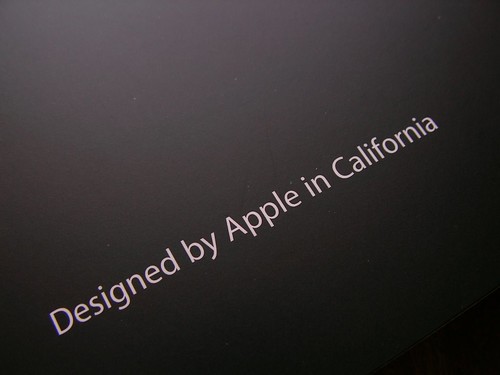
Designed by Apple in California

Furthermore, and now let us switch to intellectual property (bits), the majority of the value in the goods we consume in the developed world comes from the BITS and not the ATOMS. We pay a lot to Apple for the DESIGN of the iPhone, not for the physical atoms used to construct the phone. We pay more for blueberries prepared in a smoothie than in a bag from the freezer aisle. We pay to see Sandra Bullock win an oscar for her performance in Blind Side and not for some physical medium delivering the movie.

We need to understand how to build an economy that does a better job of promoting the creation of (and appropriate protection for) intellectual property. This is the 21st century imperative -- not manufacturing jobs. We need more products DESIGNED in the United States -- wherever they may be manufactured.

If you really want more things MADE in the US (as opposed to designed here) then one of the things we should be designing (and investing in as a country) is the fully automated manufacturing technology that brings production back to local markets - with zero labor.

But Detroit is not going to lift our economy to the next level. Silicon Valley will.

Thursday, April 29, 2010

The Computation Economy

From the 18th century and for about 200 years the world was radically transformed by something we now call the industrial revolution during which substantial changes in the methods of production and the organization of human society led to exponential growth in per capita GDP, an accompanying improvement in the standard of living and longevity, and a sustained period of accretive scientific and technological innovation unmatched in any previous period of social and economic growth.

For the past 50 years or so, a variety of writers and educators have spoken of a postindustrial economy, in which economic improvement has been driven by continuing innovation and knowledge. Some have called this the "information age" or the "knowledge economy." The language is derived from an observation that value creation is increasingly driven by the information content of a product rather than by mining, refining, and assembling the raw materials (value drivers in the industrial economy).

The idea of the "knowledge economy" was explored by Peter Drucker in his 1966 book The Effective Executive in which he contrasts the manual worker and the knowledge worker as ones which work with their hands or their heads respectively.

But trying to understand the changes coming in the next hundred years through the prism of information, knowledge, or thought misses the transformation that is at the root of the change. It would be as if one tried to understand the industrial revolution by simply observing that people had raw materials, methods for making them into things, and bodies to do so.

The transformation in the industrial revolution was about the mechanization of labor -- the ability to build a machine that augmented or supplanted labor. Division of labor was a step in the process toward mechanization - a kind of mechanization in itself as it transformed work from skilled craft to unskilled repetition.

The transformation that we are in the early days of experiencing is one in which computers are augmenting or supplanting thought. Computation is eradicating the cost of communication and the cost of coordination in our social, economic, and political systems. The initial "knowledge workers" performed tasks which will be increasingly computerized just as the workers of the industrial revolution found that once production had been efficiently divided into narrow tasks, people could be replaced by machines in those processes.

And just as the industrial revolution changed what we were capable of manufacturing, so to will computation increasingly change what we are capable of thinking. Stephen Wolfram in his 2010 talk at TED gives us some glimpses of what is possible and what is coming.

The Computation Economy is rapidly replacing the Industrial Economy - computation is the true heir to industry, not information or knowledge which are merely the raw materials of the computational engines. When we look back from a vantage point of 50 or 100 years from now on the early steps of these last 50 years, the accelerating per capita GDP, increased quality of life and longevity, and the transformation of our species will be credited to a rapid doubling and redoubling of computational power. Just as in the industrial age it was through the doubling and redoubling of physical power.