Tuesday, May 15, 2007

Half way to Vernor Vinge's Singularity

In 1993 Vernor Vinge wrote:
Within thirty years, we will have the technological means to create superhuman intelligence. Shortly after, the human era will be ended.
He didn't write this in a science fiction novel. This was not hyperbole. Vernor Vinge, a faculty member of the San Diego State University department of Mathematical Sciences is also a science fiction author. But his goal, in the non-fiction essay "The Coming Technological Singularity: How to Survive in the Post-Human Era," was to outline what he calls "The Singularity" -- defined as a course of events that would bring the human race to "...a point where our old models must be discarded and a new reality rules."

We are now almost to the halfway point of his 30 year prediction. With 15 years behind us and 15 years to go, are we still enroute to the Singularity?


It is easy to think, living in the early 21st century, that human life goes on much as it has in the past. As Ray Kurzweil details in his book on this subject, The Singularity is Near, human beings are ill-equipped to evaluate the pace of change that they are experiencing. Our perceptions of the now are mired in our own personal memories of the past. We judge our surroundings according to the relatively limited knowledge that we each contain. Furthermore we have no historical or personal experience that prepares us to comprehend the speed of change which is now occurring.

Just the changes that have occurred in the short 41 years I have been alive are staggering. As Vinge points out in his essay, the core technical innovation necessary to bring about the Singularity is computational power. In 1966 nothing on the planet existed that we would think of as a computer. In 1993, when Vinge wrote his essay, there were only a handful of computers. Last week I walked into the co-location facility where a portion of Technorati's server farm lives -- the room (one room on one floor of an immense building) throbbed with power -- heat and light came from every rack. There was more computational power in that one room than has previously existed in the history of mankind... multiply that room by the dozens of such rooms in that one building and then the thousands of such buildings around the planet and the size and scope of the transformation begins to come into focus.

In reviewing his own essay, in a set of thoughts 10 years after his original prediction, Vinge writes (in 2003) of his prediction of sufficient technical progress to bring about the Singularity within 30 years:
Now in 2003, I still think this time range statement is reasonable.
The Intel website details the hypothesis proposed by Gordon Moore commonly known as Moore's Law:
In 1965, Intel co-founder Gordon Moore saw the future. His prediction, now popularly known as Moore's Law, states that the number of transistors on a chip doubles about every two years. This observation about silicon integration, made a reality by Intel, the world's largest silicon supplier, has fueled the worldwide technology revolution.
Amazingly, Moore's 1965 vision has continued to hold true to this day. So following this graph out to the 2023 date in Vinge's Singularity prediction, we can expect that the 1 trillion transistors available in 2006 will double roughly 8 times to 128 trillion transistors. The computing power that will fit into that Technorati server room will be roughly 128 times more powerful than it is today in just 15 years.

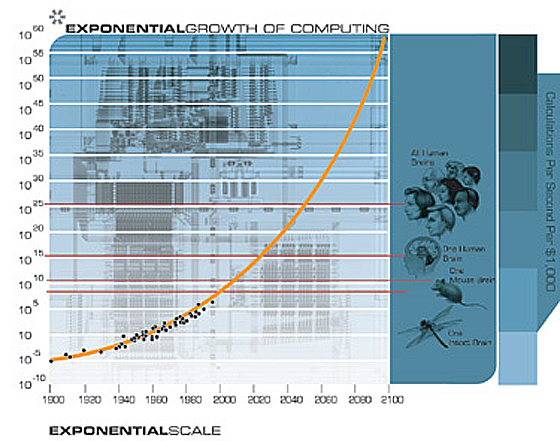
In Ray Kurzweil's 2001 essay The Law of Accelerating Returns, he provides an analysis of the computational power necessary to represent a functioning brain of a variety of different species -- insects, mice, humans... and when that computational power is likely to be available (again according to Moore's law). The date by which he has proposed modeling a mouse brain is right about now. And is if on cue, just last month a team was about to run a "simulated mouse brain at 1/10 time." From the team's write-up:
We deployed the simulator on a 4096-processor BlueGene/L supercomputer with 256 MB per CPU. We were able to represent 8,000,000 neurons (80% excitatory) and 6,300 synapses per neuron in the 1 TB main memory of the system. Using a synthetic pattern of neuronal interconnections, at a 1 ms resolution and an average firing rate of 1 Hz, we were able to run 1s of model time in 10s of real time!
The scientific team working on this research noted that there were numerous problems that they encountered in trying to provide a realistic simulation of a mouse brain in this test. But the news bulletin for the rest of us is simple -- the supposedly radical suggestion that Vinge made way back in 1993 is now coming to pass. 15 years into his 30 year time horizon, the milestones are being achieved, on schedule.

What does this mean for all of us alive today who are still likely to be around in 15 years? Stay tuned for part 2 of this post...

Friday, May 04, 2007

Business Blogging

Recently I have been speaking to executives about getting involved in the conversations about their companies and products that are already happening in the blogosphere. Everyone wants a shorthand for thinking about the "best practices" and so I have been working on boiling down my recommendations to a few simple and easy-to-remember guidelines. I thought I'd throw them into the blog here and perhaps generate some interest in a conversation -- can we as a community together refine a set of messages to use in speaking with folks that really should be involved in blogging but aren't yet because they need help understanding the why, how, etc?

First, I talk about how the blogosphere is about peers and that the challenge any company has in joining the conversation is that they start out by being something other than a peer. So the first key is that joining the conversation has to be perceived as authentic. Here is my simplified equation:

access + accountability = authenticity

The point I am trying to communicate is that real executives have to join the conversation so that the other participants in the conversation feel like they are talking to a real person who actually can speak for the company and influence outcomes.

Secondly I talk about what it takes to be a good citizen in the blogosphere:

1. Listen

2. Engage -- correct inaccuracies, respond to issues

3. Be a conversation leader

Participation means joining the whole conversation not just the parts you want to join.

I make the point that there will typically be a whole range of voices out there -- from supporters to detractors and everything in between. Most people are in the middle but you can't ever hope to win these people over in a conversation if you merely ignore detractors. Certainly some of the most extreme will never listen and never change their views and there is typically nothing that can be done to change those people's minds. But their issues left un-addressed will capture mindshare amongst the middle in the conversation. So it is always worthwhile to pay attention and provide reasonable responses (and corrections) for those extreme voices - even if the point isn't to win those people over.

This is just a start -- very interested to hear from other folks also struggling with how to explain this medium to others.

Wednesday, May 02, 2007

An Innocuos String of Characters

A very interesting drama has been playing out over the last 24 hours amongst the technical sophisticates of the Internet economy. Digg, which allows it users to post and vote for stories has come under enormous pressure to cease censorship of a simple string of characters.

As this article in UK magazine "Computing" explains, the key is part of a battle over the future of digital rights management (DRM). Google now finds 297,000 references to this hexadecimal sequence, a key to unlocking certain copy protection systems.

The Advanced Access Content System (AACS) which developed the affected DRM system has been attempting to use legal strong arm techniques to prevent the distribution of this string. The result has been an enormous increase in attention to what otherwise would have been a minor matter ignored by almost everyone.

Digg has become ground zero for the conflict because it attempted to comply with the cease and desist order sent to them by AACS. But an enormous portion of the sites community began to repeatedly post and vote for the offending information, incensed by the imposition of their free speech rights. Finally, on the Digg blog, CEO Kevin Rose wrote that the community cannot survive if all of the members are at odds with the sites staff:
But now, after seeing hundreds of stories and reading thousands of comments, you’ve made it clear. You’d rather see Digg go down fighting than bow down to a bigger company. We hear you, and effective immediately we won’t delete stories or comments containing the code and will deal with whatever the consequences might be. If we lose, then what the hell, at least we died trying.
This is an important day for the people's Internet. A company bowed to the possibility of an expensive lawsuit, testing first amendment rights of free speech. The company's customers then said "NO!" and forced the company to reverse course.

This kind of first amendment test has happened before. In an earlier case a math professor was pursued by the US government (under Clinton) for violating export controls when he wished to publish cryptography code on his website. Ultimately Daniel Bernstein won this case, with a federal panel determining that software source code is a language, and therefore export controls violated his first amendment rights.

This case is somewhat more complicated, in part because of the Digital Millenium Copyright Act. Here is a copy of the AACS complaint letter to Google. As the above link explains in the notes below the complaint, there is a substantial conflict between the first amendment and the DMCA:
The tension between the DMCA and the First Amendment is at the heart of several ongoing lawsuits. [Felten v. RIAA; Universal v. Corley] The mere posting of a link to a computer program that can be used to circumvent technical protection measures was held to be a violation of the DMCA. [Universal v. Corley (2d Ciruit cite)] The Recording Industry Association of America used the threat of a DMCA action to silence a professor whose research paper discussed circumvention of a technical protection measure. The professor subsequently mounted a legal challenge to the DMCA on First Amendment grounds and presented his paper. While courts in both of these cases have found in favor of the copyright industries, these cases are being appealed and the state of the law is yet to be determined.

Thursday, April 26, 2007

Mission Possible

A friend sent a link to this Daniel Pinchbeck article, Mission Possible, after a long conversation about mainstream media and how it is being affected by the blogosphere. Pinchbeck calls for us to "...deepen our commitment to transformation..." rather than flinch away from the disaster looming in our future. But the "transformation" he calls for is a spiritual one, not a technological one. Indeed Pinchbeck seems to have greater faith in the possibility that mainstream media can be used to change the way people think and live on this planet, then that technology can help correct or mediate the imbalances that we have created on our planet.

I found this disturbing for a number of reasons. First, and perhaps most importantly, I don't believe that we as a species have enough time left to convince people to think and live differently. There are too many of us, we are too dependent upon destructive technologies just to eat every day (much less everything else we need and want to do), and the underlying compulsion to consume is too powerful. Thus I believe that for us to save ourselves, we have to invest in and use technology to fix our world.

But I also found it to be paradoxical that Pinchbeck is arguing that using one of the tools that humans have invented (mass media) can be a successful strategy to correcting the worlds problems while using other tools (science, technology) will fail. I tracked Pinchbeck down to ask him about this. As a side note, shame on the Seattle Conscious Choice website for not making this easier. But I did find an email address by simply googling him.

Pinchbeck writes back "Every potent new technology has unleashed a deeper level of damage. The law of unintended consequences: biotech now kills the honeybees, what will nanotech destroy?"

Well, the latest news out (LA Times article) suggests that it is actually a fungus affecting bees, not biotech. And we wouldn't know this without science, much less have the ability to find a way of solving the problem.

Let's face facts -- we have already passed a key tipping point. Human beings now have the responsibility to manage the ecosystem, it is no longer self managing in a way that will sustain the health and well being of our species. We need more technology and more management of the ecosystem, not less. Just arguing that we should all become earth friendly in the way we live will not pull us back from disaster that is now brewing in our future.

Wednesday, April 18, 2007

Engaging the Author

Having tracked down Thomas Claburn -- the author of "Media Companies Confront Mortality" -- I have engaged in a spirited conversation with him about CMP, his article, blogging vs. journalism, etc. With his permission, I repeat some of that conversation here.

Claburn points out that it is CMP and not he (or any individual writer) who (1) doesn't provide "community" tools and (2) and does spread articles around their network without attribution to the original author. So to be clear - my criticism on this point was not of Thomas or of his article -- but it was of CMP.

Regarding the specific comment, Thomas writes: "Your point is well-taken. It was certainly snarky and perhaps an unfair characterization of the state of the companies present."

But he goes on to point out that I was snarky back in calling his comment "ugly." We then debated whether there is a difference between blogging (which I characterized as editorial) and writing a news article for Information Week. I contend that there is a difference -- my expectation is that something labeled "news" will be presented with an attempt at conveying an objective perspective. Snarkiness is fine in an editorial, where it is clearly an individual's perspective. This blog, for example, is unapologetically my own perspective. And while I recognize that journalists are people too and have their own perspectives and biases - I expect that news will be written in a way that doesn't broadcast those perspectives.

But the most important part of this for me is that when I did track down the author, he did reply, was accountable, was engaged with the topic and the audience. So kudos to Thomas for being the kind of journalist that can make a difference in the media 2.0 world -- even if his company is following far behind in supporting him.

Here's What's Wrong

UPDATE - See bottom of article...

Dear CMP Media, thank you for your recent coverage of the Web 2.0 Expo. I enjoyed your article covering the panel I spoke on. Your article, "Media Companies Confront Mortality" demonstrated what is wrong with mainstream media very effectively.

#1) There was no byline. The article was written by "Staff Writers" -- since it wasn't written by a specific person, there is no accountability, no ability to respond, no knowledge of whether the person writing the article actually knows anything about the topic that he/she is writing on... So this is just a pronouncement from on high -- big media saying "this is what you should believe about what happened and you should believe because we are in charge."

#2) There is no comment mechanism. I read the article and then I have no ability to discuss the article with other people reading it, no trackback mechanism so that I can link to the article from my blog and point out problems or discuss issues...

#3) With the appearance of objectivity, the article puts ugly opinions into the public sphere. Where does CMP Media get off saying that our opinions were "...coming from a panel full of poorly capitalized Web startups..." How do they know? Did they bother to inquire with any of the four of us about our capital structures?

No need to read CMP Media any more, they discredit themselves through their practices, behavior, and poor reporting.

UPDATE: It occurred to me that the version of the article I was seeing was picked up from somewhere else within CMP, and sure enough the original version is in Information Week -- here.

I have written to author Thomas Claburn - let's see if he replies!

Thursday, April 12, 2007

Technorati

Over a year ago, when I was just thinking about starting The Personal Bee, I sat down with Dave Sifry (CEO of Technorati) to chat. I felt then that the work I wanted to do was a perfect complement to Technorati.

While the timing wasn't right then for us to bring these ideas to Technorati, Dave and I maintained a friendship and communication over the 9 months that we built the first beta version of Personal Bee. And after we launched that beta, in September of last year, Dave and I agreed that we should have another conversation about bringing the two companies together.

I am happy to announce, as Dave has on his blog, that as of today The Personal Bee is a part of Technorati.

All of us on the Bee team are excited about the opportunity to participate in the evolution of Technorati, and to Be of Service to Technorati's many constituents.

Saturday, April 07, 2007

Grokking Twitter: Presence, Scope, and Permanence

Should we care about twitter? I addressed this question back in February over on my IP Inferno blog but I think I did a lousy job. Since then I have used (and thought about) the service a lot more. And I have increasingly found myself in conversations with my fellow over-40 digerati trying to explain why they should care about twitter...

And in the last week both the San Francisco Chronicle and USA Today have published articles about twitter and neither of them really get to the heart of why twitter is important and why we should care.

Stowe Boyd offers an amusing rant on the USA Today article but while he correctly points out that author Andrew Kantor does not "...understand the benefits -- or even the possibility -- of moving to a flow state of interaction..." Stowe doesn't explain what this means or why it is important.

So in the spirit of Time Magazine's Person of the Year I have taken it upon myself to explain twitter...

As the Internet has moved from obscurity to a staple of our society over the past two decades there has been an explosion in new communications tools. A useful way to think about this explosion is to think about communications around three characteristics: presence, scope, and permanence. Each of these characteristics, as I will go on to explain, has a continuum of modalities and each communication tool has optimized for performing within a particular part of that cube.

PRESENCE
Is it necessary for the participants in the communication to be present at the time the communication is created? For example if you are taking a class, you need to be present in the classroom to get value from the lecture. But you can read a book thousands of years after it was written. The recipient must be present to receive the lecture but is usually not present when a book is written. Similarly, a phone call is a synchronous form of communications -- both speaker and listener must be present. Voice mail is asynchronous -- the listener need not be present at the time the recording is made and the speaker need not be present at the time of listening.

SCOPE
Classrooms engage a defined group of people in a conversation, newspapers engage an undefined group, a phone call typically involves just two people. Scope is about the number of people involved, the relationship between those people, and the privacy of the communication.

PERMANENCE
Information has a shelf life (or even a half life). Some information is valuable for thousands of years, other information is valuable for only a moment.

Think about the kinds of communications tools that we commonly use, applying these three characteristics:

PHONE CALL
Synchronous communication (presence required), the scope is typically one-one, and (short of a recording) it is a medium best used for information of little permanence.

EMAIL
Email is asynchronous, allowing for long delays between exchanges. The scope can be one-one or one-many but there are few facilities for managing complex many-many communications on a topic. As information can be stored and retrieved for later use, it can be used for topics with some permanence though various limitations generally cause users to move to another medium for longer term storage of documents or issues of more permanence.

IM
Instant messaging is mostly synchronous, though it can have delays in replies. It is typically a one-one communication and the information usually has a very short period of value.

BLOG
Like email, a blog is asynchronous. The scope is typically one-many although commenting facilities can make them into more of a conversation. Information of value for a long time (though perhaps not decades) can be stored on blogs and accessed by a wide variety of readers.

So what is twitter? It is asynchronous (although there can be more value if both speaker and listener are present); the most valuable uses are when the communications are within a particular defined group (friends, a company); and the information has a very short term value.

Examples:
I might tweet "Headed out for a soy chai, anyone want to go?" -- this emphasizes the value of presence, the fact that I am broadcasting to people within a defined group (my office), and has a very momentary value (miss it by 5 minutes and I am already gone).

Another example (from Stowe Boyd) Chris Pirillo points to an article written by Paul Graham claiming Microsoft is dead: http://www.paulgraham.com/microsoft.html -- this is completely asynchronous, anytime I find out about it, it is valuable to me. There is little definition in the group (other than perhaps interest), and the information has some permanence.

So two things that emerge in looking at twitter in this way -- First it has an interesting ability to be useful over a range of states but tends toward group communications that are impermanent and where presence can add value but isn't necessary. Second that it complements other communication types without replacing them -- indicating that there is a place in the ecosystem for this type of communication.

Another interesting thing that you can ask about twitter is whether you can compare the role it serves in online communications with some similar off-line communication. Within every social group there are adhoc communications that serve the same purposes that twitter serves in an online world. Announcing that I am going out to get a cup of chai tea, or people sharing an interest in an article happens all the time within social groups. The difference online is that time and space become less of a constraint for allowing these group communications to occur. This is the role that twitter is serving.

Friday, March 30, 2007

Cult Of The Amateur

Perhaps it is the poet lost inside me, aching to be free. But I find this post, at so many levels, to be the perfect response to Andrew Keen's hopeless "cult of the amateur" and a subtle message to the industrial media complex about what they don't get about how the Internet is changing everything...

http://illuminaught.livejournal.com/29278.html

Get it?

SF Chronicle You Have Our Attention

A case of cause and effect? Just a week ago, Tim O'Reilly was opining that the SF Chronicle was "in trouble." Noting that he hates to "...play Valleywag..." Tim goes on to say that Phil Bronstein (editor-in-chief at the Chron) held an emergency meeting with staff in which he stated that the "news business is broken, and no one knows how to fix it."

And then this week, he started to fix it.

What is it that local journalistic endeavors can do better than anyone else? Provide coverage of whatever makes their own local scene special and different. The San Jose Mercury News could have (but hasn't) made the tech industry their special beat. But in the last week, the SF Chronicle has been making this weird thing called "web 2.0" and what author Andrew Keen is calling "the cult of the amateur" their special beat.

Today it was a story about something just 11 days old -- justin.tv -- which is capturing the interest of the technorati but who would of thought that mainstream news readers would be interested? The Chronicle made their story on Justin and his fellow nerds front page news.

Crazy? Or brilliant? Sure, most San Franciscans are like people in the rest of the country -- interested in the Iraq war, local politics, and weekend sales. But what makes this area DIFFERENT from the rest of the country is people like Justin and the crazy new companies that get created from their ideas. This is the future of local journalism -- uncovering and writing about what is special and unique about their local area.

As one of my old journalist friends used to say "three is a trend" -- the article about Justin.tv wasn't the only interesting piece in the Chron this week.

On Monday it was Dan Fost's article on phenom twitter.

On Thursday it was Dan's coverage of Kathy Sierra.

For me, this kind of coverage makes the Chronicle relevant again. It makes me visit their website and talk about them and maybe even spend $.25 to buy the paper as I make my way onto BART in the morning (the current discount for BART morning commuters).

And I think it shows the way for other local papers -- dig into what YOUR region is known for, or what you think is special. Maybe you can build an online audience, maybe you can get your local readers interested again, maybe you can be relevant again in a world where you can no longer just re-run AP articles that we are already getting on our Blackberrys...

Friday, March 09, 2007

New Communications Forum

Listening to Shel Holtz wrap up the "New Communications Forum" event in Las Vegas. By all accounts the Society for New Communications Research has put on a great show -- numerous attendees have said to me that it is the most useful and interesting conference that they have attended in years.

A few attendees, however, have said to me "gee, not much new here." An observation -- there are two kinds of attendees at this conference: a group of people eager to learn about social media and a group of people who are already engaged in inventing social media. For the first group, this was a great conference and exactly what conferences should be about -- getting enthusiastic experts in front of eager learners. But the conference didn't do as well at serving people who are already engaged and who want to take ideas and debates deeper by interacting with their peers.

This last point does not detract in any way in my mind from the value of the conference and the high quality speakers, sessions, and organization of the event. But rather, it is an observation that as an industry we still are struggling with how to create the right kind of event for experts to cooperatively advance knowledge and initiatives in their industries.

FooCamp, BarCamp, and Social Media club are good experiments, but here is a challenge to conference organizers -- can a single show serve both audiences? I would argue that it HAS to in order to work -- because you need the experts in order to have interesting content for the learners. But the experts then have to derive value from their participation.

Wednesday, March 07, 2007

Elimination of Time and Space

Great post by Doc Searls on what he calls "giant zero journalism" but which might be better understood by saying that the Internet is in the process of eliminating time and space as issues for journalism, get used to it.

Ostensibly the piece is about citizen journalism -- is it good, bad, or just different. But really it is about the mechanism by which the Internet as a technology disrupts existing businesses by changing the very laws of physics by which they operate.

In other words, when time and space are issues in the gathering and dissemination of a news product, the role of professionals and institutions is much more important than in the world we are moving toward... one in which every person can report instantaneously to everyone else on the thing that is right in front of our faces.

So what is the role of the professional and the institution when space and time drifts into inconsequential inconvenience rather than defining dominance for an industry? At best, it is a role that will change dramatically...

Monday, March 05, 2007

China Basin

Just walked through the China Basin building down on Berry Street (down by AT&T Park in SF). The last time I was there was in 1996 when I was working for CMP Media on a project called NetGuide Live:
"Building off NetGuide Magazine's reputation for expert information and quality delivery, CMP launched the first true guide to the Internet, NetGuide Live..."
or as we fondly called it back in 1996 "Project Gulliver." Ah, a trip through memory lane indeed. Whatever did happen to Beth Haggerty? Google says... InfoSeek, president of InfoRocket, CEO of LiveAdvice, and then it sort of runs out... Newt Barrett? SCORE Volunteer, Senior Vice President of the Greater Naples Chamber of Commerce... He had left CMP to buy and run Southwest Florida Business Magazine, which he apparently sold to Gulfshore Media in 2001. So many other folks from those days. Still in touch with Dan Ruby and Dan Brekke anyone else out there reading this?

Friday, March 02, 2007

2 Stars for Peace

Just heard about this incredible idea -- make Israel and Palestine into US States... Here is a brief article explaining the idea and pointing to a book by Martinne Rothblatt -- The Case for Using U.S. Statehood to Achieve Lasting Peace in the Middle East

Wednesday, February 28, 2007

Party like its 1999


Revision 3 @ Slide
Originally uploaded by valleywagprime.
One of the things that is different this time around is that Silicon Valley has its own party venues... during the bubble we had to crash established silicon valley or san francisco haunts with our Internet craze... now people like Jonathan Abrams have started bars like slide... leading to Internet parties like the one I attended last night for Revision 3 (some sort of "new" Internet TV thing)... But some things stay the same. A bunch of geeks standing around in a bar trying to talk about technology over loud music looks the same in 2007 as in 1999...

Tuesday, February 27, 2007

Matt Damon == Capt Kirk ?? WTF!

Please say its not so. Please say that they have it wrong... Could it really be true that they have cast Matt Damon as Captain James T. Kirk of the USS Enterprise!!?? Ahhh... he hasn't been cast yet! Shooting hasn't begun!! Its not too late for us to launch a "please not Matt!" campaign... IGN writes:
Confirming rumors that have been making the rounds for some months now, IGN has learned that Oscar winner Matt Damon is indeed in talks with Paramount about playing the role of Jim Kirk, previously immortalized onscreen by Emmy winner William Shatner.
In TALKS... ok. Deep breath. Titanic boy [oops Dan reminds me this is Leonardo...] Good Will Hunting Boy [doesn't have the same ring to it] doesn't necessarily get to sinkshoot [huh?] the Enterprise... and what else did they say? King Kong's Adrien Brody as Spock!? WTF!!?
For the part of Kirk's Vulcan first officer Mr. Spock, IGN has been told that none other than Oscar winner Adrien Brody (King Kong, The Pianist) is in talks with Paramount to play the role. If cast, Brody would succeed Leonard Nimoy in a role that forever marked Nimoy's career.
OK... "if cast" the said... deep breath... OK now the campaign is "Please NOT Damon and Adrien!"

Jim Zumbo Dixie Chick'd

I am not a hunter. But I respect their right to hunt. And to express their views about hunting. That seems to be what sets me apart from the "mainstream" of the gun culture in this country.

Jim Zumbo has been a lifelong hunter and a spokesperson for this sport. Recently he decided to express his opinion about assault rifles. On his blog (on Outdoor Magazine's website but here is a link since that site has been removed) he wrote:
I call them “assault” rifles, which may upset some people. Excuse me, maybe I’m a traditionalist, but I see no place for these weapons among our hunting fraternity. I’ll go so far as to call them “terrorist” rifles. They tell me that some companies are producing assault rifles that are “tackdrivers.”

Sorry, folks, in my humble opinion, these things have no place in hunting. We don’t need to be lumped into the group of people who terrorize the world with them, which is an obvious concern. I’ve always been comfortable with the statement that hunters don’t use assault rifles. We’ve always been proud of our “sporting firearms.”

Because of his comments, reports the Washington Post, Jim Zumbo has been attacked by the hunting community, he has lost his job as a writer for Outdoor Magazine, Remington has canceled their business relationship with him, the Outdoor Channel has canceled his show... and the NRA has severed its ties to him.

What happened to an America in which we are willing to accept differences of opinion, embrace diversity, defend each other's right to free speech?

This week my wife and I watched "Shut Up and Sing" - the documentary on how the Dixie Chicks were treated by the country music industry when Nicole, their lead singer, said on a stage in London that she "...was ashamed that our President is from Texas." The personal attacks included death threats. Worth watching, by the way, if you want to see an ugly side of America.

I am personally very disturbed by this lack of tolerance. I believe it is the greatest threat to our way of life -- not "terrorism."

Friday, February 23, 2007

Why People Wear Suits

Blog Maverick Mark Cuban has hit a nerve with his post "Why I Don't Wear a Suit and Can't Figure Out Why Anyone Does!" I know I couldn't help but respond but I was shocked to see that I was comment number 328... So I thought I'd post my comment here as well:

A few years ago, after the dot com bubble burst, I was in New York City and someone there said to me "I hear that people are wearing suits in Silicon Valley again." He said it in a very smug superior way, as if this was proof that some deviant culture (Internet, Silicon Valley, tech folks, etc) had been entirely wiped out by the civilized world. So I think you are dead-on that wearing a suit has become, for some of those that wear them, a symbol of superiority.

But there is another simpler explanation -- inertia. Suit wearing evolved in an age when most people had to do hard physical labor that would destroy nice clothes -- so people that wore them were saying "I don't have to do hard physical labor." Clothes as an indicator of class. Over time, suits became the uniform for office workers and as these ranks grew, the reason changed from the initial objective of differentiation to one of assimilation.

What is interesting is that in whatever culture you visit, people tend to dress alike -- Its what the anthrophologist Victor Turner calls liminality. Human beings want to be included. There is safety in being part of the pack. So we dress alike (speak alike, eat alike...) in order to show that we belong and are not dangerous outsiders.

I bet your employees dress like you.

Internet Explorer Losing Ground?

As someone who has struggled to make web pages look beautiful on Internet Explorer, Firefox, and Safari, I found this story on ars technica hard to avoid reading... "Internet Explorer loses ground to Firefox, Safari... but "the rest of the story" as Paul Harvey liked to say is that there are conflicting numbers from a variety of tracking efforts and so no one really knows...

Suffice to say that Microsoft's Internet Explorer is still somewhere around 80% of the market for browsers. The introduction of IE 7 hasn't helped them, but they are still the dominant player.

But in a related note on the ars technica site there is data that shows that Firefox isn't growing either. So who is gaining marketshare? Safari.

How could that be? The only people that use Safari are Macintosh users. Could this be an early indication that Apple is finally gaining marketshare? And how long before these users abandon Safari -- I like to complain about Internet Explorer but Safari's support for W3 standards is even more abysmal.

On a related note, I have some advice for people trying to decide which browser to support when working on their web site compatibility tests. Don't forget to test Firefox on Mac. Just testing Firefox on Windows isn't sufficient. And while the total number of users of Firefox on Mac OS X may be small - they are a very influential group. I just met with a company yesterday that has a very popular website and they have done NO testing on Firefox for Mac OS X. How can that be, I asked? And I showed them a very nasty bug that they have in their product -- just on that platform... They thought they were done when the tested on Windows. Don't get caught in the same trap!

Thursday, February 22, 2007

Twitter: An interesting experiment

I have been playing with a new web service called "twitter" today -- http://www.twitter.com

The interesting (obvious?) idea behind this service is that people want to blather about what they are doing all through the day and that other people want to know... So you can create a stream of your comments, thoughts, or reports on your activities and this creates a stream. Here is mine:

http://www.twitter.com/tshelton

Then other people can subscribe to your stream and get reports on what you are up to... you can even "nudge" other people who haven't updated and find out what they are up to

Wednesday, January 31, 2007

The Road Ahead (Looking Back)

At Davos this week Bill Gates predicted that broadcast television as we know it today will be radically transformed over the next 5 years. It reminded me of something Bill said about technology and predictions...
"People often overestimate what will happen in the next two years and underestimate what will happen in ten."
So said Bill Gates at the beginning of the Afterword for the revised edition of his mid-1990s book "The Road Ahead." It was in part an apology that some of the things he had predicted in his book hadn't happened... yet.

Looking back at the book today is interesting though. Elsewhere in the book he wrote:
"Within twenty years virtually everything I've talked about in this book will be broadly available in developed countries..."
With few exceptions (electronic wallets anyone?) the predictions made by Bill turn out to be too timid 10 years later. So in half of the 20 years everything he predicted has come about.

Does this mean that 5 years is too short or too long? Either way, if I were in broadcast television today, comments like this from Bill Gates would scare the s** out of me. Even 10 years isn't very long to rethink your entire industry.

Berkeley Local News

At the Personal Bee we are experimenting with local news aggregation. Here is a first experiment, for Berkeley California:

http://www.personalbee.com/berkeley%20buzz

Monday, December 18, 2006

Pumpkin Launching: Time's Person of the Year

Since Time has named me (and You) the person of the year for all the great videos we have uploaded, I thought I'd better do my part, so here is a video of Andy's Halloween party:

http://one.revver.com/watch/123185


Yes, that is a trebuchet - we built it the weekend before the party. It is designed to have as much as a 1000 lb counterweight, able to hurl small pumpkins 700 feet! We never achieved the optimal configuration (couldn't get enough weight) but still were hurling pumpkins between 500 and 600 feet...

Saturday, November 04, 2006

STOP CALLING ME

And I mean YOU Mr. Candidate! I am SO TIRED of having my phone ring with a recorded message from one candidate or another. DON PERATA YOU JUST LOST MY VOTE. And I am keeping track. Anyone who dares to use an automated message dialing machine to harass me LOSES MY VOTE. Join with me in this campaign. Let's send a message to these idiots that spamming us with phone calls doesn't pay!

Monday, October 23, 2006

Google Enters Another Market (Custom Search)

Everyone on the Internet fears the day that Google will enter their market. Today the fear was tangible for Rollyo and Swicki. The Financial Times reported that Google will launch tomorrow (Tuesday) "...a customisable search engine that users can carry on their own blogs and other websites..." and compares the new service to Rollyo.

Matthew Ingram carries the photo of a shark on his post about this development. Ingram points out that when Google entered the calendar market, competitor Kiko gave up and sold themselves. He asks whether or not this was the right decision -- pointing to Paul Graham's post at the time "Google Does Not Render Resistance Futile."

I find myself agreeing with Paul and Rex Hammock puts his finger on it when he writes:
There’s a social networking aspect of Rollyo that probably won’t be a part of the Google product, however the Google product will likely offer publishers, including bloggers, an instant way to monetize narrow search in the Adsense program they’re already participating in.
For all of the things that Google has done right in technology, they have done very little well in the category of social. It isn't too late for them to learn but if history is any guide, they will miss the importance of the social network in search as well.

And frankly having a strong competitor forces you to do the two things which you most need to do in any case when you are a small business -- innovate constantly and be 500% better than your larger competition. Then Google can educate the market about why the market needs your product and then you can deliver on the market's expectations. That is what YouTube did.

Friday, October 13, 2006

Please help with your critique

Stop what you are doing.

Click on this link to the Personal Bee home page:

http://www.personalbee.com


Then email or comment on this message with your thoughts about what we are doing right and wrong. Tell me, from looking at the home page, what business you think we are in. Tell me how you would use this and how you would get others to use it...

thanks!

Ted

Sunday, September 24, 2006

Diebold Delivers Georgia for Republicans

In a follow up to his story on the 2004 election, "Was the 2004 Election Stolen," Robert Kennedy brings us, in the latest issue of Rolling Stone, specific details on how Diebold has rigged voting in Georgia, with the confessions of a Diebold employee, Chris Hood. "Will The Next Election Be Hacked," is a frightening article that shows exactly how far some corrupt politicians are willing to go to insure that they keep control of our government out of the hands of the people. Folks, our democracy is in danger.

Wednesday, September 20, 2006

Wednesday, September 13, 2006

Shake Rattle And Roll!

We spent the second quarter of 2006 testing the original "beta" concept site for the Personal Bee. We spent the summer implementing everything we had learned. Now we are ready and have released the Bee to the world.

http://www.personalbee.com


You Can Be A Media Mogul

The idea is simple. Anyone one the world can create their own news site. You choose the topic. You choose the content sources. You brand your site. You decide which stories are important and which to remove... You are the master of your topic domain and can build a base of subscribers into a media empire.

Enjoy the Bee. Send your comments and suggestions!

Ted Shelton, CEO
The Personal Bee, Inc.
tshelton @ personalbee.com

Wednesday, September 06, 2006

Bush Administration Immune from Whistleblowers...

Posted without comment for your consternation:
On Labor Day, Public Employees for Environmental Responsibility (PEER) issued a press release whose title summarizes its contents all too neatly: Bush Declares Eco-Whistleblower Law Void for EPA Employees. Here's some of it:

Washington, DC - The Bush administration has declared itself immune from whistleblower protections for federal workers under the Clean Water Act, according to legal documents released today by Public Employees for Environmental Responsibility (PEER). As a result of an opinion issued by a unit within the Office of the Attorney General, federal workers will have little protection from official retaliation for reporting water pollution enforcement breakdowns, manipulations of science or cleanup failures.


The rest of the post on the terrific blog Effect Measure

Wednesday, August 23, 2006

Got Voice?

For the past few weeks I have been testing a new service, GotVoice, from a company based in Kirkland Washington with an interesting idea -- how can you profit from the stupidity of the phone company? Now perhaps that isn't the way that company executives in Kirkland would describe their strategic plan, but its hard not to look at them and think, "this is yet more evidence of how stupid US telecommunications companies are."

The idea is simple (too simple, you'd think). How can I have access to my home and cell voice mail from the web and through email? If we had telephone companies that knew how to build services that customers wanted, this wouldn't even be a question. But there is NO innovation going on at the phone company (fill in your favorite one, or AT&T if you are reading this after they have bought everyone else). Thus companies like GotVoice can come along and fill in the niche.

Here's how it works -- You sign up for an account with GotVoice (basic service is free, but added features are available at $4.95 and $9.95 a month) and give them your phone company, phone number, and voicemail "PIN" -- they will then place a call on a regular basis to your voice mail box, record your messages, and send you an email letting you know you have a message (or email you the message as an MP3 with a premium plan).

But this is absurd! Why can't the phone company simply email me the message? Why do I need a third party to glue voice mail and email together? Perhaps someone in the finance department of AT&T found a study conducted in the early 1990s which said that none of their customers wanted voice mails in their email... or maybe they have a trial of voicemail to email right now but they are only rolling it out in 3 small test markets over the next two years... or maybe they don't actually care at all about their customers and never think about introducing new products that we actually want!

In the meantime, Got Voice?

Thursday, August 17, 2006

Future of Warfare

Hope that you never meet Crusher. Watch this video to see what I mean. This is a robot. Entirely autonomous, programmed to get itself from point A to point B, and capable of "aggressive" behavior -- especially if it has weapons (which this one doesn't). Even without weapons, I wouldn't want to be chased by one of these... Of course sophisticated robotics will have military applications before they have civil ones.

Tuesday, August 15, 2006

How Republicans Plan to Steal 2006

Salon has published an interesting review of the six states where Republicans have schemed to "suppress" votes by traditional Democratic voters. Here is the article -- "Salon's Shameful Six" -- Here is an excerpt:
Opinion polls show that a majority of the public wants a Democratic Congress, but whether potential voters -- black and Latino voters in particular -- will be able to make their voices heard on Election Day is not assured. Across the country, they will have to contend with Republican-sponsored schemes to limit voting. In a series of laws passed since the 2004 elections, Republican legislators and officials have come up with measures to suppress the turnout of traditional Democratic voting blocs. This fall the favored GOP techniques are new photo I.D. laws, the criminalizing of voter registration drives, and database purges that have disqualified up to 40 percent of newly registered voters from voting in such jurisdictions as Los Angeles County.
Here are the six states that Salon calls on the carpet: Arizona, California, Florida, Indiana, Missouri, and Ohio. What are people doing about it?

DNC Announces Expanded National Voter Protection Effort

Brennan Center Election Reform Resources

Common Cause Election Reform Agenda

Tuesday, August 01, 2006

Shameful Behavior (Your Tax Dollars At Work)

At the risk of becoming the target of government investigations myself, let me now go on the record as saying that, if these reports are true, our government is engaged in the worst kind of anti-democratic behaviour, activities I thought reserved for dictators (or the Nixon Whitehouse). Yes, I am talking about the latest ACLU report "The State of Surveillance: Government Monitoring of Political Activity in Northern and Central California." The Berkeley Daily Planet has a story here which details a local incident on the UC Berkeley campus:
The local incident featured in the report was an April 2005 demonstration at UC Berkeley, sponsored by Berkeley Stop the War Coalition, aimed at military recruitment on campus.

The incident was described in an April 21, 2005, Department of Defense Threat and Local Observation Notice (TALON) report released to the ACLU by the Department of Defense following a freedom of information request and subsequent lawsuit.

The information released describes the demonstration—the “incident type”—as “specific threats,” and describes the subject as “direct action planned against recruiters at University of California at Berkeley.”

The source, whose name has been redacted from the released report, is described as “a special agent of the Federal Protective Service, U.S. Department of Homeland Security.”
The full ACLU report can be found here: http://aclunc.org/surveillance_report/

I hope you will join me in supporting Jerry Brown as the next Attorney General for the state of California. Given the folks that currently control our national government, a strong liberal California AG may turn out to be suprisingly important for the future of Democracy in this country.

Thursday, July 27, 2006

Participatory Consumption

The last couple of times I was listening to NPR on the radio I got angry. Why? Because I had a question, or a comment, or information about the discussion underway and there was no effective way to join the conversation. I thought about this and realized that since having converted my reading habits almost entirely to blogs I have been retraining my consumption habits from passive to participatory. I now expect to be able to leave a comment at the end of an article, or email the author to ask a question. I expect media consumption to be participatory! What a strange expectation...

Thursday, July 06, 2006

The Evidence for Global Warming

David Isenberg has done a tremendous job of adding value to a recent (great) article in the New York Times about global warming -- he has gone through the article and created links to all of the sources to which the article refers. All in all it is a compelling and worrisome picture of an earth in turmoil. Worth reading in its entirety. Here is the link: The Evidence for Global Warming.

Tuesday, June 20, 2006

SD Forum Visionary Awards

98 degrees in Heidi Roizen's backyard but no one is complaining (we had
to wear sweaters last year). And the winners of this year's awards:

Vinton G. Cerf

Louis V. Gerstner

John L. Hennessy

Terry Semel

Quite a line-up this evening. Should be a lot of fun...

Monday, June 19, 2006

My Father's World, My World

In thinking about the death of my father last week, I have been comparing the world my father was born into (my grandfather's world) to the world I was born into (my father's world) and the one my daughter was born into (my world). Each of us as children enjoy and suffer from the decisions that our parents, and our parents' generations have made. And with the resulting "world order."

In 1938, the year my father was born, Hitler marched into Austria and declared that it was now part of the German Reich. Great Britian and France ceded Czechoslovakia to the Germans in a short-sighted attempt to avoid war. And on November 9th, in an event to be remembered as Kristallnacht, Nazis burned synagogues, destroyed Jewish shops, and killed Jews at random. 1938 was a dark year for the world.

The earliest years of my father's childhood were spent in an America fighting world war against governments unafraid of using their power to evil ends. In 1939 Hitler invaded both Czechoslavakia and Poland and entered into the axis agreement with Italy's Mussolini. In 1940 Paris falls and France surrenders to the Nazis. And in 1941, when my father was the age my daughter is today, Japan bombed Pearl Harbor, bringing the United States into the war.

My father was almost the age my step daughter is now when, in 1945, Germany officially surrendered and the United States dropped atomic bombs on Hiroshimi and Nagasaki, accelerating Japan's surrender. At the age of 7, my father had lived his entire life in a world at war. Of course the coming years were dark as well, with the constant cloud of conflict with Stalin's Soviet Union hanging over the head's of his generation as they came into adulthood.

By 1966 when I was born, the pattern of proxy wars between the West and the Soviet Union had been established with a war in Korea mostly behind the US (well... it still isn't entirely behind us) but with war in Vietnam escalating. Despite continued hostility between the world powers, a half century of American dominance in business and technical innovation was well underway by then, making my childhood much different from my father's. Where America had been a relatively weak player in an enormously fragmented and dangerous world, my father came of age in a world where America became a world power.

After first getting a law degree from Boalt Hall at UC Berkeley, my father entered the business world with an inheritence wrested away from his wealthy uncles and grandmother. His father had passed away while he was still a child and he had grown increasingly concerned that his grandmother and uncles would spend all of the money before he received any of it... so he spent it himself instead.

He created a company called Shopper's Plan - one of the first credit card companies in the country. Before we had Visa and Mastercard, stores had "charge plates" that were specific to a particular store or sometimes (rarely) a chain of stores. The 1960s idea of the credit card was a store-independent charge plate. Shopper's Plan could offer this innovation because of the power of this new-fangled invention, the computer.

It was an audacious business idea and it would have required incredible execution to succeed with the (relatively) limited financial resources my father had at his disposal - just a few million dollars (although that was 1960s dollars...). Unfortunately my father was not a terrific business person and the business was soon on the rocks. Complicating things my father got his secretary (my mother) pregnant.

He was already married, with two daughters. Yet he left his wife and began over again with my mother. Within four years he had left my mother and moved on to a string of girlfriends before settling down with his last partner, whom he stayed with until his death (almost 30 years).

to be continued...

Friday, June 16, 2006

World as Symbolic System

For the past 14 hours I have been staring at a computer screen, logged on to various linux systems, moving files, configuring servers, testing... Deeply enmeshed in a particular symbolic system. As I drove home I saw the world with different eyes - the world as its own kind of symbolic system. Some of it imposed by man on the environment (stop sign, crosswalk) some natural (tree, rock). Each blade of grass is a symbol - albeit many without obvious meaning. Like a file you might touch but is devoid of content. Or perhaps each has a very simple meaning like all of those devices in /dev... I should really stop looking at a computer screen about now.

Monday, June 12, 2006

My Father with My Daughter April 2005

On a trip with the whole family down to Los Angeles a little over a year ago. The only time my daughter ever saw my father. He was still doing OK at that point, although the radiation treatments drained him of strength.

Charles Edward Shelton, RIP

I will be able to write more about this soon. But for now just the news. My father died today of cancer. My sister was with him in the Los Angeles hospital room.

He has been dying for 10 years of cancer - prostate cancer that was diagnosed too late to cure. The cancer spread throughout his body and fortunately for him, medical advances allowed him to live a good life over those 10 years. Only in the last 6 months or so had the disease progressed to far that his quality of life was diminished to the point where living was an enormous burden for him.

So it is with sadness, but also long expectation and relief that the living go on without him. He is survived by his long-time partner, his three daughters and me.

Memory Machine

What we write here may be much less important for who reads it today and more important as a record of our civilization at this time and place. The web is the collective memory of the millions of people that record their thoughts here. Hopefully we will find ways to record these transient memories into some more permanent form so that future researchers will have this treasure trove to draw from when trying to understand the insanity of our current times.

Wednesday, June 07, 2006

Jerry brown on election night

Jerry brown on election night
Jerry brown on election night,
originally uploaded by Ted Shelton.
Garvin Thomas, of NBC Channel 11 ended up being selected by my camera phone as the focus for this photo instead of Jerry Brown... and then I had to drop the phone in my pocket as Jerry was headed straight at me and I wanted to shake his hand to congratulate him on his win -- Jerry was modest - "the race isn't over yet."

Tuesday, June 06, 2006

Jerry is in the building...

Currently giving interviews but is modestkly repeating that while he
currently has 66% of the vote, only 2% has been counted so far....

The venue

In the shadow of the 880 freeway, 555 5th avenue is home to the Oakland
Police Officers Association. Police organizations throughout the state
have come out in favor of Brown for attorney general...

Yes, we are killing time while awaiting Jerry Brown's arrival...

News crews awaiting Jerry Brown

National and state news organizations gather to hear Jerry Brown accept
the nomination from the CA Democratic party to run in his first
statewide election since stepping down as governor...

Jerry Brown Election Night Campaign HQ

Blogging live from 555 5th avenue in Oakland where Jerry Brown will be
accepting the democratic nomination to Attorney General for
California...

Congrats to ORB

A number of exciting things are breaking this week and next week for Orb Networks where I continue to have many friends (and am a stockholder). AMD Live is one exciting partner for Orb:

"AMD LIVE! On Demand, powered by Orb extends your entertainment experience to anywhere you are, at home or on the go! Access and control your live or prerecorded TV, music, pictures, videos and more from virtually any web-connected device."

Another huge win is the distribution deal with Hauppauge which has over 8 million tuner cards in the market...

And my friends tell me that more announcements are coming! Congrats guys!

Thursday, June 01, 2006

The Stolen 2004 Election

The current issue of Rolling Stone Magazine is featuring an article by Robert F. Kennedy Jr. titled, "Was the 2004 Election Stolen?" -- Read this article. Rolling Stone also offers an editorial calling for an investigation. The lead to Kennedy's article:

"Republicans prevented more than 350,000 voters in Ohio from casting ballots or having their votes counted -- enough to have put John Kerry in the White House."

The editors of Rolling Stone:

"Enough. Only a complete investigation by federal authorities can determine the full extent of any bribery and vote rigging that has taken place. The public must be assured that the power to count the votes -- and to recount them, if necessary -- will not be ceded to for-profit corporations with a vested interest in superseding the will of the people. America's elections are the most fundamental element of our democracy -- not a market to be privatized by companies like Diebold."

Let's hope this gets the ball rolling with the electorate (since the politicians have been too afraid of the issue) to find out what really is happening to our democracy. Before it is too late.

URL: http://www.personalbee.com/bee_article.php?grpno=1211&artno=2591867

Tuesday, May 30, 2006

Transportation Metaphor for Media

An essay on the future of media, using a transpportation metaphor (and comparison...)

Summary: From the perspective of mobility, the automobile is the mass-customization post-industrial technology. Railroads are industrial transportation -- they follow specific fixed paths and travel on time s...

URL: http://www.personalbee.com/bee_article.php?grpno=1211&artno=2526386

Monday, May 29, 2006

Google Building AI

Could Google co-founder Larry Page be right (read this report from London) in saying that Google can succeed in building true artificial intelligence "within a few years?"? Late last year I wrote about an excellent speech by George Dyson republished at Edge.org (and still worth reading if you haven't already). To excerpt just one comment again:

"When our machines overtook us, too complex and efficient for us to control, they did it so fast and so smoothly and so usefully, only a fool or a prophet would have dared complain."

The development of strong artificial intelligence by anyone - country or company - will be a worldchanging event. It seems that Google really is hard at work on this task. Assuming that such an effort succeeds in developing a system which works for the betterment of its creators, one can appreciate why Google doesn't worry much about competition from Microsoft or Yahoo. Google is playing an entirely different game.

Where everyone else in the tech industry is pursuing linear technical development strategies, Google is pursuing a corner-cutting strategy of building a better tool -- a tool that (if successful) will change the entire basis for competition. How can any group of engineers at Microsoft hope to compete against the development resources of a world-wide artificial intelligence?

Time to buy Google stock?

Thursday, May 25, 2006

Watch Newsom Run

Last night I had the opportunity to attend a fundraising event for San Francisco Mayor Gavin Newsom. As luck would have it, I ended up standing right next to him as he addressed the crowd of 40 or 50 local business people that had gathered to help him pay off the last of the campaign debt from his successful mayoral campaign 2 1/2 years ago.

Newsom was articulate, knowledgable, and (for me) struck the right balance between progressive social consciousness and grounded pro-business realism. It was hard not to be impressed. In fact, the question I most wanted to ask Gavin (but respectfully did not) was "are you going to make a stop at the state house or head straight to Washington?"

When Senator Feinstein is ready to step aside, I hope our state gives Gavin a chance to represent our views, and a progressive option for our nation. I know I will be campaigning for him.

Wednesday, May 17, 2006

Peak Oil will change our lives

One of the most important articles you can read today (or even this week) is Erik Curran's "Peak Oil will change our lives" published on Monday in the Energy Bulletin.
Dozens of leading petroleum geologists as well others in the oil industry and in government have agreed that we are nearing the twilight of cheap oil. Chevron has launched a campaign to inform the public that oil is depleting. The U.S. Army is planning for permanent oil shortages. Even the U.S. Department of Energy put out a 91-page report on the subject in February 2005.

"As (oil) peaking is approached," the report said, "liquid fuel prices and price volatility will increase dramatically, and, without timely mitigation, the economic, social and political costs will be unprecedented. Viable mitigation options exist on both the supply and demand sides, but to have substantial impact, they must be initiated more than a decade in advance of peaking."
Read the whole article. And also check out the "Peak Oil Primer" that the folks at the Energy Bulletin have put together.

Thursday, May 04, 2006

A Modest Proposal - Gasoline Taxes

Everyone is talking about how "high" gasoline prices are now in the US. One brave soul testifying to congress yesterday actually suggested that the best way to reduce America's dependency on foreign oil would be an increase in gasoline taxes. Yes, raise the price of gasoline. Think congress would consider this? Not if they want to be re-elected.

But lets take a quick look at the numbers. We are spending $10 billion per month fighting George's war in Iraq. According to the US Government Energy Information Administration we consume roughly 20 million barrels per day. A barrel is about 42 gallons of gas. So that 840 million gallons of gas per day. Or 25 billion gallons per month. So a $0.50 per gallon fuel tax would pay for the Iraq war and have money left over to rebuild New Orleans.

Friday, April 21, 2006

Question for Runners

I run fairly in the morning here in Berkeley, so (on a good morning) I often don't see anyone at all. But sometimes I see other runners. Invariably if the runner is male he will make some gesture in greeting, usually a wave. However if the runner is female, she will refuse to even make eye contact much less wave. Assuming my experience is similar to other male runners (and is not just because I look scary...) here is the question -- do female runners wave to other female runners? Is it that waving in greeting is something only male runners do or is it a separation of the sexes issues?

Tuesday, April 11, 2006

Personal Bee Beta Launched

It has taken longer than I had originally wanted. And we aren't as far along as I would have liked. And there are 2 or 3 bugs that are really nagging at me to go fix... BUT, we have done it - pushed the new look and feel of The Personal Bee live out to the world. You can read what Dan Brekke has to say about the launch over here on the Bee Blog.

The biggest thing missing from this release, which I hope to rectify by the first week of May, is the ability to create new Bee editions -- this is still in a private beta. There are two primary reasons for this -- (1) the wizards we have under development which will make it easy to create a new Bee aren't ready yet and (2) we want to get a new phrase parser into production to handle significant increases in the number of bees that we will be handling...

So what IS in this release?

A beautiful new look and feel, access to 40+ public Bees, the ability to discover articles within those topic areas that are interesting and then tag, comment, and email those articles. Also, the ability to export a "reading list" to another website or blog...

Discover, Share, Build -- these are the three legs of our stool. We have more work to do to lengthen those legs and make this a platform for all kinds of news aggregation and distribution, but we have the core of the idea in place. Enjoy.

Monday, March 20, 2006

Save the Mercury News?

Saving the Mercury News? This strikes me as a little like the "third rail" of our world -- talking about the future of print media in an online forum run by the very print business being discussed... But it is an important question that deserves a serious answer.

As anyone who knows me will tell you, I am a strong supporter of a free and independent media. I am in the camp that believes that democracy is only possible when the society supports and protects a free flow of information and ideas. I am strongly influenced by thinkers such as Richard Rorty ("Take care of freedom and truth will take care of itself").

But I am troubled by the notion that the Mercury News needs to be "saved." What exactly does this mean? A review of the "save the merc" website does not clarify the situation. On this site I read:
"We are apprehensive that a buyer who does not understand our community and value the journalism that we provide will adopt what one Wall Street analyst termed a "scorched earth" policy. Under this scenario, substantial cost-cutting and smaller staffs would follow a sale. The impact on our community of readers and advertisers would be severe."
If the impact on the "community of readers and advertisers" was severe, then this business strategy of destroying the value inherent in the community coverage would be counter-productive to the goal of running a profitable business. Why would a buyer destroy the asset that he or she purchased?

In the "State of the Media 2006" - a report out from The Project for Excellence in Journalism (stateofthemedia.org) we learn that newspapers are reducing local coverage all over the country. Philadelphia, offered as emblematic, has half as many reporters (24) covering the local community than they had in 1980 (46). Some of this attrition might be attributed to increasing productivity, but clearly some of it is due to a reduced editorial budget which comes as a direct result of dropping readership and advertising.

So it is not unreasonable for the Mercury News staff to worry that their paper may get leaner in the years to come. Especially if the current trends continue and readership of print continues to decline. And especially if the print mode is the primary focus of their enterprise.

But as Silicon Beat itself has shown, there is a vibrant community of interest online for the kinds of local coverage (tech industry in this case) that journalists at what we have come to call big city newspapers can offer. So perhaps the real challenge for "saving" the San Jose Mercury News and other daily papers is to learn how the new online media can prove to be a generator of readership and advertising as the old media of print declines into our memories.

Change is hard. People have a lot of trouble with change. But somehow we live in a world of flush toilets, jet airplanes, and the Internet anyway.

Thursday, March 16, 2006

Stanley - DARPA Grand Challenge

Sam Perry and I just did a very cool thing -- he couldn't be here at the MediaX conference this afternoon, but we both have the new MacBook Pro which has a built in camera and iChat video... so I just turned the laptop around and gave him a personal webcast of Sebastian Thrun's presentation on how Stanford won the DARPA Grand Challenge.

technorati tags: ,

Harvesting Implicit Knowledge

Bernardo Huberman, Consulting Professor, Applied Physics is speaking here at MediaX on "Harvesting Implicit Knowledge" -- he proposes that a key differentiator of great organizations is their ability to extract, aggregate analyze and properly act on information quickly.

Today we need to discover communities of interest. We can do this by looking at the electronic communications that we use - tools like email and even powerpoint. People that communicate often tend to establish links that persist. Thus using the connections implicit in email communications it is possible to surface the connections between individuals in a company, uncovering implicit organizational structures.

One of the reasons we are talking about this at MediaX is that this effort is an example of how there can be cross-fertilization from adjacent fields. The way in which this group is developing the notion of implicit communities is by applying a concept from mathematics -- "betweenness centrality" -- in which a graph has community structure if it consists of groups of nodes with many more links within each group than between different groups.

technorati tags:

Hooray I am a Gen-Xer

According to the presentation currently under way here at the MediaX conference, Generation X started in 1965... phew! I just made it. The presentation is on Aging -- "50 is the new 35" -- sound good to me. Hopefully by the time I am 50, 60 will be the new 35. That way I can be 25 forever...

MediaX Conference At Stanford

Enormous congratulations to Ellen Levy, Director of Industry Research and Collaboration for MediaX at Stanford University. I am sitting in the audience now, listening to the opening comments from John Hennessey, President of the University. The fact that John is here, giving these opening remarks, is in itself an enormous endorsement for the incredible work that Ellen and her organization are doing to connect industry with research. And the program over the next day and a half speaks to the enormous breadth of the collaboration that is being nurtured by this organization.

John notes that "..increasingly Universities will be the place that basic research and core technologies are developed." He is laying out an ambition program for evolving the educational initiatives as well as the research agendas that Stanford is undertaking. Examples that John offers for questions a University is uniquely suited to asking:

"How would you design the Internet today, if you could start with a clean state."

"What are the implications when people live not 10 years past their retirement age, but 20, 30, even 40?"

He closes with a quotation: "We can't solve problems by using the same kind of thinking we used to create those problems" - Albert Einstein

technorati tags: , , ,

Monday, March 13, 2006

Oakland Fuel Cell Busses

Some time ago I wrote about seeing a fuel cell bus on a flat bed truck headed for Oakland. Today comes news of these fuel cell busses going into service.
Integrating the UTC Power fuel cell with a hybrid-electric drive system has enabled us to achieve twice the fuel efficiency of diesel.
For the planet's sake, lets hope this trial is successful and brings more fuel cells to market quickly.

Tuesday, March 07, 2006

Yellow Machine Rocks

I rarely endorse products, but once in awhile I am blown away by how great a company, service, or product is -- so I want to tell everyone I know. Such is the case with Anthology Solutions which makes a terrific networked storage solution called Yellow Machine. I bought one for my home network, but they are focused on the small business market right now. For less than $2 per gigabyte I got a 680 gigabyte networked home storage solution that worked right out of the box with minimal setup (and nothing very technical). I bought their 1 terabyte version which, running RAID 5, comes out to the 680 gb of usable space. Now everyone in the family can safely back up files. More importantly, we are now running iTunes (which drives our stereo 90% of the time) from any computer in the house, accessing a shared iTunes music directory on the Yellow Machine.

A few other notable features -- the Yellow Machine ships with a VPN router with double firewall and an 8-port LAN switch and WAN gateway. So not only is this a RAID 5 storage solution, but it is also your network hub and firewall to the outside world. All for $1,299!

The company has 1.6 and 2 terabyte models planned as well.

The coolest thing? 1 terabyte tucked under my arm when I left work on Friday to go home and set it up. Geesh, I remember when the first commercial 1 terabyte data storage facility was turned on (to much fanfare)... oh well, I guess I am getting old!

Saturday, February 25, 2006

Mighty Tots

There are 168 preschools within 5 miles of my house, at least according to Mighty Tots, a new web site launched by my friend (and Bee collaborator) Nick Chim. The site promises to become a valuable resource for parents of preschool aged children. The first feature, naturally enough, is a tool for finding preschools in your area. The hope is that directors of these preschools will fill out the information so that it can be a useful comparison tool. And that parents will write reviews... And what will the next resource for parents be? Stay tuned!

Tuesday, February 21, 2006

Transparency in Engineering

It is an interesting experiment -- develop a new product in the full light of day. Well, we don't release every bug-strewn version of The Personal Bee out into the wild, but we have been pretty close to our goal of a 2-week release cycle. The details of our latest release are here on the Bee Blog. Mostly we are hammering out bugs but cool features are sneaking in. But I can't wait for us to get this current nuts and bolts phase over with and start moving forward with work on the user experience. That will be exciting!

Talking to Larry Lessig at Mashup Camp

mashup_62.JPG
mashup_62.JPG,
originally uploaded by dsearls.
Mashup Camp was one of the best conferences I have ever attended. I wish I could go down again today, but we need to get a new release of the Bee out the door... In the meantime, it is fun to see all of the Flickr photos of the conference showing up -- here is one that Doc Searls took of me talking to Larry Lessig about the future of software copyrights...

Monday, February 20, 2006

Larry Lessig at Mashup Camp

A long time ago (and I'll go and dig up the blog post link later) I had an extended debate with Larry Lessig about software copyright. It was great to hear him speak today at Mashup Camp and to hear how his thinking has evolved. Or maybe I just misunderstood him... The core of the debate was about whether when someone asserts a copyright claim over software, whether there should be a published human readable form of that software provided to the marketplace. I pointed out that if software companies were compelled to do so, it would gut the value that copyright might offer in the first place.

Today, Lessig offered a similar point, but with the clarity that such human readable form could be provided in a "time-encrypted" format, such that it could only be readable at the point that the copyright had expired. Now that idea makes sense.

technorati tags:

"Type O" - Mashup

Doc Searls made the comment, I think on the fly, that we are all "type O" here at Mashup camp -- which is to say, the blood type that can mix with any other... I have to say I am positively impressed with the results so far. 300 smart people in a room will result in interesting conversations, productive relationship development, and (I bet) a whole bunch of cool new ideas unleashed on the rest of the world...

technorati tags:

Bee About Mashup Camp

I am using Personal Bee to track the blog posts coming out of Mashup Camp -- check it out here

technorati tags:

More on the idea of Mashup Camp

"You are in charge of deciding what happens here, which also means that you are responsible for what happens here." OK, sounds reasonable. Talking about why they are trying this format -- the organizers are trying to achieve the "coffee-break like feel" that sometimes is the most productive part of a conference, throughout the conference... I love experiments in conferences. I really do. Because as I have written before (say about the first BlogOn conference) the way most conferences operate is completely broken. It sort of makes me want to run a conference...


technorati tags:

Mashup Camp

So here I am at the Computer History Museum, early on Monday (Presiden't Day). While most of the Bay Area sleeps, 300 geeks have converged on the museum to compare notes, collaborate on projects, and show off --> Mashup Camp Website. We are told that this is an "unconference" but I think it might be more appropriate to call it the anarchy conference...

At best we might say that it is "self-organizing" which might work... In the great Heideggerian tradition (thesis, antithesis, synthesis) I think the style is more of a reaction to standard conference style. So maybe this is an anti-conference rather than an unconference... But this is another way to say that I think we are on our way to another kind of conference but that we aren't there yet.

Right now there are a line of "technology providers" introducing themselves... at 30 seconds each none of this information is going to stick. So I guess this part of the morning is to give us a chance to wake up... Next up we are supposed to propose conference sessions and build our own conference organically -- hey, I'm game... just skeptical ;-)


technorati tags:

Saturday, February 18, 2006

This can't be good news department

You have to get a little bit worried with information like this --

twice as much ice is going into the sea as it was five years ago.

Independent Online Edition > Environment

The article goes on to talk about how sea levels were 25 meters higher than they are today the last time the earth's average temperature was 3 degrees warmer than it is now... and we are rebuilding the levees in New Orleans for a category 3 hurricane? Hmmm....

TechCrunch5

IMG_6239
IMG_6239,
originally uploaded by michaelarrington.
Congrats to Scoble and Israel and Arrington -- a great party (400+ people!) and great launch of the Naked Conversations book.

And anyone who went to this party is now a believer (if they weren't already) -- the Internet craze is officially back on...

Actuarial Tables ARE Interesting

Most people when they hear the words "actuarial tables" think of statistical analysis and insurance and other boring subjects... But after reading a recent article about US biologist Shripad Tuljapurkar of Stanford University and his presentation at the American Association for the Advancement of Science annual meeting in St. Louis, I began to wonder if the way we create actuarial tables is all wrong. And if so, there will be enormous implications far beyond the insurance industry since we base many of our business decisions, political decisions, and personal life decisions on how long we think we will live.

According to the US Government, if you are born today you are likely to live to be about 74 years old as a male or about 80 as a female. Here is the statistical table from the social security website. What this means is that the average age at death for all people born today is 74 (I'll use the male statistics throughout this, but you can go look up the female statistics on the table if you are interested). This means that every infant that dies brings down the "average" life expectancy. Thus, as you would expect, as you grow older your "life expectancy" increases. At 20 years of age, the average life expectancy has increased to over 75 years. That is, of all the people still alive at 20, they will on average live another 55 years.

This method of calculating life expectancy assumes that relative lifespans are constant. Or, to quote the SSA website,

"The period life expectancy at a given age for 2001 represents the average number of years of life remaining if a group of persons at that age were to experience the mortality rates for 2001 over the course of their remaining life."

But this last point is precisely the one that Dr. Tuljapurkar brings into question in his report. He claims that at the current pace of medical advancement that we are adding one year of life expectancy each five years of medical research. Thus the life expectancy for someone born today should be 20 years longer than the "...mortality rates for 2001..." -- and this is just the average...

In his report he suggests that by 2050, we should be thinking that a retirement age of 85 is normal. Based on 2001 mortality rates, only the top quartile will live to be more than 85 years old. Even assuming that over the 50 years, we have added an average of 10 years of life (or, made 85 year olds as healthy as 75 year olds are today) only about half of all citizens live to be over 75 today. So these raises an interesting question about "retirement" age -- how should we think about these "golden years?" Who gets to participate? Only 50% of the population?

One of the interesting aspects of the actuarial table is looking for the "knee" in the graph. If you think about the primary causes of death you can group them largely into 3 categories -- accidents, self-inflicted, and disease. Most of the medical research that Dr. Tuljapurkar is talking about addresses disease, and in particular disease afflicting us in our old age. Thus even if the ultimate age at which we leave does not grow substantially, the "knee" in the curve could move dramatically.

91% of all US males make it past their 50th birthday. 85% are still alive at 60. At 65, when our parents think they should retire, 78% of american males are still alive. The die-off acclerates into the next few decades. 10 years later, at 75, only 58% are still alive, a 20% loss in 10 years. By comparison, between 50 and 60 only 6% die.

It seems reasonable to assume that a lot of these people are dying from preventable diseases. Even that changes in social behavior (the reduction of smoking, for example) already is going to have a big impact on this "knee" in the graph. Thus it may be reasonable to think that, rather than assuming an 85 year old in 2050 will be as healthy as a 75 year old is today, that as many as 78% of all Americans in that cohort are still alive at 85. This is a lot different than thinking that they are as healthy as 65 year olds. In fact, we may be a nation of hospital bound, breathing tube linked, living dead in 2050. The fact that medicine can keep us alive does not address the question of our quality of life at that age.

There is one male in the US out of every 100,000 born in 1906 that is alive today. The real question for the medical profession is not whether 100 years old will become, for our children, the average life expectancy. But rather, whether or not we will be living happy and healthy lives into our second centuries.