Thursday, May 24, 2007

Engagement: Does it Matter?


engagement
Originally uploaded by Ted Shelton
I have been thinking about the question of if and when companies and brands should engage in this thing we call "social media" and it occurred to me to apply that old favorite, Pascal's Wager, to this question.
You might remember that guy Pascal from a college philosophy course. He thought to apply logic to the question of whether or not to live as if God existed... to quote the Wikipedia article:


We are faced with the following possibilities:


  1. You live as though God exists.

    • If God exists, you go to heaven: your gain is infinite.

    • If God does not exist, your loss is nothing.


  2. You do not live as though God exists.

    • If God exists, you go to hell: your loss is infinite.

    • If God does not exist, you gain nothing & lose nothing.


So I wondered whether one could use this same logical system to address the question of whether or not a brand should engage (authentically!) with their audiences using social media. Here is the revised synopsis:

In his Wager, Pascal provides an analytical process for a person to evaluate options in regarding belief in God. This is often misinterpreted as simply believing in God or not. As Pascal sets it out, the options are two: live as if God exists, or do not live as if God exists. There is no third possibility.

Therefore, we are faced with the following possibilities:

  1. You join in the conversation authentically.

    • If engagement matters, you go to heaven: your gain is infinite.

    • If engagement does not matter, your loss is nothing.


  2. You fail to join in the conversation or do so in-authentically.

    • If engagement matters, you go to hell: your loss is infinite.

    • If engagement does not matter, you gain nothing & lose nothing.


I kind of liked leaving in the going to heaven or hell as the metaphorical equivalent of what happens when a brand screws this up. But here is the serious question:

Take all of the examples of social media engagement (or lack) and see if they fit into this grid? Can you find an example of a company that engaged authentically but still went to hell?

I can certainly come up with examples of the opposite -- companies that have engaged authentically and reaped the rewards. And companies that have not engaged or have engaged in-authentically going to hell.

On this last point, Chris Heuer (a friend and someone I am working on a project with) and I were just discussing one such in-authentic participant which he just posted about on his Social Media Club blog -- Ragan. Will they "go to hell" for this?

I believe that the most powerful thing about this new "social media" is that the truth eventually comes out and the people that care enough (the ones who matter) learn the truth.

There is an axiom in the news business that the lie is on page one while the correction lands on page 23. That happens because mainstream news has, as a default, a short attention span. But the blogosphere has a very long attention span.

If you know of an example that shows my "pascal's wager" to be wrong -- especially in that upper quadrant, please let me know.

Whistle-Blowing Teen

OK, so perhaps the teen that filmed this video of his high school english teacher (MongZilla) didn't do it with the intention of being a whistle-blower. But the story that the Seattle PI is reporting misses the really interesting point here.

As a parent, I watched this video and thought, if my child was ever in this person's classroom I would be raising hell with the school. This person shouldn't be teaching. How is it that this person has apparently been behaving like this in the classroom for years and hasn't been terminated?

We should give the kids some credit for expressing their frustration that their education is being compromised because the system can't give them qualified teachers.

Thursday, May 17, 2007

Singularity Part 2

This is a follow up post to the one I made on Tuesday about Vernor Vinge's 1993 essay "The Coming Technological Singularity." In part one I lead with a quotation from the essay. Here it is again:
Within thirty years, we will have the technological means to create superhuman intelligence. Shortly after, the human era will be ended.
In part one I offered some thoughts on the first sentence of this quotation -- the time horizon for the development of superhuman intelligence. In this second part I will discuss the second sentence.

Vinge is wrong.

The human era has already ended.

And this points out an interesting fact about Singularities as a phenomenon. When you are in the midst of one, you can only see a little ahead and a little behind. So you don't really notice the gradual change underway. Only in hindsight can you look back and see that something fundamental changed at some point which made everything that came afterwards different.

Why do I say that the human era has already ended? Over the 40 years of my lifetime, humanity has developed a symbiotic relationship with computers -- a relationship which has now become a dependency. Over the 100 years before that we developed a dependency on industrialization and electricity, but this is fundamentally different. Imagine for a moment what would happen to our civilization if we were, for some reason, no longer able to use computers. Would the human race come to an end? No. Would hundreds of millions of people around the world perish? Almost certainly.

But leaving aside the obvious dependencies on computers for agriculture, transportation, safety and the like. And focus on one specific category of human endeavor, what economists like to call the "knowledge worker." The most productive category of our citizenry, the category that makes all of the advances in the rest of our society possible, is the knowledge worker. Scientist, engineer, designer, analyst, adviser... All of these people are dependent upon computers to do their jobs.

The next amazing medical breakthrough, the next computer chip, the next bridge or political campaign -- all of these things will be possible because a human being and a computer are working together. When you think about "superhuman intelligence" don't leave the human out of the equation. The very first superhuman intelligences are already here amongst us -- they are us, every time we use a computer to do something that, as a human, we couldn't have done on our own.

What is the most populous city on the planet? Mumbai, with over 13 million people. Am I so smart that I know this? No. Google told me about Wikipedia which has a page listing the most populous cities in the world.

Trying to understand Colony Collapse Disorder in which huge numbers of bees are dying? Scientists are using computerized DNA sequencing to uncover the reasons.

Designing a complex new product? You are probably using one of the many specialized Computer Aided Design software packages to make it possible.

Reading this post? Even if it is on paper, someone needed a computer to access it and print it out for you.

Our symbiotic relationship with computers has already made it possible for our generation to accomplish things that no previous human being could have done. We are already living in an age of "superhuman intelligence" -- one that will continue to accelerate as these computers continue to become more powerful and as they become more integrated into everything that we do.

Tuesday, May 15, 2007

The End of Flickr?

UPDATE: Stewart offers an apology and explanation and says it was a mistake...

On May 2nd, the Digg Community took control of Digg's editorial policy, ensuring that the encryption key for HD DVDs would be widely publicized.

Flickr may similarly remember May 15th as the day that their community rises up against an editorial policy decision which seems, to them, to be unfair.

On Monday, May 14th, respected photographer (and Zooomr CEO) Thomas Hawk published this post on his blog, relating the story of another Flickr photographer who alleged that her photographs were being ripped off. Along with this blog post, he posted this photo, which if you click on the link you will see is now missing, removed by Flickr staff.

So far, there are 8 other Technorati posts linking to Thomas Hawk's post.

And 18 comments on Flickr -- MOST FROM PRO USERS.

I predict that this is going to be an important moment for Flickr, which under Yahoo's watchful gaze has pretty much kept its independence since it was acquired a little over a year ago. But Yahoo (like Digg) would prefer not to be in the middle of a lawsuit. So they would rather remove content, on request, then get into the debate about who is right on the underlying issue. But what does it mean then to be the printing press for the citizenry?

That was the underlying test over at Digg, and Digg ended up giving in to the demands of the community. Yahoo is a bit bigger and more able to combat an angry audience. So will the audience rise up, as they did with Digg, and keep posting the photograph at the core of this conflict over and over again?

Half way to Vernor Vinge's Singularity

In 1993 Vernor Vinge wrote:
Within thirty years, we will have the technological means to create superhuman intelligence. Shortly after, the human era will be ended.
He didn't write this in a science fiction novel. This was not hyperbole. Vernor Vinge, a faculty member of the San Diego State University department of Mathematical Sciences is also a science fiction author. But his goal, in the non-fiction essay "The Coming Technological Singularity: How to Survive in the Post-Human Era," was to outline what he calls "The Singularity" -- defined as a course of events that would bring the human race to "...a point where our old models must be discarded and a new reality rules."

We are now almost to the halfway point of his 30 year prediction. With 15 years behind us and 15 years to go, are we still enroute to the Singularity?


It is easy to think, living in the early 21st century, that human life goes on much as it has in the past. As Ray Kurzweil details in his book on this subject, The Singularity is Near, human beings are ill-equipped to evaluate the pace of change that they are experiencing. Our perceptions of the now are mired in our own personal memories of the past. We judge our surroundings according to the relatively limited knowledge that we each contain. Furthermore we have no historical or personal experience that prepares us to comprehend the speed of change which is now occurring.

Just the changes that have occurred in the short 41 years I have been alive are staggering. As Vinge points out in his essay, the core technical innovation necessary to bring about the Singularity is computational power. In 1966 nothing on the planet existed that we would think of as a computer. In 1993, when Vinge wrote his essay, there were only a handful of computers. Last week I walked into the co-location facility where a portion of Technorati's server farm lives -- the room (one room on one floor of an immense building) throbbed with power -- heat and light came from every rack. There was more computational power in that one room than has previously existed in the history of mankind... multiply that room by the dozens of such rooms in that one building and then the thousands of such buildings around the planet and the size and scope of the transformation begins to come into focus.

In reviewing his own essay, in a set of thoughts 10 years after his original prediction, Vinge writes (in 2003) of his prediction of sufficient technical progress to bring about the Singularity within 30 years:
Now in 2003, I still think this time range statement is reasonable.
The Intel website details the hypothesis proposed by Gordon Moore commonly known as Moore's Law:
In 1965, Intel co-founder Gordon Moore saw the future. His prediction, now popularly known as Moore's Law, states that the number of transistors on a chip doubles about every two years. This observation about silicon integration, made a reality by Intel, the world's largest silicon supplier, has fueled the worldwide technology revolution.
Amazingly, Moore's 1965 vision has continued to hold true to this day. So following this graph out to the 2023 date in Vinge's Singularity prediction, we can expect that the 1 trillion transistors available in 2006 will double roughly 8 times to 128 trillion transistors. The computing power that will fit into that Technorati server room will be roughly 128 times more powerful than it is today in just 15 years.

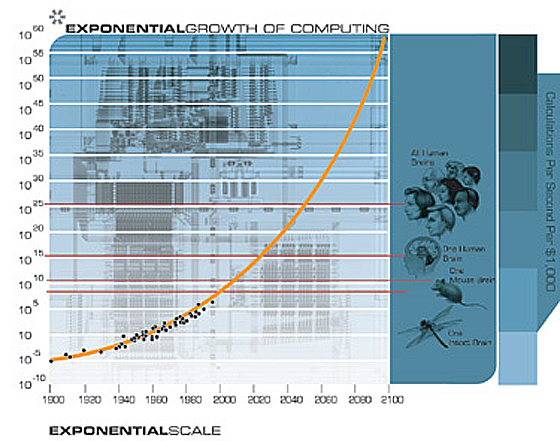
In Ray Kurzweil's 2001 essay The Law of Accelerating Returns, he provides an analysis of the computational power necessary to represent a functioning brain of a variety of different species -- insects, mice, humans... and when that computational power is likely to be available (again according to Moore's law). The date by which he has proposed modeling a mouse brain is right about now. And is if on cue, just last month a team was about to run a "simulated mouse brain at 1/10 time." From the team's write-up:
We deployed the simulator on a 4096-processor BlueGene/L supercomputer with 256 MB per CPU. We were able to represent 8,000,000 neurons (80% excitatory) and 6,300 synapses per neuron in the 1 TB main memory of the system. Using a synthetic pattern of neuronal interconnections, at a 1 ms resolution and an average firing rate of 1 Hz, we were able to run 1s of model time in 10s of real time!
The scientific team working on this research noted that there were numerous problems that they encountered in trying to provide a realistic simulation of a mouse brain in this test. But the news bulletin for the rest of us is simple -- the supposedly radical suggestion that Vinge made way back in 1993 is now coming to pass. 15 years into his 30 year time horizon, the milestones are being achieved, on schedule.

What does this mean for all of us alive today who are still likely to be around in 15 years? Stay tuned for part 2 of this post...

Friday, May 04, 2007

Business Blogging

Recently I have been speaking to executives about getting involved in the conversations about their companies and products that are already happening in the blogosphere. Everyone wants a shorthand for thinking about the "best practices" and so I have been working on boiling down my recommendations to a few simple and easy-to-remember guidelines. I thought I'd throw them into the blog here and perhaps generate some interest in a conversation -- can we as a community together refine a set of messages to use in speaking with folks that really should be involved in blogging but aren't yet because they need help understanding the why, how, etc?

First, I talk about how the blogosphere is about peers and that the challenge any company has in joining the conversation is that they start out by being something other than a peer. So the first key is that joining the conversation has to be perceived as authentic. Here is my simplified equation:

access + accountability = authenticity

The point I am trying to communicate is that real executives have to join the conversation so that the other participants in the conversation feel like they are talking to a real person who actually can speak for the company and influence outcomes.

Secondly I talk about what it takes to be a good citizen in the blogosphere:

1. Listen

2. Engage -- correct inaccuracies, respond to issues

3. Be a conversation leader

Participation means joining the whole conversation not just the parts you want to join.

I make the point that there will typically be a whole range of voices out there -- from supporters to detractors and everything in between. Most people are in the middle but you can't ever hope to win these people over in a conversation if you merely ignore detractors. Certainly some of the most extreme will never listen and never change their views and there is typically nothing that can be done to change those people's minds. But their issues left un-addressed will capture mindshare amongst the middle in the conversation. So it is always worthwhile to pay attention and provide reasonable responses (and corrections) for those extreme voices - even if the point isn't to win those people over.

This is just a start -- very interested to hear from other folks also struggling with how to explain this medium to others.

Wednesday, May 02, 2007

An Innocuos String of Characters

A very interesting drama has been playing out over the last 24 hours amongst the technical sophisticates of the Internet economy. Digg, which allows it users to post and vote for stories has come under enormous pressure to cease censorship of a simple string of characters.

As this article in UK magazine "Computing" explains, the key is part of a battle over the future of digital rights management (DRM). Google now finds 297,000 references to this hexadecimal sequence, a key to unlocking certain copy protection systems.

The Advanced Access Content System (AACS) which developed the affected DRM system has been attempting to use legal strong arm techniques to prevent the distribution of this string. The result has been an enormous increase in attention to what otherwise would have been a minor matter ignored by almost everyone.

Digg has become ground zero for the conflict because it attempted to comply with the cease and desist order sent to them by AACS. But an enormous portion of the sites community began to repeatedly post and vote for the offending information, incensed by the imposition of their free speech rights. Finally, on the Digg blog, CEO Kevin Rose wrote that the community cannot survive if all of the members are at odds with the sites staff:
But now, after seeing hundreds of stories and reading thousands of comments, you’ve made it clear. You’d rather see Digg go down fighting than bow down to a bigger company. We hear you, and effective immediately we won’t delete stories or comments containing the code and will deal with whatever the consequences might be. If we lose, then what the hell, at least we died trying.
This is an important day for the people's Internet. A company bowed to the possibility of an expensive lawsuit, testing first amendment rights of free speech. The company's customers then said "NO!" and forced the company to reverse course.

This kind of first amendment test has happened before. In an earlier case a math professor was pursued by the US government (under Clinton) for violating export controls when he wished to publish cryptography code on his website. Ultimately Daniel Bernstein won this case, with a federal panel determining that software source code is a language, and therefore export controls violated his first amendment rights.

This case is somewhat more complicated, in part because of the Digital Millenium Copyright Act. Here is a copy of the AACS complaint letter to Google. As the above link explains in the notes below the complaint, there is a substantial conflict between the first amendment and the DMCA:
The tension between the DMCA and the First Amendment is at the heart of several ongoing lawsuits. [Felten v. RIAA; Universal v. Corley] The mere posting of a link to a computer program that can be used to circumvent technical protection measures was held to be a violation of the DMCA. [Universal v. Corley (2d Ciruit cite)] The Recording Industry Association of America used the threat of a DMCA action to silence a professor whose research paper discussed circumvention of a technical protection measure. The professor subsequently mounted a legal challenge to the DMCA on First Amendment grounds and presented his paper. While courts in both of these cases have found in favor of the copyright industries, these cases are being appealed and the state of the law is yet to be determined.

Thursday, April 26, 2007

Mission Possible

A friend sent a link to this Daniel Pinchbeck article, Mission Possible, after a long conversation about mainstream media and how it is being affected by the blogosphere. Pinchbeck calls for us to "...deepen our commitment to transformation..." rather than flinch away from the disaster looming in our future. But the "transformation" he calls for is a spiritual one, not a technological one. Indeed Pinchbeck seems to have greater faith in the possibility that mainstream media can be used to change the way people think and live on this planet, then that technology can help correct or mediate the imbalances that we have created on our planet.

I found this disturbing for a number of reasons. First, and perhaps most importantly, I don't believe that we as a species have enough time left to convince people to think and live differently. There are too many of us, we are too dependent upon destructive technologies just to eat every day (much less everything else we need and want to do), and the underlying compulsion to consume is too powerful. Thus I believe that for us to save ourselves, we have to invest in and use technology to fix our world.

But I also found it to be paradoxical that Pinchbeck is arguing that using one of the tools that humans have invented (mass media) can be a successful strategy to correcting the worlds problems while using other tools (science, technology) will fail. I tracked Pinchbeck down to ask him about this. As a side note, shame on the Seattle Conscious Choice website for not making this easier. But I did find an email address by simply googling him.

Pinchbeck writes back "Every potent new technology has unleashed a deeper level of damage. The law of unintended consequences: biotech now kills the honeybees, what will nanotech destroy?"

Well, the latest news out (LA Times article) suggests that it is actually a fungus affecting bees, not biotech. And we wouldn't know this without science, much less have the ability to find a way of solving the problem.

Let's face facts -- we have already passed a key tipping point. Human beings now have the responsibility to manage the ecosystem, it is no longer self managing in a way that will sustain the health and well being of our species. We need more technology and more management of the ecosystem, not less. Just arguing that we should all become earth friendly in the way we live will not pull us back from disaster that is now brewing in our future.

Wednesday, April 18, 2007

Engaging the Author

Having tracked down Thomas Claburn -- the author of "Media Companies Confront Mortality" -- I have engaged in a spirited conversation with him about CMP, his article, blogging vs. journalism, etc. With his permission, I repeat some of that conversation here.

Claburn points out that it is CMP and not he (or any individual writer) who (1) doesn't provide "community" tools and (2) and does spread articles around their network without attribution to the original author. So to be clear - my criticism on this point was not of Thomas or of his article -- but it was of CMP.

Regarding the specific comment, Thomas writes: "Your point is well-taken. It was certainly snarky and perhaps an unfair characterization of the state of the companies present."

But he goes on to point out that I was snarky back in calling his comment "ugly." We then debated whether there is a difference between blogging (which I characterized as editorial) and writing a news article for Information Week. I contend that there is a difference -- my expectation is that something labeled "news" will be presented with an attempt at conveying an objective perspective. Snarkiness is fine in an editorial, where it is clearly an individual's perspective. This blog, for example, is unapologetically my own perspective. And while I recognize that journalists are people too and have their own perspectives and biases - I expect that news will be written in a way that doesn't broadcast those perspectives.

But the most important part of this for me is that when I did track down the author, he did reply, was accountable, was engaged with the topic and the audience. So kudos to Thomas for being the kind of journalist that can make a difference in the media 2.0 world -- even if his company is following far behind in supporting him.

Here's What's Wrong

UPDATE - See bottom of article...

Dear CMP Media, thank you for your recent coverage of the Web 2.0 Expo. I enjoyed your article covering the panel I spoke on. Your article, "Media Companies Confront Mortality" demonstrated what is wrong with mainstream media very effectively.

#1) There was no byline. The article was written by "Staff Writers" -- since it wasn't written by a specific person, there is no accountability, no ability to respond, no knowledge of whether the person writing the article actually knows anything about the topic that he/she is writing on... So this is just a pronouncement from on high -- big media saying "this is what you should believe about what happened and you should believe because we are in charge."

#2) There is no comment mechanism. I read the article and then I have no ability to discuss the article with other people reading it, no trackback mechanism so that I can link to the article from my blog and point out problems or discuss issues...

#3) With the appearance of objectivity, the article puts ugly opinions into the public sphere. Where does CMP Media get off saying that our opinions were "...coming from a panel full of poorly capitalized Web startups..." How do they know? Did they bother to inquire with any of the four of us about our capital structures?

No need to read CMP Media any more, they discredit themselves through their practices, behavior, and poor reporting.

UPDATE: It occurred to me that the version of the article I was seeing was picked up from somewhere else within CMP, and sure enough the original version is in Information Week -- here.

I have written to author Thomas Claburn - let's see if he replies!

Thursday, April 12, 2007

Technorati

Over a year ago, when I was just thinking about starting The Personal Bee, I sat down with Dave Sifry (CEO of Technorati) to chat. I felt then that the work I wanted to do was a perfect complement to Technorati.

While the timing wasn't right then for us to bring these ideas to Technorati, Dave and I maintained a friendship and communication over the 9 months that we built the first beta version of Personal Bee. And after we launched that beta, in September of last year, Dave and I agreed that we should have another conversation about bringing the two companies together.

I am happy to announce, as Dave has on his blog, that as of today The Personal Bee is a part of Technorati.

All of us on the Bee team are excited about the opportunity to participate in the evolution of Technorati, and to Be of Service to Technorati's many constituents.

Saturday, April 07, 2007

Grokking Twitter: Presence, Scope, and Permanence

Should we care about twitter? I addressed this question back in February over on my IP Inferno blog but I think I did a lousy job. Since then I have used (and thought about) the service a lot more. And I have increasingly found myself in conversations with my fellow over-40 digerati trying to explain why they should care about twitter...

And in the last week both the San Francisco Chronicle and USA Today have published articles about twitter and neither of them really get to the heart of why twitter is important and why we should care.

Stowe Boyd offers an amusing rant on the USA Today article but while he correctly points out that author Andrew Kantor does not "...understand the benefits -- or even the possibility -- of moving to a flow state of interaction..." Stowe doesn't explain what this means or why it is important.

So in the spirit of Time Magazine's Person of the Year I have taken it upon myself to explain twitter...

As the Internet has moved from obscurity to a staple of our society over the past two decades there has been an explosion in new communications tools. A useful way to think about this explosion is to think about communications around three characteristics: presence, scope, and permanence. Each of these characteristics, as I will go on to explain, has a continuum of modalities and each communication tool has optimized for performing within a particular part of that cube.

PRESENCE
Is it necessary for the participants in the communication to be present at the time the communication is created? For example if you are taking a class, you need to be present in the classroom to get value from the lecture. But you can read a book thousands of years after it was written. The recipient must be present to receive the lecture but is usually not present when a book is written. Similarly, a phone call is a synchronous form of communications -- both speaker and listener must be present. Voice mail is asynchronous -- the listener need not be present at the time the recording is made and the speaker need not be present at the time of listening.

SCOPE
Classrooms engage a defined group of people in a conversation, newspapers engage an undefined group, a phone call typically involves just two people. Scope is about the number of people involved, the relationship between those people, and the privacy of the communication.

PERMANENCE
Information has a shelf life (or even a half life). Some information is valuable for thousands of years, other information is valuable for only a moment.

Think about the kinds of communications tools that we commonly use, applying these three characteristics:

PHONE CALL
Synchronous communication (presence required), the scope is typically one-one, and (short of a recording) it is a medium best used for information of little permanence.

EMAIL
Email is asynchronous, allowing for long delays between exchanges. The scope can be one-one or one-many but there are few facilities for managing complex many-many communications on a topic. As information can be stored and retrieved for later use, it can be used for topics with some permanence though various limitations generally cause users to move to another medium for longer term storage of documents or issues of more permanence.

IM
Instant messaging is mostly synchronous, though it can have delays in replies. It is typically a one-one communication and the information usually has a very short period of value.

BLOG
Like email, a blog is asynchronous. The scope is typically one-many although commenting facilities can make them into more of a conversation. Information of value for a long time (though perhaps not decades) can be stored on blogs and accessed by a wide variety of readers.

So what is twitter? It is asynchronous (although there can be more value if both speaker and listener are present); the most valuable uses are when the communications are within a particular defined group (friends, a company); and the information has a very short term value.

Examples:
I might tweet "Headed out for a soy chai, anyone want to go?" -- this emphasizes the value of presence, the fact that I am broadcasting to people within a defined group (my office), and has a very momentary value (miss it by 5 minutes and I am already gone).

Another example (from Stowe Boyd) Chris Pirillo points to an article written by Paul Graham claiming Microsoft is dead: http://www.paulgraham.com/microsoft.html -- this is completely asynchronous, anytime I find out about it, it is valuable to me. There is little definition in the group (other than perhaps interest), and the information has some permanence.

So two things that emerge in looking at twitter in this way -- First it has an interesting ability to be useful over a range of states but tends toward group communications that are impermanent and where presence can add value but isn't necessary. Second that it complements other communication types without replacing them -- indicating that there is a place in the ecosystem for this type of communication.

Another interesting thing that you can ask about twitter is whether you can compare the role it serves in online communications with some similar off-line communication. Within every social group there are adhoc communications that serve the same purposes that twitter serves in an online world. Announcing that I am going out to get a cup of chai tea, or people sharing an interest in an article happens all the time within social groups. The difference online is that time and space become less of a constraint for allowing these group communications to occur. This is the role that twitter is serving.

Friday, March 30, 2007

Cult Of The Amateur

Perhaps it is the poet lost inside me, aching to be free. But I find this post, at so many levels, to be the perfect response to Andrew Keen's hopeless "cult of the amateur" and a subtle message to the industrial media complex about what they don't get about how the Internet is changing everything...

http://illuminaught.livejournal.com/29278.html

Get it?

SF Chronicle You Have Our Attention

A case of cause and effect? Just a week ago, Tim O'Reilly was opining that the SF Chronicle was "in trouble." Noting that he hates to "...play Valleywag..." Tim goes on to say that Phil Bronstein (editor-in-chief at the Chron) held an emergency meeting with staff in which he stated that the "news business is broken, and no one knows how to fix it."

And then this week, he started to fix it.

What is it that local journalistic endeavors can do better than anyone else? Provide coverage of whatever makes their own local scene special and different. The San Jose Mercury News could have (but hasn't) made the tech industry their special beat. But in the last week, the SF Chronicle has been making this weird thing called "web 2.0" and what author Andrew Keen is calling "the cult of the amateur" their special beat.

Today it was a story about something just 11 days old -- justin.tv -- which is capturing the interest of the technorati but who would of thought that mainstream news readers would be interested? The Chronicle made their story on Justin and his fellow nerds front page news.

Crazy? Or brilliant? Sure, most San Franciscans are like people in the rest of the country -- interested in the Iraq war, local politics, and weekend sales. But what makes this area DIFFERENT from the rest of the country is people like Justin and the crazy new companies that get created from their ideas. This is the future of local journalism -- uncovering and writing about what is special and unique about their local area.

As one of my old journalist friends used to say "three is a trend" -- the article about Justin.tv wasn't the only interesting piece in the Chron this week.

On Monday it was Dan Fost's article on phenom twitter.

On Thursday it was Dan's coverage of Kathy Sierra.

For me, this kind of coverage makes the Chronicle relevant again. It makes me visit their website and talk about them and maybe even spend $.25 to buy the paper as I make my way onto BART in the morning (the current discount for BART morning commuters).

And I think it shows the way for other local papers -- dig into what YOUR region is known for, or what you think is special. Maybe you can build an online audience, maybe you can get your local readers interested again, maybe you can be relevant again in a world where you can no longer just re-run AP articles that we are already getting on our Blackberrys...

Friday, March 09, 2007

New Communications Forum

Listening to Shel Holtz wrap up the "New Communications Forum" event in Las Vegas. By all accounts the Society for New Communications Research has put on a great show -- numerous attendees have said to me that it is the most useful and interesting conference that they have attended in years.

A few attendees, however, have said to me "gee, not much new here." An observation -- there are two kinds of attendees at this conference: a group of people eager to learn about social media and a group of people who are already engaged in inventing social media. For the first group, this was a great conference and exactly what conferences should be about -- getting enthusiastic experts in front of eager learners. But the conference didn't do as well at serving people who are already engaged and who want to take ideas and debates deeper by interacting with their peers.

This last point does not detract in any way in my mind from the value of the conference and the high quality speakers, sessions, and organization of the event. But rather, it is an observation that as an industry we still are struggling with how to create the right kind of event for experts to cooperatively advance knowledge and initiatives in their industries.

FooCamp, BarCamp, and Social Media club are good experiments, but here is a challenge to conference organizers -- can a single show serve both audiences? I would argue that it HAS to in order to work -- because you need the experts in order to have interesting content for the learners. But the experts then have to derive value from their participation.

Wednesday, March 07, 2007

Elimination of Time and Space

Great post by Doc Searls on what he calls "giant zero journalism" but which might be better understood by saying that the Internet is in the process of eliminating time and space as issues for journalism, get used to it.

Ostensibly the piece is about citizen journalism -- is it good, bad, or just different. But really it is about the mechanism by which the Internet as a technology disrupts existing businesses by changing the very laws of physics by which they operate.

In other words, when time and space are issues in the gathering and dissemination of a news product, the role of professionals and institutions is much more important than in the world we are moving toward... one in which every person can report instantaneously to everyone else on the thing that is right in front of our faces.

So what is the role of the professional and the institution when space and time drifts into inconsequential inconvenience rather than defining dominance for an industry? At best, it is a role that will change dramatically...

Monday, March 05, 2007

China Basin

Just walked through the China Basin building down on Berry Street (down by AT&T Park in SF). The last time I was there was in 1996 when I was working for CMP Media on a project called NetGuide Live:
"Building off NetGuide Magazine's reputation for expert information and quality delivery, CMP launched the first true guide to the Internet, NetGuide Live..."
or as we fondly called it back in 1996 "Project Gulliver." Ah, a trip through memory lane indeed. Whatever did happen to Beth Haggerty? Google says... InfoSeek, president of InfoRocket, CEO of LiveAdvice, and then it sort of runs out... Newt Barrett? SCORE Volunteer, Senior Vice President of the Greater Naples Chamber of Commerce... He had left CMP to buy and run Southwest Florida Business Magazine, which he apparently sold to Gulfshore Media in 2001. So many other folks from those days. Still in touch with Dan Ruby and Dan Brekke anyone else out there reading this?

Friday, March 02, 2007

2 Stars for Peace

Just heard about this incredible idea -- make Israel and Palestine into US States... Here is a brief article explaining the idea and pointing to a book by Martinne Rothblatt -- The Case for Using U.S. Statehood to Achieve Lasting Peace in the Middle East

Wednesday, February 28, 2007

Party like its 1999


Revision 3 @ Slide
Originally uploaded by valleywagprime.
One of the things that is different this time around is that Silicon Valley has its own party venues... during the bubble we had to crash established silicon valley or san francisco haunts with our Internet craze... now people like Jonathan Abrams have started bars like slide... leading to Internet parties like the one I attended last night for Revision 3 (some sort of "new" Internet TV thing)... But some things stay the same. A bunch of geeks standing around in a bar trying to talk about technology over loud music looks the same in 2007 as in 1999...

Tuesday, February 27, 2007

Matt Damon == Capt Kirk ?? WTF!

Please say its not so. Please say that they have it wrong... Could it really be true that they have cast Matt Damon as Captain James T. Kirk of the USS Enterprise!!?? Ahhh... he hasn't been cast yet! Shooting hasn't begun!! Its not too late for us to launch a "please not Matt!" campaign... IGN writes:
Confirming rumors that have been making the rounds for some months now, IGN has learned that Oscar winner Matt Damon is indeed in talks with Paramount about playing the role of Jim Kirk, previously immortalized onscreen by Emmy winner William Shatner.
In TALKS... ok. Deep breath. Titanic boy [oops Dan reminds me this is Leonardo...] Good Will Hunting Boy [doesn't have the same ring to it] doesn't necessarily get to sinkshoot [huh?] the Enterprise... and what else did they say? King Kong's Adrien Brody as Spock!? WTF!!?
For the part of Kirk's Vulcan first officer Mr. Spock, IGN has been told that none other than Oscar winner Adrien Brody (King Kong, The Pianist) is in talks with Paramount to play the role. If cast, Brody would succeed Leonard Nimoy in a role that forever marked Nimoy's career.
OK... "if cast" the said... deep breath... OK now the campaign is "Please NOT Damon and Adrien!"