Chief Customer Officer of Catalytic - an AI and Automation company providing Fortune 500 companies with the ability to rapidly reduce the cost of every day business activities while simultaneously increasing quality, employee satisfaction, and customer loyalty.
But it is certainly reasonable to look at all the Morfords (and Alan Mutters) out there and all the Shirkys out there and ask - how can these two groups of very smart people be so opposed to each other on the basics and how can anyone understand where this is really going?
To this debate I offer a visual aid, the butterfly graph which I have thus named because you could see each of the loops on the left and right of the image as wings and because I like the idea of catching the winds of change... allow me a little poetic license.
But here is how to read this graph -- The red line is the "old way" of doing things and the green line is the "new way." The slope shows that the old way declines in efficacy as the new way increases. At some point the pace at which the old way is declining accelerates and then flattens again as many niche uses hang on over time.
The blue bar in the middle is the period of confusion during which the old way is still working, so adherents can claim that there is a path ahead for their existing model of how things should work -- and their claim is bolstered because the new way isn't yet clear and working.
One of the really interesting characteristics of this blue period is that the old way will take on attributes of the new -- which will both hasten its demise as well as suppress the emergence of a new way that works. An example in the news business is the "free content" which is so hotly debated now amongst the two sides of the future of news argument. Early on in the process, the economic rationale of providing free (advertising supported) content made sense to newspapers eager to build online audiences. So instead of radically re-examining their businesses (and maybe creating craigslist or match.com) newspapers continued to pursue the product logic of the printed world but with a digital distribution. So for this reason every online paper reproduces the print version horoscopes as one example.
But as the "old way" declines -- in this case physical paper distribution becoming less desirable to consumers than instant online access -- having adopted the model of free content and retaining the bundling logic of the physical media, prevents newspapers from radically rethinking their model - they simply don't have the economic wherewithal to experiment. And at the same time the continued flood of free high quality content is dampening entrepreneurs ability to accelerate new models effectiveness. It will take many more Rocky Mountain News and Seattle P-I failures before the slope really shifts and we start to see a crossover of new experiments working and the old recognizably being dead and done.
So to Morford's reasonable complaint to Clay Shirky that he "...has no idea what will replace newspapers and professional journalism." I would answer that Morford himself as a stakeholder in the future of journalism has a better chance of answering the question than Shirky the professor -- answer by stop supporting the old print media and start experimenting in the new digital media. Yes as in other periods of revolution there will be a period in which many of these experiments fail. But the seeds of the new are already planted and growing and the strong ones will fully replace the old over time. And I don't agree with the pace -- I think it will be years and not decades.
Back in February of 2004 when Joseph Pine (author of Mass Customization and now Authenticity) gave this talk at the TED conference, few people were using the words "Social Media" -- "Joseph Pine: What do consumers really want?" But his comments speak directly to why (to quote one of my favorite articles on social technology's disruption of 20th century methods):
In his talk Pine provides a model for thinking about the "Progression of Economic Value" from agrarian society to the modern day.
Pine outlines these four stages of economic value which he associates (like Toffler) with an agrarian, industrial, and now a post-industrial economy. In the agrarian phase all we had were commodities and the production and control of those commodities was the central aspect of our economy.
In the industrial phase we took commodities and manufactured them into goods, which then could be distributed and marketed. But Pine describes a "commodification" of goods as the broad-based ability to manufacture a high quality and low cost product.
His first book, Mass Customization explored how companies should escape from the commodification of goods. His suggestion that companies add a service, customization. But this approach has been commodified as well as all providers learn that they can be equally good at customization.
This led Pine to the idea of "experience" and more recently "authenticity" as the differentiation which companies could strive to provide to keep their products distinct from those made by others. In his view it is not just the product that customers care about, but the experience of buying and using that product. Think of Apple's retail stores as an example.
But as Pine observes, this new "experience economy" requires a high level of authenticity and most companies, in the age of social media, are unprepared to deliver. Charles Green wrote recently on the topic of Customer Centricity in his Trust Matters blog:
..."customer centricity" is so easily hijacked by the dominant ideology of competitive advantage. The competitive paradigm—our leading view of business today—is repressively tolerant of customer-centricity. The hijacking turns the new idea into merely a tactic to serve the old idea. Customer centricity is neutralized, subsumed into the competitive paradigm.
Charles goes on to give specific examples, like the message when you are on hold with customer service assuring you that "your business is important to us." This rings untrue to the caller, it isn't what Pine would call "authentic."
If your company is selling a product that has become equivalent in cost and quality to those of your competitors, Pine's message is for you -- you must now focus on the total customer experience and not just the product to succeed. And once you do, you will discover a whole new challenge in rising to the demand for authenticity. Meeting that demand will require you to reformulate your company's policies, philosophies, and your organizational structure.
Yes its true, the super-secretive Halsey Minor backed Scoutlabs is launching today according to a post from co-founder Jenny ZesZut. And even better, they are giving away 30-day free trials for their outstanding social media monitoring and collaboration platform. I learned about Scoutlabs through ex-Technorati folks (they have hired some of the very best) and am very grateful to have been one of the early testers on the system. We are already using the product with a number of our clients and I expect that to increase.
There are a lot of aspects of the Scoutlabs product that I like, perhaps the best is the collaboration model -- getting all of a team on the same page about what is going on with our company. I will post a longer review later -- but for now rush over to their site and request a free 30-day evaluation... tell them Ted sent you!
The new Symbian Foundation is getting its first public exposure this week in Barcelona at the Mobile World Congress. A new blog has been created for the Symbian Foundation where you can see some photos from the booth and also see the new logo. It is a great compliment that Lee Williams, the new Executive Director, has invited me to contribute to the Symbian Foundation leadership team as an advisor and I have thrown myself into this effort with heart and soul.
The basic mission of the new Symbian is to release the entire Symbian operating system as an open source project and to coordinate a broad community of companies and individuals to build that OS as the premier mobile computing platform. With the long heritage that Symbian has and the tremendously deep technology that is a part of that history, this decision to open source the operating system really changes the game in the mobile world. There is a long road ahead to fully realize the vision, but operators, manufacturers, and software developers will need to take Symbian into account as they make their future plans -- and I believe in Lee Williams and the movement that he has begun to make Symbian the pre-eminent mobile computing platform.
Another lovely visit to the AT&T store, this time because a member of my family dropped her iPhone into the, err... toilet. "It was in my back pocket and I..." oh whatever. Fine I will get a new iPhone for you. But wait! What is this! I have to pay full price AND sign up for an additional 2 year contract?? Huh??
Apparently the special price is only for NEW lines being activated. But for some reason when you purchase an iPhone as a replacement you not only pay the higher full price for the device but AT&T still insists upon tacking on two more years to your contract commitment.
Surely this is not right! Timothy, the "sales consultant" at the 425 Market AT&T store assures me this is true and insists that it is all Apple's fault. And you know what? I agree with him. It is definitely Apple's fault that in the US I have no choice (if I don't jail break my phone) but to have AT&T as my service provider.
Which reminds me of another beef I have about AT&T -- how is it that I can have five bars of signal strength and the 3G symbol but absolutely no data connectivity? Why is it that from my office, also with five bars of signal strength, no one can hear me talk? Why is it that you guys can't figure out how to give me an iPhone app that lets me alert you to a problem with your network using the GPS coordinates for where I am having trouble? Why can't you become more customer centric? Oh, because you are a monopoly and you don't need to be customer centric. Right, I knew that. Hey Barack!!!
As some of you already know, I have been working on a book. So far I have written first drafts of twelve chapters and second or third drafts of a few. The book is the result of reflecting on the fifteen years I have now spent participating in the evolution of the Web, and more specifically is inspired by the consulting work I am currently doing. In this work I am trying to help businesses understand the fundamental shift that is underway right now in the very notion of production, brought about by the rapid adoption of social technologies.
Many people have written about The Power of the Network (David Cushman) or to be more academic, The Wealth of Networks (Yochai Benkler). And marketers have been warned about what happens when there is a Groundswell (Charlene Li and Josh Bernoff) or what to do when Here Comes Everbody (Clay Shirky). And these all have been terrific inspirations for my thinking.
But this book is a little bit different from these others. As I write in the introduction
"I wrote this book for every business person struggling to make sense of the changes that are sweeping through our world today."
That is, this is a book that seeks to help explain what is happening in every day language and what to do about it as an individual business person.
Embracing the same concepts that I am writing about in the book, I have launched today a website on which I will be publishing drafts of every chapter, open to comment (and hopefully improvement!) by anyone who chooses to stop by. The site is:
In a week or so I will load a few more chapters on and so on, hopefully settling into a regularly weekly update cycle. I hope this idea of writing a book in public captures your interest and that you join in and tell me what I am getting right and wrong!
Please step in and disagree with me. But personally I am really starting to feel an emotion when I see advertising that I feel when I see SPAM in my email inbox which is to say -- anger, frustration, and in some cases a sense of befuddlement... why is that brand wasting their money cluttering up my media experience? So I have been trying very hard to come up with a model that explains when advertising "works" and when it doesn't.
In the broadest sense, SPAM email messages are:
unwanted messages from unknown senders
which can also be a good description for advertising. Most of the time advertisements are by definition unwanted -- they are clutter or they are blockades between me and what I want to see or do -- whether in my real (magazine, TV) or virtual (web) environment.
But there are certain circumstances in which an advertiser can overcome either the "unwanted" aspect of their message or the "unknown" aspect of themselves as a sender. Here are some of the ways an advertiser can overcome the "unwanted" message problem:
INFORMATIONAL - provide (or link to) valuable information -- I may not have realized I wanted the information, but having it makes me feel better.
ENTERTAINING - make me laugh, or at least smile, or have a sense of wonder -- I'll likely forgive the intrusion
CONTEXTUAL - get the context and timing right -- such as an ad in search results -- you guess correctly that I am actually seeking the information
The unknown sender problem is a bit more complex and an understanding of this challenge can emerge from again comparing with email. Think about emails you receive from people and how you would evaluate their appropriateness based on the content of the email and the relationship you have to the person sending the message. Messages might be more beneficial (a party invite) or more costly (a solicitation for money, a request for an introduction) and you will evaluate these in the context of the social strength of the relationship. A message from a "best friend" might always be welcome, even if it contains a quite costly request. Whereas the most beneficial message from a stranger would likely be unwelcome (if not also distrusted).
The same calculation is true of brands -- you might know of a brand, like McDonald's, but hold it in low regard. Thus as solicitation to purchase cheap burgers might seem very unwelcome. But if you really enjoyed eating at McDonald's the same solicitation would perhaps be quite welcome.
An interesting option is presented by Retargeter to which I was recently introduced by Auren Hoffman of Rapleaf (more on Auren's really interesting business in a later post). Mechanically what Retargeter does is tag a visitor to your website so that later on, when that visitor is on a page with advertising on which Retargeter has bought the ad space, an ad for your company can be shown to that visitor. In this way you are showing an ad specifically to people who (by visiting your site) have expressed an interest in your company.
This can of course be taken to an extreme and I have not yet connected to Retargeter to ask how a company can limit the number of ads shown to any one person or the length of time after a site visit during which an ad might be shown. But by showing ads to a person who has proactively visited your site, you are almost certainly connecting in the short run with someone who has a strong interest in your brand.
This may seem counter-intuitive. Shouldn't a company spend money to raise awareness with people who DON'T know the company? Why spend money advertising to someone who has already visited your site? Actually for many kinds of businesses a company needs to build up awareness and be top of mind to ultimately lead a customer from an expression of interest to a purchase decision. Advertising to people who already have some awareness of your business can remind them of an option under consideration and thus shorten a sales cycle or raise your brand over a competitor.
I am very interested to hear of other examples of advertising that is not spam. My inclination right now is to strongly recommend against spending money on advertising and instead for companies to focus on creating meaningful connections with their markets. But I also accept that there are circumstances in which advertising "works." Defining those circumstances will become an important tool for companies to understand how to allocate marketing dollars between this one-way messaging and the more labor intensive (though usually more rewarding) two-way communication.
One might wonder why an organization would choose to use a blog as a communication tool if, as in the case of Federated Media's Blog, the organization doesn't allow comments. To be clear, at the bottom of each post there is a form for submitting comments. But one glance at the home page shows that submitted comments do not move from moderation to publication.
Sure, lots of blogs out there have no comments -- my blog in fact has very few. The number of people who choose to comment after all is relatively small by comparison to the total number of readers, and there has to be something to say. John Battelle was, for example, kind enough to comment on my blog when I published a compliment of his Web 2.0 Summit. But what else would anyone have to say to that post?
On the other hand, if you claim, as John has in his "Change and Opportunity" post about a 10% staff reduction at Federated Media, that your company has
...completely reinvented the concept of what "marketing" could be.
you might expect a few people to want to comment. And if you are going to claim that you
...helped define the practice of what we call "conversational marketing."
then you probably owe the market a real conversation. But maybe this blog post shows exactly what is wrong with the definition John has been using for "conversational marketing" -- too much marketing and no conversations.
Totally Transparent Layoffs
Tony Hsieh has certainly set the bar for transparency quite high in his blog post about Zappos layoffs back in November. Crain Communications' Workforce Management magazine wrote about that act of courage, "Social Media Begins Forcing the Totally Transparent Layoff." In this article author Ed Frauenheim quotes Libby Sartain, former head of human resources for Yahoo, saying
“People tweet, people blog, people text,” Sartain said. “You are going to have a completely transparent workplace at all times. You can’t really spin it.”
The blog post that Tony did has pages of comments from engaged customers, past employees, and industry observers. One past employee writes
Tony Hsieh and Alfred Lin are some of the insightful, kind, and compassionate corporate executives that I have ever had the privileged of working under.
Now that is a company people will want to work for, even if it (like all companies) will sometimes have to layoff employees.
The Case for Transparency
Done right, transparency can be a powerful tool for a company to communicate its core values and, even in a difficult time, build a positive impression of the company in the larger marketplace. So what was wrong with John's blog post? Let's start with the title - it wasn't about respecting the people who were being shown the door, it wasn't about telling the marketplace that Federated treats its employees, even in bad times, with honor and respect. It was instead a marketing pitch for Federated. From the title of the post -- "Change and Opportunity" -- and on throughout the post John writes about FM and not about the people who are now without work.
Secondly the post didn't communicate to customers, in this case the sites which Federated represents, what will happen to them. Will it take longer to get a report? Will fewer ads be sold? Will some sites be cut? An important customer, Michael Arrington, claims he read about the changes on their blog. Certainly in both communicating to employees and to customers a blog post does not replace private communications (in which FM was undoubtedly also engaged). But transparent communications can help bridge the communications gap and make sure that the company's point of view is made clear.
And transparency has the additional benefit of speaking to the much larger audience of potential customers and potential employees to tell the company's story and show what the company stands for and believes in, demonstrating how it treats its stakeholders through good times and bad.
Advertising vs. Conversations
For me the most interesting aspect of this story is the one which appears to have been the most mangled in the way in which it was communicated (and reported). Paid Content reported the news with the headline "Federated Media Shifts Away From Display Ads" which is probably not the lede that John was hoping for. According to Chas Edwards, quoted in this article, Federated had over $39 million in revenues in 2008. One would guess that most of this is from "dumb display advertising" as Edwards calls it, hoping perhaps that his dumb advertisers don't notice how dumb he thinks they are for giving him their money.
But I think Federated Media does have a great opportunity to lead the industry in a fundamental change and that John Battelle could be a great spokesperson for doing marketing in an entirely different way. As Joseph Pine tells us in his latest book, what we really crave is authenticity from the companies with whom we do business. In my view "conversational marketing" is about being transparent and being authentic - having a real, open, interactive conversation with others in the marketplace, treating them as peers.
But if FM is going to be a leader, they will have to start by being a good example themselves.
Reporting on the Forbes list of the wealthiest people in the world, CBC News (Canada) writes that the 34 "Web Billioniares" have a collective net worth of $109.7 Billion. Overall the total worth of just America's wealthiest is, according to "The Forbes 400," worth approximately $1.57 trillion. And in this time of global economic crises, the governments of the world plan on spending many trillions in the next 12 months to help our industries and citizens.
So when we look at the tragedy in the Middle East of the Palestinian and Israeli confrontation, it is helpful to put into context some simple math. 1.5 million people live in Gaza. If you assume an average family size of 20, that is 75,000 families. What if the wealthiest people on earth offered each of these families a relocation package worth $1 million dollars, for a total investment in world peace of just $75 Billion? Add in a few governmental and non-governmental bodies instead of just making this the work of private individuals, and suddenly we could expand beyond Gaza and institute a global relocation program for politically displaced families.
The plan is not without challenges beyond convincing one (or more) wealthy people and countries to donate the funds. And you would have to find 75,000 places around the world ready to accept a Gaza family (albeit now worth $1 million) or a family from one of the other places we would expand this program to include. And there would be an enormous challenge as the program expanded in trying to determine how to distribute funds to non-Gaza families who would also want to join the program. The struggling citizens of a thousand places would wonder why they too shouldn't be the beneficiaries of such largess.
But there is a good reason to start with Palestine. Is there any other people on the planet that have been displayed by the United Nations establishing a nation state for a different group of people? While many injustices have been done to many people around the globe by individual governments, I can't think of anywhere else where the world governments have come together to displace a people (albeit for a great cause in establishing a Jewish homeland).
Of course one might wonder whether a Gaza family would make the rational economic decision to leave their land and relocate to an unknown place and, having done so, whether that family would use the opportunity to build a new life or to plot revenge upon Israel. A program of this kind would need to include a great deal of social and educational support. And not every family would agree to go so there would be the challenge of a diminishing population in Gaza who would be increasingly a concentrated minority of interests which oppose Israel.
But an offer of this kind would also bring into the sunlight two perversities of the current conflict -- first, that Arab states find that it is more valuable to have this embattled civilian population constantly on the edges of Israel and second that some of those people themselves are more dedicated to the destruction of Israel than they are to the well-being of their own people.
And the math points out a fascinating and frustrating asymmetry to the war on terror. We are willing to spend billions of dollars every month on an unnecessary war in Iraq, but we are unwilling to spend the money required to solve one of the most critical issues contributing to political instability in the middle east (and the world).
So here is a challenge to the economies of the world as we launch trillion dollar "stimulus" programs. What can we do to organize resettlement of the Palestinians? How can we create a program into which individuals and governments will be challenged to contribute large sums of cash on an ongoing basis, and regional governments encouraged to accept the resettled immigrants, so that over the next half-dozen years every family who wishes to leave Gaza may have the opportunity to do so?
First step - Begin a fund for the resettlement of Palestinians and invite individuals and governments to contribute funds for this purpose.
Second Step -- Once some minimum funding level has been achieved ($50 million?) establish the Gaza Sweepstakes. Any family who elects to leave Gaza may receive, for free, a lottery ticket. Each week, a number of families will be transported away from Gaza. The relocations will be covered by the media, the relocated families will receive ongoing attention as they integrate with the new communities into which they have been delivered. The families will receive money and counseling to assist them in integrating into their new community.
Third Step -- having demonstrated the success on a small scale, a global campaign of citizens appealing to their governments will be launched to raise a growing fund to relocate Palestinians, and when that project has been completed it will be expanded to the next most problematic population in the world.
William Gibson is credited with the wonderful quote, "...the future is already here. It's just not very evenly distributed." I was reminded of this quote twice here in Helsinki this week as I spoke with a variety of companies about the impact of social technologies on their businesses. It is way too easy when you are sitting in the middle of the tornado of change to lose perspective on the winds that rage around you and, more importantly, the seeming calm in the path ahead of the tornado.
Forrester has done a great job of documenting this path, where it has been, where it is now, and where it is heading. The survey data which they have made available through the Social Technographic Profile Tool can give you a snapshot of this progress. Now updated with 2008 data, you can see the differences between the US, where 38% of 18-24 year-olds are now creating content online and Germany, for example, where the number is a much smaller 22%. Or the difference between the 18-24 year-old cohort and 45-54 year-olds in the US where the creator rate is only 16%.
But as Forrester analyst Jeremiah Owyang shows on his Web Strategist blog the trends for every demographic in every region are toward more engagement. Perhaps the most dramatic finding is the change in "inactives" -- people who are paying no attention at all to social media -- from 44% in 2007 to 25% in 2008.
In addition to engaging more people, the other often overlooked impact of social media is in the way that it is changing mainstream media. So even for those people who are not engaging directly, the news and entertainment that they consume is changing. Journalists and entertainers are amongst the most likely to be engaged with these new social technologies and what they report and create is clearly being influenced by this new medium.
As Gibson might say, the future will never be evenly distributed, but the path of this cyclone seems clear to us now -- social media will change every business and will change virtually every aspect of how we develop products, market and sell them, provide service to our customers, organize our work environments... In every industry there will be companies that embrace these new tools and new approaches and those that are torn apart by the fierce winds of change.
I love David Byrne's music, but I feel compelled to disagree with his recent blog post in which he opines that the bankruptcy of the Tribune Company is leading to a world in which we will have "No More News." I would, by the way, complain on his blog but he doesn't provide a comments capability. Perhaps as a public figure of his stature it is impractical to allow comments since moderating them would be such a time burden. But lets bookmark this point for a moment, as I think the lack of dialog (and perhaps the lack of understanding of what this dialog brings) contributes to Byrne's misunderstanding of what is happening in the media ecosystem.
The basic point that Byrne makes has certainly been repeated endlessly - the Internet has radically transformed the business of news and the companies which have understood how to make a living collecting and distributing news in the last century are failing to find a new model as the fundamentals of this business change. Byrne also mentions (though without commentary) the fact that the people running these news businesses have been making changes which make them even less relevant. I thought this observation was particularly well stated:
Likewise, these newspapers have dumped most of their foreign bureaus, food critics, and film critics, and are loathe to assign reporters to stories that will take months to research and write. In doing so, they are eviscerating that which makes newspapers different from online reviews, blogs and websites.
But Byrne goes on to complain that there is an enormous threat to our democracy because of the decline of these traditional news businesses and I think this is a mistake.
It is undoubtedly true that we are in the midst of an enormous tumultuous period of change for the news business. It is also true that from the perspective of the traditional news business, their model is being eviscerated. But this does not mean that there are no possible models for a news business. In fact, I believe that the future of news is very bright and that as a society we will (and in some cases already are) enjoy more news content not less in the future.
First of all, Byrne ignores the fact that bloggers and "citizen journalists" are already making an enormous impact in challenging entrenched media interests and bringing more facts and more "sunlight" into our political processes. The political campaigns of the past year showed how effectively the non-mainstream media could play a role in debunking lies, providing information which would otherwise not have made it into the limited space of broadcast media, and giving people with specific local information a way to get that information to a national (and international) audience.
The wonderful NPR program "On The Media" recently had a segment on the Japanese Kisha Press Clubs which make transparent a fact which is as surely true with our mainstream media -- that journalists will sometimes become too friendly with the people that they are covering in order to obtain access and that this closeness will then taint the coverage of these people. The Kisha Clubs institutionalized this closeness even going so far as to manage a list of issues which all participating journalists (which is to say, those that got access to representatives of the government) would agree NOT to cover. And this is only coming to light now because of bloggers.
Journalism will change, the business of news will change, but rather than looking at the failure of the traditional news media as being a threat to democracy, as Byrne does, I prefer to look at the strength of our democracy as being the force which will lead to a new journalism and a new business of news. This was certainly the case for the newspaper industry we have today. Newspapers were started by people passionate about the mission of the fourth estate and only later were taken over by accountants.
Al Gore, in his closing keynote speech at this year's Web 2.0 Summit conference, provides an interesting perspective on the broadcast media industry. In brief he observes that the printing press started a process in which knowledge was democratized but that television (and in general the concentration of media ownership) was a "re-feudalizing" force in our society for the past 50 years. Concentrating ownership and control of the media into a small number of corporate interests reduced the number of voices participating in the conversations of our society. While one could certainly point to the tendency of some news vehicles (like Fox) to use this power to promote a particular ideological position, the more frequent result was blandness.
Social creation of the news is removing the blandness and is a force FOR democracy. The future of in-depth reporting, investigative journalism, and foreign news desks, which Byrne worries we will lose, will emerge from this creative power of social production. We are still in the infancy of this new medium and we have a lot to learn still about what forms this NEW fourth estate will take. But I already believe that we are witnessing an explosion of news, not an elimination.
I recently went to purchase an iPhone 3G here in lovely San Francisco. Walking toward the Apple store, I remembered that halfway between my office and the beautiful apple store at one stockton street is an AT&T store. I don't really need to go to the Apple store, I thought to myself. So instead I went through the glass doors at the corner of Market and 3rd and into customer hell.
The first thing I noticed was the grouchy sullen customers seated around the room -- perched is probably a better way to describe this as there wasn't really anywhere to sit. So they were leaning against displays, sitting on the ground... The second thing I noticed was the sullen AT&T employee with a clipboard who approached me.
"Hi, can I put you on the waiting list?" he asked.
"Uh... how long is the wait?"
"Only 20-30 minutes."
OK, so here I am, a live customer wanting to give them my money, and they want me to sit on the ground in their store for 20-30 minutes in order to have the privilege of buying something from them!? I said no thank you, turned around and walked right out again. Off to the Apple store a few more blocks down Market.
When I arrived at the Apple store it was buzzing with happy people. A smiling Apple employee was waiting at the front door here as well.
"How can I help you today?" he asked.
"I'd like to buy an iPhone 3G"
"I can bring it right to you - do you know what size and color you want?"
This is a company that actually wants my business. Too bad it is attached to one that doesn't. Like Oscar and Felix, you have to wonder (other than a script writer looking for gags) what makes these two companies able to even stand talking to each other much less trying to offer a joint customer experience.
When I happily walked back to my office, I had to stop at the AT&T store again and wave my new phone at the sullen AT&T employee with the clipboard. In the same amount of time that I would have been sitting on the floor of his horrible shop I had walked to the Apple store, had a great shopping experience, and walked back again.
Memo to AT&T executives -- could you PLEASE learn something from your partner Apple?
From October 5 through October 7th in 2004 I was at the Hotel Nikko in California as a paying attendee of the very first O'Reilly Web 2.0 conference. It was a fantastic event and got my attention re-focused on a set of technologies and markets that I continue to focus on to this day. At the time I was an entrepreneur-in-residence for Mohr Davidow Ventures but since then I have been a poor struggling entrepreneur and have chosen to hang out in the lobby instead of paying to attend. This year that changed, and I once again paid to attend the now 5 year old Web 2.0 Summit and I am happy I did.
Yes, it is expensive to attend. But overall, there are few better places to check in with the leading change-makers in technology and business. The topics, people, and format all generated a perfect environment for thinking about the coming year and what we have to get done as business people and citizens to improve our companies and the world.
Whether it was Mary Meeker pushing through 50 slides in 20 minutes of her Technology / Internet Trends Report or Shai Agassi explaining how his company Better Place is transforming the way we will use electric cars or the brilliant closing remarks by Al Gore about the election and how the Internet is transforming democracy... Web 2.0 Summit absolutely delivered on the promise that:
"...the leaders of the Internet economy are turning their attention to the world outside our industry. And conversely, the best minds of our generation are turning to the Web for solutions. At the fifth annual Web 2.0 Summit, we'll endeavor to bring these groups together."
They did and I was glad I was there for the event. I'll be a paying attendee again in 2009.
Hello Aer Lingus, are you listening? I doubt it. Today you had an opportunity to make me into a huge fan and instead you turned me into a hater. If you'd like to know how customer service can work to make your business loved by customers, go study Zappos and see how a REAL company treats its customers. You guys? Well, you suck.
Sure, you just lost 20 million euros. Sure your staff is all about to go on strike. But maybe your real problem is that you have really lousy policies that demonstrate that you hate your customers!
I booked a flight from Heathrow to Dublin - a route you fly every hour. I happened to get done in London early and came out to the airport early. So I walked up to your ticket counter to see if there was space on an earlier flight. Why yes, there is! In fact there is lots of space! And not just on one flight, but on three flights prior to mine (I am on the last of the day). BUT your policy is to charge full fare -- an extra 150 pounds sterling -- to change!! That is stupid.
You had the chance to delight me by getting to Dublin early, at no additional cost to you. Instead I am sitting in the Heathrow airport, mad at you, vowing never to book on your airline again.
Sounds like you'll lose more than 20 million euros next year. In fact, I think you'll be BANKRUPT. In a bad economy, the remaining customers have choices and they will choose the best airlines - and that is NOT you.
Or you can change! It would be hard, but give it a try.. oh yeah. You aren't even listening.
Well, for the rest of you that are -- take a look at Aer Lingus, they are a great example of what NOT to do.
Great article by Peter Kim on Mashable "The 22 Step Social Media Marketing Plan." Peter lists these 22 social media tools and gives concrete examples of companies using them:
Here’s a framework of 22 tools to consider with notable brand examples:
OK its not working right now, but keep trying it -- Obama's transition team has launched a website -- http://www.change.gov/ which invites all of America to start getting engaged in the work of changing government. I am so glad that the terrific team that Obama put together to guide his online work for the campaign is still hard at work and is already making history with the way this government is going to use the Internet to connect citizens with their government!
You know I am a huge supporter, have been a LinkedIn member since you were in private Beta. And you know how eagerly I have awaited the launch of your applications platform.
But I have to say, I keep finding myself saying "what the heck??" when I try to use your product.
I'd like to suggest that you open up a collaborative product development process with your customers to get feedback from the people that want you to succeed on how your product needs to evolve to achieve the promise that it so clearly has but has not yet fulfilled.
This kind of message (see attached) tell me in big red bold type - GO AWAY, DON'T USE OUR PRODUCT.
I don't think that is the message you want to send.
(With apologies to Bob Dylan) Inspired by the news this last week that the Christian Science Monitor has become the first of the major US newspapers to end print publication -- don't think they'll be the last...
The News Media They Are A-Changin'
Come gather 'round people Wherever you roam And admit that sources of news Around you have grown And accept it that soon You'll be digital to the bone. If your news to you Is worth savin' Then you better start webbin' Or you'll disappear with a moan For the news media they are a-changin'.
Come writers and critics Who prophesize with your pen And keep your eyes wide The chance won't come again And don't speak too soon For the web's still developin' And there's no tellin' who will be reportin' For the journalist now Will be later a citizen For the news media they are a-changin'.
Come senators, congressmen Please heed the call Don't stand in the doorway Don't block up the hall For he that gets hurt Will be he who has stalled The internet has come And it is ragin'. It'll soon shake your Windows And rattle your walls For the news media they are a-changin'.
Come mothers and fathers Throughout the land And don't criticize What you can't understand Your sons and your daughters Are beyond your command Your old print forms are Rapidly agin'. Please get out of the new one If you can't lend your hand For the news media they are a-changin'.
The line it is drawn The curse it is cast The slow one now Will later be fast As the present now Will later be past Print is Rapidly fadin'. And the first one now Will later be last For the news media they are a-changin'.
Thank you O2 for my free iPhone. Yes, you heard me. For a minimum monthly contract of £ 45 the nice people at O2 in the UK will give you a free iPhone. My bill has been more like £ 80 a month with the amount I have been over there, so I happily collected my free phone. I still don't have one here in the U.S. though. Do I really want to commit to another two years on ATT? Maybe President Obama will actually re institute some oversight of the communications industry and ATT will be forced to become more competitive... I think I'll wait and see.
In the meantime, Apple, why can't I take my US SIM card and slide it into that UK iPhone. Did you really have to lock phone serial numbers to particular carriers? Sigh. So now I have to carry two phones EVEN IF they are both 3G iPhones.
Which brings me to my other complaint - why can't the carriers figure out how to let us have reasonable calling rates from multiple countries? Even if I have to have a contract with multiple carriers, my SIM should be "multi-homed" -- registered with each carrier I have a contract with.
Anyone in the telecommunications industry listening?
There is a tipping point, as Malcolm Gladwell famously defined it, for the old media world, driven as it has been by advertising dollars. This day of reckoning was coming, no matter what, but now it will be here sooner due to the current economic crises. 2009 could be the first year in a long time with an actual decline in total dollars spent in the US on advertising. And if it is, massive changes will finally take place in the relationship between media, advertising companies, and the public relations business.
Already a memo is circulating claiming that a number of well known print publications are close to failure. Here is a partial list, you'll recognize more than a few: Entertainment Weekly, Kiplinger's Personal Finance, SmartMoney, Men's Vogue, Teen Vogue, Nickelodeon, National Geographic for Kids, Sports Illustrated for Kids.
But the economic pain that publishers are going to experience in the next few quarters is going to bring down quite a few larger publications as well. An analysis of advertising spend as a percentage of GDP over the past 100 years shows that it has fluctuated between 1% and 3% but has been remarkably stable over the past 25 years at around 2% of GDP. This has been over a period when annual GDP has grown from 3.5 trillion to 13.8 trillion dollars (though not as large a growth when inflation is taken into account).
It is clear from the historical record that recessionary periods can put pressure on advertising expenditure both through a decline in the GDP and through a decline in the percentage of GDP spent on advertising. The last time annual Real GDP (which is to say, inflation adjusted GDP) actually declined was the beginning of the 1990s.
As you can see in this graph of historical real GDP by quarter and by year as hard as the early 2000 period was for us in tech, annualized Real GDP didn't drop. In both periods, however, advertising spending declined as a percentage of GDP -- in the early 1990s by .1% and in the early 2000s by .2%. So based on this historical record, media companies should expect a decline in the amount spent on advertising due to the current economic crises, and that decline may be especially severe as Real GDP is likely to fall in 2009.
But something else has clearly been going on in the last few years, even as the economy has been growing, which adds a third threat. From 2004 overall advertising spend as a percentage of GDP has declined by .1% in each year, dropping from 2.4% to 2.0% in 2007. From 2006 to 2007 this meant an inflation adjusted dollar decline in advertising. Arguably this decline is coming as the result of the changing spending habits of corporations within the overall marketing budget. As authors John Deighton and Leora Kornfeld argue in the HBSarticle Unanticipated Consequences
"...the shift from broadcasting to interaction within digital communities is moving the locus of control over meanings from marketer to consumer and rewarding more participatory, more sincere, and less directive marketing styles."
Marketers who are taking this seriously are shifting dollars away from advertising and into more engaging, more direct connection with markets.
If you take all three factors into consideration, a drop of $50 billion on advertising spend in 2009 is conceivable. The actual drop is likely to be less severe, but could be as much as 10% of total spend (which would be about $30 billion). If so, 2009 will be a watershed year for media.
Look at this from the perspective of the complete ecosystem. Tens of billions of dollars reduced from advertising spend means many fewer jobs at advertising companies and perhaps more than a few that fail. The loss of dollars into media companies will reduce the number of journalists, the number of pages, and probably the number of publications. This will then have an impact on traditional PR as there will be fewer journalists and fewer publications to pitch.
All of this is great news for bringing about a new world of direct company-market communications. It will accelerate the realization by companies that they can talk directly to their customers and prospects -- "more participatory, more sincere, and less directive marketing styles."
Robert Goldberg and I invested a ton of time and thought into our PitchCamp workshop at Web 2.0 Expo Europe (held in Berlin again this year) but I have to say, it would not have been a huge success (thanks Mike Butcher for saying so!) without the tireless help of numerous others. But before I get into the thank you shout outs I must tell you about the terrific companies that won the arduous pitch process. We had 12 great companies and I think all of them made great progress in their pitches. But here were the judges favorites:
Jens Redmer – Head of European New Business Development, Google
Carsten Rudolph – Emerging Business Team, Microsoft
Rob Schiller – Investor and Entrepreneur
Reshma Sohoni – CEO, Seedcamp
Yossi Vardi – Investor and Entrepreneur
Part of what made this so much fun was a terrific group of sponsors who provided prizes and sponsored the PitchParty afterwards -- I have to especially thank Ernst & Young, LinkedIn, iSteps, ContentTeam, Hobnox, SixApart, and VentureBeat.
But let me save the most superlatives for the tremendous, astounding, wonderful David Nöel of Hobnox who did an amazing amount of work to bring everything together on the ground in Berlin so that we had a great party and hundreds of happy pitchcampers. THANKS DAVID!
Attention John McCain - take time now to send a memo to all party members. Subject: Don't Steal The Election. Sure, some of us poor losers in blue states think the Republicans have stolen the last two presidential elections. And perhaps Republicans can forgive us for some of these (hilarious) satires of Diebold voting machines in Florida fixed to only record votes for Dub-yah. After all, there were a few inconsistencies. But does the Republican party really think that America is going to stand for this B.S. again? Apparently they do. Reporting on CNN in an article calmly titled "Long Lines, Glitches Reported in Early Voting" CNN's Sean Callebs, Brian Todd and Manav Tanneeru report this frightening comment from a voter in West Virginia:
In West Virginia's Jackson County, there were some reports that voting machines were accidentally recording the wrong vote.
"I went in there and pushed the Democrat ticket, and it jumped to the Republican ticket for president of the United States," said Calvin Thomas, an 81-year-old West Virginian.
Can this really be true? Did 81-year-old Calvin Thomas simply make this up in order to raise the specter of Republican voter fraud? Did CNN report this as yet another example of the "liberal biased media" stoking the flames of unrest against our duly elected representative government?
I certainly would not go as far as Jack Myers who predicts civil unrest and political demonstrations should the outcome of next Tuesday's election be a defeat for Obama. However, I think it is reasonable to point out to the election commissioners of every state that a perception of fraud in this election will significantly damage the faith of Americans and the world in our democracy and undermine our ability to be a positive force for good in the world. As Myers writes:
This time you will be uncovered. While some may try to obstruct the votes of Democratic-leaning segments of society, hundreds of thousands of poll watchers are on hand outside polling places. The Democratic National Committee has lawyers standing at the ready in contested states.
So am I concerned that the election will be stolen? Am I concerned that John McCain, Patriot and war hero, will allow a result to stand which rests upon voter fraud? Absolutely not. If John McCain is elected President of the United States and if John McCain knows that this election was achieved through subverting the democtratic process of this country, I fully expect him to assure his place in our history as a savior of our democracy by standing on stage and telling the American people and the world exactly how the election was stolen and renouncing the results. Note to McCain -- seems like a much easier way to become a permanent positive part of the history of America than trying to turn around this economy!
I will reserve judgement on the US Government's $700 billion bailout plan until we see how well it works. But in the meantime there is something that all of us can do which is as important, if not more. I call it 700 billion smiles.
One of the core issues that the economy has is not about money, at least not directly. It is about confidence. I am seeing this issue every day -- your business may not have felt any impact from a slowdown in the general economy, but all this bad news is weighing you down. You might feel depression, anxiety, or just be calmly postponing decisions about purchases or investments -- waiting to see how things turn out.
But those behaviors, compounding across the world economy, are bringing about the recession just as certainly as the shortage of capital for commercial paper.
Optimism is an enormously powerful economic stimulant. Pessimism an equally powerful retardent. What we all need to do is rebuild our own confidence, and help those around us. That is where the smiles come in.
First of all, smiling will make YOU feel better. Really. The corners of your mouth pushing upwards actually tricks your brain into releasing chemicals which improve your mood. Try it.
And secondly, smiling is contagious. If people see you smiling, they will find themselves wanting to smile as well.
It's a powerful tribal behavior which we can tap into and help improve the mood, thereby confidence, and by extension the economy.
They didn't call it the great DEPRESSION for nothing. Now get out there and start smiling!
Robert Goldberg and I have been working hard to improve and expand the format of our "Pitch Camp x.0" Workshop at Web 2.0 Expo Europe and we have some very exciting updates:
1. Due to demand from entrepreneurs we have expanded the panel of experts that now includes folks from Google, Sun, Microsoft, Accel, Atlas Ventures and more! Check out the expanded session description here http://www.budurl.com/2wx6
2. We have made the format even more interactive. Now each participating company will be pre-assigned one of the panelists as a coach. There will be a hands on session where the coach helps in real time each company revise the pitch. This should get the competitive juices flowing. Other attendees to the workshop will also be assigned to observe the process.
3. We have found thousands of dollars worth of prizes to give away to the winners who will judged by the entire panel of experts. Check out the site http://www.budurl.com/2wx6 for more details on the prizes
6. IMPORTANT the deadline for submitting an application to pitch and participate is OCTOBER 11th. Email me to get an application -- tshelton (a) theconversationgroup.com
7. Several companies who are financially strapped have approached us to see if they could participate. We are talking to the O’Reilly folks about the possibility of getting one, but at most two session only passes for 1-2 worthy companies. Not a done deal yet, but we are hopeful. FYI if they become available these passes will only get you into the Pitchcamp Workshop and nothing else. So if your applying to pitch and are operating on a shoestring, in the applications process please let us know your circumstances and we will see what we can do to offer you a Scholarship!
8. PARTY – we are having a special VIP party later Tuesday night ONLY for people who attend the workshop. Details and tickets will be provided at the workshop, but take my word for it… it’s going to be great!
Are you coming to Web 2.0 Expo in Berlin at the end of the month? If you are, please join Robert Goldberg and I for our October 21st workshop on how to improve the way you tell your company's story to VCs, partners, and the media. Here is the link to the official session description:
where you will see the great lineup of folks at our panel:
* Mike Butcher – European Editor TechCrunch * Toby Copel – Managing Director of Europe, Yahoo! * Matt Marshall – Managing Editor and CEO, Venture Beat * Mehrdad Piroozram – Managing Partner, iSteps Widget Ventures * Reshma Sohoni – CEO, Seedcamp * Adam Valkin – Head of Digital Media and New Business, Endemol * Yossi Vardi – Investor and Entrepreneur
BUT HERE IS THE IMPORTANT PART -- PAY ATTENTION
Sorry for yelling :-) Robert and I are looking for 8-12 startups that want to participate in the camp as the example companies (anyone can come and participate as an attendee of Web 2.0 Expo). These participating companies get
1) one-on-one coaching by one of our panelists 2) special prizes for participating and even better prizes for being the best 3) oh, and you'll probably improve the way you tell your story to VCs, partners, and the media!
Send an email to Robert -- robert(at)crossroadsvc(dot)com -- if you want to be one of the companies.
In Keen's book we are told that a terrible thing is happening, all kinds of people are connecting to each other online and sharing their views with each other and this "amateur content" is destroying "our cultural standards and moral values." I could, complain about how Keen's view is stuck somewhere in the past, but this pro-establishment view is thoroughly entrenched in our culture and regularly keeps otherwise rational people from understanding the radical reformation of our society that is underway.
In one recent conversation a seemingly well-educated person told me that she only reads reviews of movies in the New Yorker and thinks it is ridiculous that people would trust average people's individuals views on movies instead of a trusting a "professional movie reviewer."
I thought she must be joking, so I laughed... which did not seem to go over well.
So I pointed out that I would much rather have the opinions of other liberal dads with daughters about a movie than some "professional" in New York who I may have nothing in common with and who may be evaluating the movie based on criteria meaningless to me. It was fascinating to hear her angry retort:
"sure, and someday maybe we'll go into a science classroom and anyone who wants to will get up and give the lecture instead of someone who actually knows something about science!"
Wow, I thought. This really misses the whole point. Whether a movie is good or not is about a statement of preference. Sure, a professional videographer might have something to say about the quality of the camera work -- but when I am reading a review, I just want to know whether or not I will have a good time!
So in cases of preference, an "amateur" opinion can be just as (if not more) valuable than "professional" opinion since it may more accurately reflect a view that has relevance for the recipient. So what about cases where opinion is not at stake, where presumably there is some agreed upon "facts?"
Certainly it is true that if I want specific knowledge I want to go to someone whom I trust to have the knowledge -- so in a science class I would want an instructor that has, through some professional process, been certified as having such knowledge... But then shall we leave aside that such certification can be unreliable ?
Which brings up a second dimension -- how does one becomes a professional and be "certified" -- and why do we assume that the way in which "professionals" are certified is better than any other method for identifying experts? It is a testament to how deeply we believe in "professionals" that we want to see an institutional certification and that this is more trusted than recognition from a community.
What I see happening in this "amateur" media is that the audience, instead of editors, are selecting the best content producers. They are recommending the best producers by reading them, linking to them, and recommending them. This does present a challenge when "facts" are at stake -- the writer most preferred by an audience might not be the one who is the most accurate. And it certainly doesn't put any sort of control in place for reviewing material for accuracy.
But this has a way of self-correcting over time. The web provides a platform for debate. Over time on any truly controversial issue, the conversation becomes a bell curve -- advocates on one side and opponents on the other with the bulky middle made up of people who don't really care.
And hasn't that always been true with the "professionals" as well?
A comment on my blog from Michael asks why don't I blog about why I think Obama is the right choice for our next president. My only problem with doing that is that I can't hope to have enough time to be complete in my post, so if you'll forgive me for missing important points:
(1) America vs. the rest of the world How do we in America want to play on the world scene? I believe that Barack Obama is America's best chance to re-engage as a partner in solving the world's many problems. During the last eight years we have become an arrogant unilateral military force unwilling to cooperate to solve the world's pressing energy, security, economic and environmental issues. We need a President, and I believe Obama is the one, who can entirely change that equation and demonstrate to the world that we are willing to be a peer and collaborate on solutions.
(2) The War on Terror I do not agree with the language and the policies of America's unilateral "war on terror" -- I believe that our policies have made us less safe in the world, not more. We need to partner with the rest of the developed world to build up the economies and the opportunities of the poorest people. Social equity and economic opportunity is the best solution to the threat of terrorism. It is a people who have nothing to lose that will throw their lives away against those that they perceive to be tyrants. So help them have something they are afraid to lose. Build up their economies and their lives. Obama offers policies of economic and social engagement with the poorest parts of the world -- and a message of reconciliation and hope that I believe, coming from him, that they will hear.
(3) The growing disparity in wealth here in America The best America, the strongest America, is the one which has a strong and healthy middle class. Obama is committed to increasing economic and social equality here in the US. I believe that innovation is the key to solving the world's problems and that we need a tax system which encourages and rewards innovation. But we can achieve this goal without gutting the middle class and forcing more and more of our population into the desperation of poverty. In fact, we cannot have a system which encourages and rewards innovation if we end up with a population of haves and have-nots. The greatest strength of our democracy and our economy is the well-educated middle class with disposable income. Obama's policies on taxes, education, and healthcare will reverse the current frightening trends to create a small population of super rich surrounded by a nation of the very poor.
(4) Technology and innovation More than any candidate Obama understands the importance of technology and innovation - whether it is his support for NASA and manned space missions, his focus on increased competitiveness in telecommunications, his understanding that we must make massive investments in energy innovation, or his recognition that fundamental research in the sciences must not be bogged down by religious bickering - Obama is the one candidate ready to make innovation the centerpiece of the next great age of our nation.
(5) Tolerance of Diversity Both as a symbol and through the government he will lead, Obama will lead our nation in embracing the most important values that have made us successful over the past 200+ years -- embracing diversity and equality of all people regardless of their beliefs, their gender, their color, or any other way in which we are different.
Like I said, this isn't exhaustive. But I think the two candidates - John McCain and Barack Obama - are as different as can be on the issues that I consider to be the most important facing America and the world -- environment, society, economy, global relations, innovation and technology -- I simply do not understand what causes thoughtful Americans to support John McCain. I know that they do, and I seek to understand. But from my perspective, John represents a set of dead-ends that have been fully played out by the Bush administration. We can all see where these policies lead - and it is not good for ANY American in the long run. Nor for anyone in the world.
We have a responsibility as a wealthy nation to think about the whole planet. Vote for Barack Obama so that there is a tomorrow for us, for our children, and for all of those that will come beyond.
CNN staked out Joe Biden's house and at 8:44 pm EST reported that suddenly the Biden family was under significantly increased police protection. It was probably then that we could have all guessed that Joe Biden would be the next Vice President of the United States -- not withstanding the American electorate losing its mind and electing John McCain in November.
On the subject of John McCain, just a guess - McCain team wrote one press release with the name of the VP candidate left open — then when the announcement came out, inserted Biden's name.
Can't they come up with something more thoughtful than "There has been no harsher critic.." ? I mean, its not even true. Clinton was clearly Obama's harshest critic.
I guess I have lived in California for too long. I just cannot imagine what motivates anyone to believe that McCain would be a good president. And yet there are the polls saying that roughly half of our great nation wants McCain and his promise to:
(1) reduce taxes for the rich (2) continue to wage war in the middle east (3) further destroy America's reputation in the world (4) support anti-competitive policies in telecommunications (5) restrict research into stem-cells (6) take away a woman's right to choose in a core issue of her own health and well-being (7) undermine our basic freedoms
I'd guess I need to try and spend some time hearing why McCain's supporters believe he would be a good leader for our country. For the life of me, I can't understand it at all.
Today, the Obama campaign released “Unfit for Publication,” a fact-check of the latest Republican attack machine’s book, full of false, rehashed attacks. The report outlines a sampling of the lies, half-truths and misleading statements in the book “Obama Nation,” by Jerome Corsi. It also reports Corsi’s controversial and bigoted comments and his involvement previous smear attacks, like the false swift-boat attacks on John Kerry.
"Jerome Corsi is a discredited liar who is peddling another piece of garbage in order to continue the Bush-Cheney politics he helped perpetuate four years ago. His is one of what will likely be many lie-filled books rushed to print this election cycle that are cobbled together from debunked internet sources to make money and advance a partisan agenda. We will forcefully respond to these smears with all means at our disposal,” said Obama campaign spokesman Tommy Vietor.
Here’s the button you should look for on our www.fightthesmears.com site, which will soon link to the report:
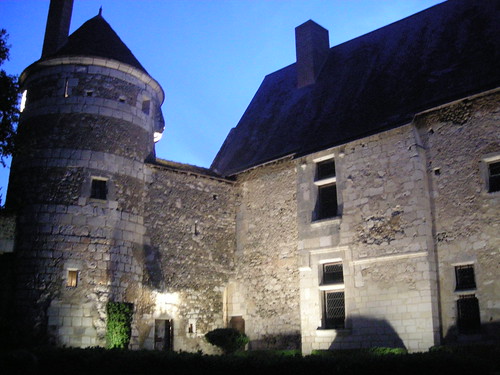
Certainly one of the most memorable events of my family's visit to Europe this summer was our stay at Chateau de Matval, a castle outside Vendome (45 minutes south of Paris by TGV). The castle (oh, chateau I mean) has been restored over the past 30 years through the efforts of Bob and Claude Mitrani. The result is truly amazing -- they have made the castle into a home, but kept intact medieval architectural details (including a low stone doorway arch that I conked my head on).
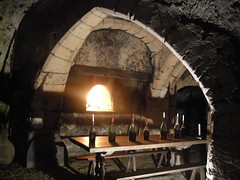
A highlight of our visit was the treat of having pizza inside a 6th century cave, in the original oven and dining room. This room was already old when in the 1700s people were scratching their names and dates into the limestone arches holding up the ceiling. The fire must be built 10-12 hours before you expect to use the oven but once going can cook an enormous amount of food. In fact this oven was used during World War II to cook bread for the neighboring village of Bonneveau.
Sitting inside caves that have been inhabited since the Chateau was founded in 524 AD is an incredible experience, but the rest of the castle is just as amazing as well. The tower is one of the few that exist from the 12th century - many having fallen or been destroyed. Originally this castle likely had four towers and was a traditional square. Other details from the 13th and 14th century including beautiful stone arches have all been restored by the Mitrani family.
Of course the 20th century pool was also nice during the hot afternoons in central France -- all in all a most amazing experience. Bob and Claude have now decided to make their home available for rent during a few weeks of the summer so if you are interested in a chateau for rent at the top of the Loire valley with two of the most wonderful hosts you can imagine - let me know or contact them directly and mention my name. You will have the time of your life!
OK - I have now been to Paris twice in the last week without going to Paris. Oh, if you haven't been keeping up with the story, the family is spending the summer in France. I am traveling around different places to work with clients. We just arrived last Friday at CDG and jumped in a car to head to Le Havre, our home for three weeks (a beautiful, wonderful home). So that was my first time in Paris in the last week - and all I saw was freeway as I drove out of town. Then, on Monday, I had to head to Brussels. So I took the train from Le Havre to Paris -- which comes into St Lazar -- then took the RER E line between their and Gare du Nord (entirely underground) and jumped on the train to Brussels. Again in Paris without really being IN Paris Aargh!
Pundits say she has probably lost her Senate seat in NY, but she continues to have an enormously passionate audience nationwide, and in Puerto Rico where she beat nominee-in-waiting Obama 2 to 1 on Sunday. For awhile, those of us that are novices in the chess game that is power politics, have been wondering why she is still running. Why is she still at it on June 2nd? After the rules committee has already closed the door? Aha! Tomorrow in her conciliatory speech acknowledging that Obama has won the nomination she will ask for one little thing -- the VP slot. And if she does, can Obama deny her that role?
Brilliant.
Its not her first choice certainly. But battling all the way to the convention could lose the race for the Dems AND ruin her chance to run in 2012. Being VP is a heck of a lot better than ending her career. And if she and Barack can win this (and why wouldn't they?) then she is still in line for the presidency -- at least as the favored (undisputed) candidate in 2016.
Photos are now going up on Flickr -- over 600 of them -- from our May 29th event "There's a New Conversation" -- click here -- eventually I will cull through them and make a photo album of the best. Like this one of a thoughtful Peter Hirshberg preparing his presentation.
In a recent TED Conference talk, law professor Yochai Benkler speaks on the topic "open-source economics" and makes the compelling argument that
collaborative projects like Wikipedia and Linux represent the next stage of human organization.
The heart of Benkler's argument is a distinction he makes between "industrial production" and "distributed production" and "social production." The impact of the transition that Benkler describes reaches far beyond "open source."
In fact I believe that the shift that Benkler describes is also at the core of understanding the way in which business will change over the next decade.
Soho Engineering Works
Scottish inventor James Watt filed a patent in 1769 for a steam engine. His company, Soho Engineering Works, is often cited as a landmark on the map of events that brought about the "industrial revolution."
This progress began to accelerate about 150 years ago when the steam engine began to find broad application in transportation and power generation. Mass production, mass markets, and mass media all grew up around this set of technical advances.
The challenge of the modern corporation in the twentieth century was one of coordinating large numbers of resources (people, equipment, capital) by aggregating those resources under the control of a small number of individuals who could direct those resources toward a specific end (you know, capitalism).
Along the way we had to develop hierarchical organizational structures, operational efficiencies to simplify and standardize the role of labor, eliminate differences in products to achieve economies of scale in manufacturing and distribution, and invent a marketing methodology that delivered a simple message to the largest number of people through an increasingly consolidated set of media outlets (you know, industrial production).
And we think of the world that Watt created as being "normal."
How to stop worrying and learn to love the Internet
1) everything that’s already in the world when you’re born is just normal;
2) anything that gets invented between then and before you turn thirty is incredibly exciting and creative and with any luck you can make a career out of it;
3) anything that gets invented after you’re thirty is against the natural order of things and the beginning of the end of civilisation as we know it until it’s been around for about ten years when it gradually turns out to be alright really.
With a nod to Dr. Strangelove, the late Douglas Adams penned an article for the News Review section of The Sunday Times all the way back on August 29th, 1999 entitled "How to Stop Worrying and Learn to Love the Internet." Like Strangelove's bomb, Adams sees the Internet as a challenge to us on how to adapt to a world which has suddenly and forever been fundamentally changed by technology. Its funny to read, as Adams always is, but it would be funnier if we had all already understood the core message of change that the Internet brings and shown some adaptability.
Far too many of us still believe that the industrial world is normal. In fact it was a brief episode in human evolution. It expresses some of the best and worst of what is possible in moving from tribes to global civilization. And its undoing actual began long before the Internet -- which is to say, like the 80 years that passed between Watt's patent and the real take-off point for the industrial revolution, the technology to bring about the next major economic, social, and political force has actually been at work for decades. The Internet (and the web in particular) is the tipping point -- the application of this new technology into a product that will transform instead of merely change incrementally.
The Magic of Coordinating Distributed Production
But many people miss WHY the Internet is so important. They focus on how it "disintermediates" existing markets but this is a symptom not a cause. Some focus on how it "levels the playing field" making it possible for small companies to compete against large ones or individuals to have a voice -- also a symptom. The really important change is in the way in which resources are coordinated.
In an industrial production model, coordination of resources was dependent upon people managing and overseeing the investment, labor, or other resources. But three things have changed this -- virtually free computation, data storage, and network bandwidth. Now we can put the algorithm in charge of coordinating distributed production.
How does this change things?
Each of us have a capacity to produce -- money, data, ideas, opinions, observations. That production can be quickly and easily harnessed via web applications, and then coordinated across all like producers to achieve outcomes that no one person could ever achieve.
A simple example of this is the website "FreeRice" which aggregates attention and cash and converts the two into donations of rice to the UN world hunger program. The site was created by programmer John Breen who was interested in helping his sons study for their SAT college entry exams. So he created a site that provides vocabulary challenges. In exchange for each correct definition 20 grains of rice are donated. These donations are funded by advertising (currently Unilever is promoting their partnership with the World Food Programme) .
So what is happening here? The value to someone (in this case Unilever) for a moment of your attention is worth approximately 20 grains of rice. Alone these pennies of value for your attention and my attention are difficult to do anything with. It is difficult for Unilever to find an efficient way to spend that little money at a time. It is difficult for anyone to do anything with that little. But John Breen, by creating this point of coordinated production called FreeRice, gives Unilever an efficient way to aggregate enough attention to be worth their time (and money) to spend to attract that attention. And the output of that attention, the aggregate of all those pennies for attention, is large enough to make a real difference in the world.
32 Billion grains of rice donated in the first six months.
What does this mean for you?
Start applying the following question to the things you want to achieve -- in your business, in your community, and in your life -- how can you use the Internet to coordinate production to more rapidly attain your objective?
This has a set of questions you need to ask in order to be successful. Here is just a beginning: What is the resource you wish to coordinate? What is the right way to engage the people who have that resource? How will you promote this amongst the various participants? What are the component parts that you need to build, buy, borrow? Who will partner with you to make this possible?
Denver used to be an important international hub for United Airlines. After today I have the clear sense that it has become an important regional hub, but is no longer a major starting point for international flights...
I made the mistake of booking my London travel through Denver. Why? Because they could guarantee me an upgraded seat into business class (you know - lie flat across the atlantic). Since I am err.. was going straight into meetings in London, sleeping on the plane seemed key.
But first our flight was delayed out of SFO. Then there was some "microburst" activity on the ground in Denver. So I missed the connection. And the next flight to London out of Denver is 8:20 pm the next day. Thats right, one per day.
So I had to get myself out of there -- Here is the crazy routing that still gets me in on the 7th (yes, it took awhile to sort this one out). Denver to Chicago. Chicago to Washington Dulles. Dulles to London. I get in at about 10:00 pm on the 7th.
Total elapsed time - almost 24 hours. Four separate flights. The beautiful insides of SF, Denver, Chicago, Washington, and of course London terminals.
 To this debate I offer a visual aid, the butterfly graph which I have thus named because you could see each of the loops on the left and right of the image as wings and because I like the idea of catching the winds of change... allow me a little poetic license.