A comment on my blog from Michael asks why don't I blog about why I think Obama is the right choice for our next president. My only problem with doing that is that I can't hope to have enough time to be complete in my post, so if you'll forgive me for missing important points:
(1) America vs. the rest of the world
How do we in America want to play on the world scene? I believe that Barack Obama is America's best chance to re-engage as a partner in solving the world's many problems. During the last eight years we have become an arrogant unilateral military force unwilling to cooperate to solve the world's pressing energy, security, economic and environmental issues. We need a President, and I believe Obama is the one, who can entirely change that equation and demonstrate to the world that we are willing to be a peer and collaborate on solutions.
(2) The War on Terror
I do not agree with the language and the policies of America's unilateral "war on terror" -- I believe that our policies have made us less safe in the world, not more. We need to partner with the rest of the developed world to build up the economies and the opportunities of the poorest people. Social equity and economic opportunity is the best solution to the threat of terrorism. It is a people who have nothing to lose that will throw their lives away against those that they perceive to be tyrants. So help them have something they are afraid to lose. Build up their economies and their lives. Obama offers policies of economic and social engagement with the poorest parts of the world -- and a message of reconciliation and hope that I believe, coming from him, that they will hear.
(3) The growing disparity in wealth here in America
The best America, the strongest America, is the one which has a strong and healthy middle class. Obama is committed to increasing economic and social equality here in the US. I believe that innovation is the key to solving the world's problems and that we need a tax system which encourages and rewards innovation. But we can achieve this goal without gutting the middle class and forcing more and more of our population into the desperation of poverty. In fact, we cannot have a system which encourages and rewards innovation if we end up with a population of haves and have-nots. The greatest strength of our democracy and our economy is the well-educated middle class with disposable income. Obama's policies on taxes, education, and healthcare will reverse the current frightening trends to create a small population of super rich surrounded by a nation of the very poor.
(4) Technology and innovation
More than any candidate Obama understands the importance of technology and innovation - whether it is his support for NASA and manned space missions, his focus on increased competitiveness in telecommunications, his understanding that we must make massive investments in energy innovation, or his recognition that fundamental research in the sciences must not be bogged down by religious bickering - Obama is the one candidate ready to make innovation the centerpiece of the next great age of our nation.
(5) Tolerance of Diversity
Both as a symbol and through the government he will lead, Obama will lead our nation in embracing the most important values that have made us successful over the past 200+ years -- embracing diversity and equality of all people regardless of their beliefs, their gender, their color, or any other way in which we are different.
Like I said, this isn't exhaustive. But I think the two candidates - John McCain and Barack Obama - are as different as can be on the issues that I consider to be the most important facing America and the world -- environment, society, economy, global relations, innovation and technology -- I simply do not understand what causes thoughtful Americans to support John McCain. I know that they do, and I seek to understand. But from my perspective, John represents a set of dead-ends that have been fully played out by the Bush administration. We can all see where these policies lead - and it is not good for ANY American in the long run. Nor for anyone in the world.
We have a responsibility as a wealthy nation to think about the whole planet. Vote for Barack Obama so that there is a tomorrow for us, for our children, and for all of those that will come beyond.
Tuesday, August 26, 2008
Saturday, August 23, 2008
Obama Selects Biden as running mate
CNN staked out Joe Biden's house and at 8:44 pm EST reported that suddenly the Biden family was under significantly increased police protection. It was probably then that we could have all guessed that Joe Biden would be the next Vice President of the United States -- not withstanding the American electorate losing its mind and electing John McCain in November.
On the subject of John McCain, just a guess - McCain team wrote one press release with the name of the VP candidate left open — then when the announcement came out, inserted Biden's name.
Can't they come up with something more thoughtful than "There has been no harsher critic.." ? I mean, its not even true. Clinton was clearly Obama's harshest critic.
I guess I have lived in California for too long. I just cannot imagine what motivates anyone to believe that McCain would be a good president. And yet there are the polls saying that roughly half of our great nation wants McCain and his promise to:
(1) reduce taxes for the rich
(2) continue to wage war in the middle east
(3) further destroy America's reputation in the world
(4) support anti-competitive policies in telecommunications
(5) restrict research into stem-cells
(6) take away a woman's right to choose in a core issue of her own health and well-being
(7) undermine our basic freedoms
I'd guess I need to try and spend some time hearing why McCain's supporters believe he would be a good leader for our country. For the life of me, I can't understand it at all.
On the subject of John McCain, just a guess - McCain team wrote one press release with the name of the VP candidate left open — then when the announcement came out, inserted Biden's name.
Can't they come up with something more thoughtful than "There has been no harsher critic.." ? I mean, its not even true. Clinton was clearly Obama's harshest critic.
I guess I have lived in California for too long. I just cannot imagine what motivates anyone to believe that McCain would be a good president. And yet there are the polls saying that roughly half of our great nation wants McCain and his promise to:
(1) reduce taxes for the rich
(2) continue to wage war in the middle east
(3) further destroy America's reputation in the world
(4) support anti-competitive policies in telecommunications
(5) restrict research into stem-cells
(6) take away a woman's right to choose in a core issue of her own health and well-being
(7) undermine our basic freedoms
I'd guess I need to try and spend some time hearing why McCain's supporters believe he would be a good leader for our country. For the life of me, I can't understand it at all.
Friday, August 15, 2008
Obama Campaign Responds to Republican Lies
Today, the Obama campaign released “Unfit for Publication,” a fact-check of the latest Republican attack machine’s book, full of false, rehashed attacks. The report outlines a sampling of the lies, half-truths and misleading statements in the book “Obama Nation,” by Jerome Corsi. It also reports Corsi’s controversial and bigoted comments and his involvement previous smear attacks, like the false swift-boat attacks on John Kerry.
"Jerome Corsi is a discredited liar who is peddling another piece of garbage in order to continue the Bush-Cheney politics he helped perpetuate four years ago. His is one of what will likely be many lie-filled books rushed to print this election cycle that are cobbled together from debunked internet sources to make money and advance a partisan agenda. We will forcefully respond to these smears with all means at our disposal,” said Obama campaign spokesman Tommy Vietor.
Here’s the button you should look for on our www.fightthesmears.com site, which will soon link to the report:

"Jerome Corsi is a discredited liar who is peddling another piece of garbage in order to continue the Bush-Cheney politics he helped perpetuate four years ago. His is one of what will likely be many lie-filled books rushed to print this election cycle that are cobbled together from debunked internet sources to make money and advance a partisan agenda. We will forcefully respond to these smears with all means at our disposal,” said Obama campaign spokesman Tommy Vietor.
Here’s the button you should look for on our www.fightthesmears.com site, which will soon link to the report:
Friday, August 01, 2008
Medieval Pizza Recipes

Certainly one of the most memorable events of my family's visit to Europe this summer was our stay at Chateau de Matval, a castle outside Vendome (45 minutes south of Paris by TGV). The castle (oh, chateau I mean) has been restored over the past 30 years through the efforts of Bob and Claude Mitrani. The result is truly amazing -- they have made the castle into a home, but kept intact medieval architectural details (including a low stone doorway arch that I conked my head on).
A highlight of our visit was the treat of having pizza inside a 6th century cave, in the original oven and dining room. This room was already old when in the 1700s people were scratching their names and dates into the limestone arches holding up the ceiling.
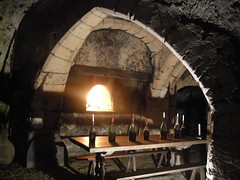 The fire must be built 10-12 hours before you expect to use the oven but once going can cook an enormous amount of food. In fact this oven was used during World War II to cook bread for the neighboring village of Bonneveau.
Sitting inside caves that have been inhabited since the Chateau was founded in 524 AD is an incredible experience, but the rest of the castle is just as amazing as well. The tower is one of the few that exist from the 12th century - many having fallen or been destroyed. Originally this castle likely had four towers and was a traditional square. Other details from the 13th and 14th century including beautiful stone arches have all been restored by the Mitrani family.
Of course the 20th century pool was also nice during the hot afternoons in central France -- all in all a most amazing experience. Bob and Claude have now decided to make their home available for rent during a few weeks of the summer so if you are interested in a chateau for rent at the top of the Loire valley with two of the most wonderful hosts you can imagine - let me know or contact them directly and mention my name. You will have the time of your life!
Tuesday, July 08, 2008
Complaint Department
OK - I have now been to Paris twice in the last week without going to Paris. Oh, if you haven't been keeping up with the story, the family is spending the summer in France. I am traveling around different places to work with clients. We just arrived last Friday at CDG and jumped in a car to head to Le Havre, our home for three weeks (a beautiful, wonderful home). So that was my first time in Paris in the last week - and all I saw was freeway as I drove out of town. Then, on Monday, I had to head to Brussels. So I took the train from Le Havre to Paris -- which comes into St Lazar -- then took the RER E line between their and Gare du Nord (entirely underground) and jumped on the train to Brussels. Again in Paris without really being IN Paris Aargh!
But Brussels is nice...
But Brussels is nice...
Monday, June 02, 2008
Brilliant move Hillary
Pundits say she has probably lost her Senate seat in NY, but she continues to have an enormously passionate audience nationwide, and in Puerto Rico where she beat nominee-in-waiting Obama 2 to 1 on Sunday. For awhile, those of us that are novices in the chess game that is power politics, have been wondering why she is still running. Why is she still at it on June 2nd? After the rules committee has already closed the door? Aha! Tomorrow in her conciliatory speech acknowledging that Obama has won the nomination she will ask for one little thing -- the VP slot. And if she does, can Obama deny her that role?
Brilliant.
Its not her first choice certainly. But battling all the way to the convention could lose the race for the Dems AND ruin her chance to run in 2012. Being VP is a heck of a lot better than ending her career. And if she and Barack can win this (and why wouldn't they?) then she is still in line for the presidency -- at least as the favored (undisputed) candidate in 2016.
Good move Hillary.
Obama-Clinton '08 ! OC08
UPDATE: Senator Feinstein begins the drumbeat for a Vice President Hillary Clinton
Brilliant.
Its not her first choice certainly. But battling all the way to the convention could lose the race for the Dems AND ruin her chance to run in 2012. Being VP is a heck of a lot better than ending her career. And if she and Barack can win this (and why wouldn't they?) then she is still in line for the presidency -- at least as the favored (undisputed) candidate in 2016.
Good move Hillary.
Obama-Clinton '08 ! OC08
UPDATE: Senator Feinstein begins the drumbeat for a Vice President Hillary Clinton
Saturday, May 31, 2008
Peter Hirshbeg
Photos are now going up on Flickr -- over 600 of them -- from our May 29th event "There's a New Conversation" -- click here -- eventually I will cull through them and make a photo album of the best. Like this one of a thoughtful Peter Hirshberg preparing his presentation.

Thursday, May 22, 2008
Industrial vs. Social Production
In a recent TED Conference talk, law professor Yochai Benkler speaks on the topic "open-source economics" and makes the compelling argument that
In fact I believe that the shift that Benkler describes is also at the core of understanding the way in which business will change over the next decade.
This progress began to accelerate about 150 years ago when the steam engine began to find broad application in transportation and power generation. Mass production, mass markets, and mass media all grew up around this set of technical advances.
The challenge of the modern corporation in the twentieth century was one of coordinating large numbers of resources (people, equipment, capital) by aggregating those resources under the control of a small number of individuals who could direct those resources toward a specific end (you know, capitalism).
Along the way we had to develop hierarchical organizational structures, operational efficiencies to simplify and standardize the role of labor, eliminate differences in products to achieve economies of scale in manufacturing and distribution, and invent a marketing methodology that delivered a simple message to the largest number of people through an increasingly consolidated set of media outlets (you know, industrial production).
And we think of the world that Watt created as being "normal."
Far too many of us still believe that the industrial world is normal. In fact it was a brief episode in human evolution. It expresses some of the best and worst of what is possible in moving from tribes to global civilization. And its undoing actual began long before the Internet -- which is to say, like the 80 years that passed between Watt's patent and the real take-off point for the industrial revolution, the technology to bring about the next major economic, social, and political force has actually been at work for decades. The Internet (and the web in particular) is the tipping point -- the application of this new technology into a product that will transform instead of merely change incrementally.
In an industrial production model, coordination of resources was dependent upon people managing and overseeing the investment, labor, or other resources. But three things have changed this -- virtually free computation, data storage, and network bandwidth. Now we can put the algorithm in charge of coordinating distributed production.
How does this change things?
Each of us have a capacity to produce -- money, data, ideas, opinions, observations. That production can be quickly and easily harnessed via web applications, and then coordinated across all like producers to achieve outcomes that no one person could ever achieve.
A simple example of this is the website "FreeRice" which aggregates attention and cash and converts the two into donations of rice to the UN world hunger program. The site was created by programmer John Breen who was interested in helping his sons study for their SAT college entry exams. So he created a site that provides vocabulary challenges. In exchange for each correct definition 20 grains of rice are donated. These donations are funded by advertising (currently Unilever is promoting their partnership with the World Food Programme) .
So what is happening here? The value to someone (in this case Unilever) for a moment of your attention is worth approximately 20 grains of rice. Alone these pennies of value for your attention and my attention are difficult to do anything with. It is difficult for Unilever to find an efficient way to spend that little money at a time. It is difficult for anyone to do anything with that little. But John Breen, by creating this point of coordinated production called FreeRice, gives Unilever an efficient way to aggregate enough attention to be worth their time (and money) to spend to attract that attention. And the output of that attention, the aggregate of all those pennies for attention, is large enough to make a real difference in the world.
32 Billion grains of rice donated in the first six months.
This has a set of questions you need to ask in order to be successful. Here is just a beginning: What is the resource you wish to coordinate? What is the right way to engage the people who have that resource? How will you promote this amongst the various participants? What are the component parts that you need to build, buy, borrow? Who will partner with you to make this possible?
collaborative projects like Wikipedia and Linux represent the next stage of human organization.The heart of Benkler's argument is a distinction he makes between "industrial production" and "distributed production" and "social production." The impact of the transition that Benkler describes reaches far beyond "open source."
In fact I believe that the shift that Benkler describes is also at the core of understanding the way in which business will change over the next decade.
Soho Engineering Works
Scottish inventor James Watt filed a patent in 1769 for a steam engine. His company, Soho Engineering Works, is often cited as a landmark on the map of events that brought about the "industrial revolution."This progress began to accelerate about 150 years ago when the steam engine began to find broad application in transportation and power generation. Mass production, mass markets, and mass media all grew up around this set of technical advances.
The challenge of the modern corporation in the twentieth century was one of coordinating large numbers of resources (people, equipment, capital) by aggregating those resources under the control of a small number of individuals who could direct those resources toward a specific end (you know, capitalism).
Along the way we had to develop hierarchical organizational structures, operational efficiencies to simplify and standardize the role of labor, eliminate differences in products to achieve economies of scale in manufacturing and distribution, and invent a marketing methodology that delivered a simple message to the largest number of people through an increasingly consolidated set of media outlets (you know, industrial production).
And we think of the world that Watt created as being "normal."
How to stop worrying and learn to love the Internet
1) everything that’s already in the world when you’re born is just normal;With a nod to Dr. Strangelove, the late Douglas Adams penned an article for the News Review section of The Sunday Times all the way back on August 29th, 1999 entitled "How to Stop Worrying and Learn to Love the Internet." Like Strangelove's bomb, Adams sees the Internet as a challenge to us on how to adapt to a world which has suddenly and forever been fundamentally changed by technology. Its funny to read, as Adams always is, but it would be funnier if we had all already understood the core message of change that the Internet brings and shown some adaptability.
2) anything that gets invented between then and before you turn thirty is incredibly exciting and creative and with any luck you can make a career out of it;
3) anything that gets invented after you’re thirty is against the natural order of things and the beginning of the end of civilisation as we know it until it’s been around for about ten years when it gradually turns out to be alright really.
Far too many of us still believe that the industrial world is normal. In fact it was a brief episode in human evolution. It expresses some of the best and worst of what is possible in moving from tribes to global civilization. And its undoing actual began long before the Internet -- which is to say, like the 80 years that passed between Watt's patent and the real take-off point for the industrial revolution, the technology to bring about the next major economic, social, and political force has actually been at work for decades. The Internet (and the web in particular) is the tipping point -- the application of this new technology into a product that will transform instead of merely change incrementally.
The Magic of Coordinating Distributed Production
But many people miss WHY the Internet is so important. They focus on how it "disintermediates" existing markets but this is a symptom not a cause. Some focus on how it "levels the playing field" making it possible for small companies to compete against large ones or individuals to have a voice -- also a symptom. The really important change is in the way in which resources are coordinated.In an industrial production model, coordination of resources was dependent upon people managing and overseeing the investment, labor, or other resources. But three things have changed this -- virtually free computation, data storage, and network bandwidth. Now we can put the algorithm in charge of coordinating distributed production.
How does this change things?
Each of us have a capacity to produce -- money, data, ideas, opinions, observations. That production can be quickly and easily harnessed via web applications, and then coordinated across all like producers to achieve outcomes that no one person could ever achieve.
A simple example of this is the website "FreeRice" which aggregates attention and cash and converts the two into donations of rice to the UN world hunger program. The site was created by programmer John Breen who was interested in helping his sons study for their SAT college entry exams. So he created a site that provides vocabulary challenges. In exchange for each correct definition 20 grains of rice are donated. These donations are funded by advertising (currently Unilever is promoting their partnership with the World Food Programme) .
So what is happening here? The value to someone (in this case Unilever) for a moment of your attention is worth approximately 20 grains of rice. Alone these pennies of value for your attention and my attention are difficult to do anything with. It is difficult for Unilever to find an efficient way to spend that little money at a time. It is difficult for anyone to do anything with that little. But John Breen, by creating this point of coordinated production called FreeRice, gives Unilever an efficient way to aggregate enough attention to be worth their time (and money) to spend to attract that attention. And the output of that attention, the aggregate of all those pennies for attention, is large enough to make a real difference in the world.
32 Billion grains of rice donated in the first six months.
What does this mean for you?
Start applying the following question to the things you want to achieve -- in your business, in your community, and in your life -- how can you use the Internet to coordinate production to more rapidly attain your objective?This has a set of questions you need to ask in order to be successful. Here is just a beginning: What is the resource you wish to coordinate? What is the right way to engage the people who have that resource? How will you promote this amongst the various participants? What are the component parts that you need to build, buy, borrow? Who will partner with you to make this possible?
How do I get started?
Watch Benkler's speech for yourself:Wednesday, May 07, 2008
Getting to London the hard way
Denver used to be an important international hub for United Airlines. After today I have the clear sense that it has become an important regional hub, but is no longer a major starting point for international flights...
I made the mistake of booking my London travel through Denver. Why? Because they could guarantee me an upgraded seat into business class (you know - lie flat across the atlantic). Since I am err.. was going straight into meetings in London, sleeping on the plane seemed key.
But first our flight was delayed out of SFO. Then there was some "microburst" activity on the ground in Denver. So I missed the connection. And the next flight to London out of Denver is 8:20 pm the next day. Thats right, one per day.
So I had to get myself out of there -- Here is the crazy routing that still gets me in on the 7th (yes, it took awhile to sort this one out). Denver to Chicago. Chicago to Washington Dulles. Dulles to London. I get in at about 10:00 pm on the 7th.
Total elapsed time - almost 24 hours. Four separate flights. The beautiful insides of SF, Denver, Chicago, Washington, and of course London terminals.
Anyone want to bet on where my luggage ends up?
I made the mistake of booking my London travel through Denver. Why? Because they could guarantee me an upgraded seat into business class (you know - lie flat across the atlantic). Since I am err.. was going straight into meetings in London, sleeping on the plane seemed key.
But first our flight was delayed out of SFO. Then there was some "microburst" activity on the ground in Denver. So I missed the connection. And the next flight to London out of Denver is 8:20 pm the next day. Thats right, one per day.
So I had to get myself out of there -- Here is the crazy routing that still gets me in on the 7th (yes, it took awhile to sort this one out). Denver to Chicago. Chicago to Washington Dulles. Dulles to London. I get in at about 10:00 pm on the 7th.
Total elapsed time - almost 24 hours. Four separate flights. The beautiful insides of SF, Denver, Chicago, Washington, and of course London terminals.
Anyone want to bet on where my luggage ends up?
Tuesday, April 15, 2008
May 29th - There's A New Conversation Palo Alto
Announcing the second in the series! We are bringing our celebration of Cluetrain at 10 to Palo Alto -- Graciously hosted by SAP at their offices just off of Foothill Expressway.
We have expanded the format from the February in New York event to respond to the many requests for more networking time and more discussion time. The full day event (including cocktail reception afterwards) will now include both presentations and breakout sessions for discussion with all attendees.
This larger format is more costly to produce, and so the fee for attending the event will be $185 (continental breakfast, lunch, and cocktail reception are included). But until May 10th you can register for an "early bird" rate of just $95
More on the event:
Ten years ago, four authors came together to start a new conversation about marketing. The result was a book called The Cluetrain Manifesto and with it, Chris Locke, Rick Levine, Doc Searls, and David Weinberger nailed 95 Theses on the door of the Internet and challenged us all to wake up to a transformation underway in how companies and people engage in markets. Looking back over the past ten years we have learned a lot about what happens when mass markets adopt collaborative online communities and it is time to revisit this vital document that played an important role in starting a new conversation about what it means to be a marketer. What have we learned? What was right and wrong? What was left out that we should have been thinking about? What should we be thinking about for the next ten years?
* Doc Searls, co-author of "The Cluetrain Manifesto" and fellow at Harvard's Berkman Institute
* Peter Hirshberg, Chairman of the Executive Committee of Technorati and Chairman and Partner at The Conversation Group
* Jeremiah Owyang, VP, Principal Analyst, Forrester Research
* Deborah Schultz, independent social media expert
Register for our May 29th event in Palo Alto CA at http://conversation.eventbrite.com/
We have expanded the format from the February in New York event to respond to the many requests for more networking time and more discussion time. The full day event (including cocktail reception afterwards) will now include both presentations and breakout sessions for discussion with all attendees.
This larger format is more costly to produce, and so the fee for attending the event will be $185 (continental breakfast, lunch, and cocktail reception are included). But until May 10th you can register for an "early bird" rate of just $95
More on the event:
Ten years ago, four authors came together to start a new conversation about marketing. The result was a book called The Cluetrain Manifesto and with it, Chris Locke, Rick Levine, Doc Searls, and David Weinberger nailed 95 Theses on the door of the Internet and challenged us all to wake up to a transformation underway in how companies and people engage in markets. Looking back over the past ten years we have learned a lot about what happens when mass markets adopt collaborative online communities and it is time to revisit this vital document that played an important role in starting a new conversation about what it means to be a marketer. What have we learned? What was right and wrong? What was left out that we should have been thinking about? What should we be thinking about for the next ten years?
* Doc Searls, co-author of "The Cluetrain Manifesto" and fellow at Harvard's Berkman Institute
* Peter Hirshberg, Chairman of the Executive Committee of Technorati and Chairman and Partner at The Conversation Group
* Jeremiah Owyang, VP, Principal Analyst, Forrester Research
* Deborah Schultz, independent social media expert
Register for our May 29th event in Palo Alto CA at http://conversation.eventbrite.com/
Wednesday, April 09, 2008
The Social Hub at Web 2.0 Expo
The Conversation Group is producing a blogger lounge at the upcoming Web 2.0 Expo in San Francisco -- if you are in town, I hope you'll join the fun. Space is limited so you'll need to register at
http://blogtropolus.eventbrite.com
Here is the official information:
Blogtropol.us is the dedicated media and networking lounge for bloggers, content producers, and journalists during Web 2.0 Expo 2008. In a private suite, in the middle of the conference action, Blogtropol.us is designed for you to host and share conversations among digital influencers – both online and offline.
Open to all digital media-makers attending Web 2.0 Expo, Blogtropol.us is the exclusive venue for creating media and discussing conference happenings. Daily live streamed and on-demand video shows will be broadcast to cover the most important conversations of the conference for online discussion and sharing.
CONNECT: Free bandwidth, power, workstations and superior Internet connectivity provided
RE-CHARGE: Food, refreshments, beverages, and afternoon happy hour
RELAX: Daily yoga sessions and chair massages
FOLLOW: @blogtropolus on Twitter to keep up with all of the Blogtropol.us and Web 2 action, as it happens
Blogtropol.us is brought to you by: Snap, Mzinga, Something Simpler Systems, BottleNotes, Pandora, Socialtext, Radian6, Elephant Pharmacy, and CNET Webware.
In order to participate you must have a Web 2.0 Expo Pass or conference pass AND you must register for the lounge at - http://blogtropolus.eventbrite.com. Space is limited!
http://blogtropolus.eventbrite.com
Here is the official information:
Blogtropol.us is the dedicated media and networking lounge for bloggers, content producers, and journalists during Web 2.0 Expo 2008. In a private suite, in the middle of the conference action, Blogtropol.us is designed for you to host and share conversations among digital influencers – both online and offline.
Open to all digital media-makers attending Web 2.0 Expo, Blogtropol.us is the exclusive venue for creating media and discussing conference happenings. Daily live streamed and on-demand video shows will be broadcast to cover the most important conversations of the conference for online discussion and sharing.
CONNECT: Free bandwidth, power, workstations and superior Internet connectivity provided
RE-CHARGE: Food, refreshments, beverages, and afternoon happy hour
RELAX: Daily yoga sessions and chair massages
FOLLOW: @blogtropolus on Twitter to keep up with all of the Blogtropol.us and Web 2 action, as it happens
Blogtropol.us is brought to you by: Snap, Mzinga, Something Simpler Systems, BottleNotes, Pandora, Socialtext, Radian6, Elephant Pharmacy, and CNET Webware.
In order to participate you must have a Web 2.0 Expo Pass or conference pass AND you must register for the lounge at - http://blogtropolus.eventbrite.com. Space is limited!
Thursday, March 27, 2008
Destroy the Democratic Party
This meme is really taking off. Already Google has indexed about 26,200 results for a search on
What has everyone upset? Number one is the idea that the super delegates will select the nominee, against the clear majority expression of will by the direct electorate. As one politically connected friend of mine recently said "that would tear the party apart, like the whigs being destroyed by disagreement in the mid 1800s." I don't believe he was connecting the debate of that time (over slavery) to the debate today (also with a racial component). But it was an interesting point about how deep differences of value can bring to an end institutions which have otherwise stood the test of time. While not as long-lived as the current Democratic party (there have been others), the Whig party lasted a long 23 years -- for some voters it existed during their entire lifetimes at the moment of its destruction.
In case you have been hiding under a rock, but somehow read my blog, the latest in this debate is the entry of Nancy Pelosi into the fray. Through her media representative, her position was clarified quite clearly today:
The debate about super delegates is of course a veiled debate about Clinton vs. Obama -- sort of like a war in Korea or Vietnam, its a proxy war for the bigger issue. The saddest part of this process for me is in watching the Clintons entirely deconstruct. How does it remain a rational position to say that Obama is not ready for the White House given the broad support he has received from other politicians and from the electorate? To continue this petty and self-serving argument merely reduces Hillary Clinton to the position of spoiler.
"destroy the democratic party" +obama +clinton"Google Blog Search (not always the best source...) has 118 results from this query in the last month, and only 2 more if you expand the scope of the search to "all time." 7 of these results are from the past day -- making a monthly average something over 200, so the meme may still be seeing acceleration.
What has everyone upset? Number one is the idea that the super delegates will select the nominee, against the clear majority expression of will by the direct electorate. As one politically connected friend of mine recently said "that would tear the party apart, like the whigs being destroyed by disagreement in the mid 1800s." I don't believe he was connecting the debate of that time (over slavery) to the debate today (also with a racial component). But it was an interesting point about how deep differences of value can bring to an end institutions which have otherwise stood the test of time. While not as long-lived as the current Democratic party (there have been others), the Whig party lasted a long 23 years -- for some voters it existed during their entire lifetimes at the moment of its destruction.
In case you have been hiding under a rock, but somehow read my blog, the latest in this debate is the entry of Nancy Pelosi into the fray. Through her media representative, her position was clarified quite clearly today:
"The speaker believes it would do great harm to the Democratic Party if superdelegates are perceived to overturn the will of the voters," Daly said. "This has been her position throughout this primary season, regardless of who was ahead at any particular point in delegates or votes.”This was partially in response to a set of big wheel donors who sent a letter to her stating, in part, that superdelegates "have an obligation to make an informed, individual decision about whom to support and who would be the party’s strongest nominee."
The debate about super delegates is of course a veiled debate about Clinton vs. Obama -- sort of like a war in Korea or Vietnam, its a proxy war for the bigger issue. The saddest part of this process for me is in watching the Clintons entirely deconstruct. How does it remain a rational position to say that Obama is not ready for the White House given the broad support he has received from other politicians and from the electorate? To continue this petty and self-serving argument merely reduces Hillary Clinton to the position of spoiler.
Monday, March 24, 2008
Vertical Search = Vertical Market
"Watch Out Google, Vertical Search is Ramping Up!" shouted a September 2006 headline in Read/Write Web. According to the "experts" we were going to see a rising tide of vertical search products like Technorati, pluggd, retrevo, zoominfo, and Farecast taking market share from mass market Google. But by the beginning of 2008, Read/Write Web was instead describing Vertical Search as limited to "...the search space that Google has not yet grabbed..." So what happened?
I have been reading about the panel on vertical search at the SES conference in New York. Bill Tancer (Hitwise) points out that search is increasingly dominated by Google:
- 66% Google,
- Yahoo 21%,
- MSN 7%
- Ask 4%
- Other 2%
And Google has been doing a great job putting "vertical search" content into its search engine. And so a lot of searchers are going "from search engine to search engine."
The result of this is that many of these vertical search engines receive an enormous amount of their overall traffic from Google (their supposed enemy). These "pass-through vistors" have not learned to go to the vertical search engines, but start with Google, end up at a vertical search location for the results they want, and then move on to their destination -- never developing a relationship directly with the vertical search engine.
The really interesting unanticipated consequence? Vertical search companies are being lulled into believing that there is a mass market audience for their vertical search products. This skews expectations and business model -- making these companies think that this pass-through traffic, which represents the larger share of their page views, is also the most valuable part of their traffic.
Instead, I believe that these vertical search companies would do much better to focus on the dedicated repeat visitors -- the vertical MARKET that their vertical search capabilities appeal to, and to find ways to serve that core repeat audience and not the fickle pass through audience that comes from Google.
Once a vertical search company has focused on their core audience, there are a set of very different decisions they will make about the features and core capabilities to invest in from an engineering perspective. And a very different set of revenue opportunities to explore.
In the end, Google is going to do a great job in virtually every vertical search category for the "casual" searcher. Differentiating from Google is going to mean focusing on the needs of a particular vertical user, not just carving out one data type to index.
I have been reading about the panel on vertical search at the SES conference in New York. Bill Tancer (Hitwise) points out that search is increasingly dominated by Google:
- 66% Google,
- Yahoo 21%,
- MSN 7%
- Ask 4%
- Other 2%
And Google has been doing a great job putting "vertical search" content into its search engine. And so a lot of searchers are going "from search engine to search engine."
The result of this is that many of these vertical search engines receive an enormous amount of their overall traffic from Google (their supposed enemy). These "pass-through vistors" have not learned to go to the vertical search engines, but start with Google, end up at a vertical search location for the results they want, and then move on to their destination -- never developing a relationship directly with the vertical search engine.
The really interesting unanticipated consequence? Vertical search companies are being lulled into believing that there is a mass market audience for their vertical search products. This skews expectations and business model -- making these companies think that this pass-through traffic, which represents the larger share of their page views, is also the most valuable part of their traffic.
Instead, I believe that these vertical search companies would do much better to focus on the dedicated repeat visitors -- the vertical MARKET that their vertical search capabilities appeal to, and to find ways to serve that core repeat audience and not the fickle pass through audience that comes from Google.
Once a vertical search company has focused on their core audience, there are a set of very different decisions they will make about the features and core capabilities to invest in from an engineering perspective. And a very different set of revenue opportunities to explore.
In the end, Google is going to do a great job in virtually every vertical search category for the "casual" searcher. Differentiating from Google is going to mean focusing on the needs of a particular vertical user, not just carving out one data type to index.
Saturday, March 22, 2008
Say it Aint so Joe
Publications as mainstream as Time Magazine have begun referring to Senator Joe Lieberman as a possible running mate for Republican John McCain. Is it really true? Could Joe Lieberman really be considering shacking up in the White House with the conservative agenda's best bet for holding on to the presidency? In the immortal words once spoken to Shoeless Joe Jackson, "say it aint so Joe!"
Let's get this straight. John McCain believes (from his campaign website) that
The scary possibility is that Joe Lieberman with be the nadir this year, instead of Nader -- handing center of the road voters to the conservative coalition and dooming our country to at least four more years of horribly misguided policies, further damaging our reputation in the world, and further eroding our economy.
SAY IT AINT SO JOE
Let's get this straight. John McCain believes (from his campaign website) that
"...Roe v. Wade is a flawed decision that must be overturned..."And let's not forget that this is the guy that goes around singing "bomb, bomb, bomb, bomb Iran."
"...the institution of marriage is a union between one man and one woman..."and that it should be "...a federal crime for researchers to use cells or fetal tissue from an embryo created for research purposes..."
The scary possibility is that Joe Lieberman with be the nadir this year, instead of Nader -- handing center of the road voters to the conservative coalition and dooming our country to at least four more years of horribly misguided policies, further damaging our reputation in the world, and further eroding our economy.
SAY IT AINT SO JOE
Tuesday, March 18, 2008
TED: Also a great conference
No the TED -- http://www.ted.com conference is not named after me, but instead stands for Technology Education and Design. For the past month I have been taking advantage of the incredible gift that TED has given all of humanity (or at least that portion that has Internet access and understands English) by making years and years of their conference talks available as podcasts.
To say that the speakers at TED are amazing wouldn't do justice to the incredible breadth of knowledge and depth of experience that these remarkable people have achieved and are able to share through engaging presentations. Must see TV for any curious person -- it almost doesn't matter which 20 minute talk you choose. They are all hidden treasure waiting to be discovered.
What I have been doing is downloading them to my iPhone and listening to a few each day during my morning run. Sometimes I have to stop and switch to the video, as the visual elements are often amazing -- but mostly I just listen. And then go on thinking about the ideas for days.
Highly recommended!
To say that the speakers at TED are amazing wouldn't do justice to the incredible breadth of knowledge and depth of experience that these remarkable people have achieved and are able to share through engaging presentations. Must see TV for any curious person -- it almost doesn't matter which 20 minute talk you choose. They are all hidden treasure waiting to be discovered.
What I have been doing is downloading them to my iPhone and listening to a few each day during my morning run. Sometimes I have to stop and switch to the video, as the visual elements are often amazing -- but mostly I just listen. And then go on thinking about the ideas for days.
Highly recommended!
Wednesday, March 12, 2008
Congratulations Obama (or - why isn't this over?)
Let me make a bold statement. Obama has won the Democratic nomination. With his latest wins in Mississippi and the Texas Caucasus, Obama now has (ignoring "superdelegates") 161 more delegates than Hillary Clinton. The number of delegates at stake in Pennsylvania is 188 -- so Hillary Clinton would have to win almost 100% of the vote to pull ahead of Obama. That is not going to happen. Even if Clinton has a two digit lead (and polls do show her as ahead in that state) she is unlikely to close the gap by more than 50 delegates, leaving Obama with a comfortable 100 delegate lead of Clinton going into the convention.
No wonder the Clinton camp would like to bring Florida and Michigan back into the fold. And how stupid it was of the Democratic party to try and disenfranchise these voters! But any attempt to take the results of the February primaries and apply them to the current situation will be as severe a miscarriage of our representative democratic process as if the super delegates were allowed to chose the Democratic party nominee.
There are only two options now for the DNC -- award the nomination to Obama or rerun the primaries in those two states. How terrible for our nation that we will waste $30 million on this exercise. Michigan, by the way is 156 delegates and Florida is 210. So if you combine those two with the 188 in Pennsylvania, there are a total of 554 delegates at stake. Clinton would have to win 162 more than Obama. As close as each of these races has been, do YOU think you would win that many more? Is this worth $30 million that could be used for education in our public schools?
No wonder the Clinton camp would like to bring Florida and Michigan back into the fold. And how stupid it was of the Democratic party to try and disenfranchise these voters! But any attempt to take the results of the February primaries and apply them to the current situation will be as severe a miscarriage of our representative democratic process as if the super delegates were allowed to chose the Democratic party nominee.
There are only two options now for the DNC -- award the nomination to Obama or rerun the primaries in those two states. How terrible for our nation that we will waste $30 million on this exercise. Michigan, by the way is 156 delegates and Florida is 210. So if you combine those two with the 188 in Pennsylvania, there are a total of 554 delegates at stake. Clinton would have to win 162 more than Obama. As close as each of these races has been, do YOU think you would win that many more? Is this worth $30 million that could be used for education in our public schools?
Saturday, March 08, 2008
Video from Austin (SXSW)
The team from The Conversation Group is on the ground here in Austin and filming all over the conference and all over town! Our goal is to bring you a taste of what it is like here at the SXSW interactive conference -- our partner Pure Digital provided us with the wonderful Flip video cameras and we have been putting them to good use on our new site, This is SXSW.
The lastest video, which I am just posting now, is a rundown on what happened this morning in the session on what teens want from their phones and from the Internet -- attendees couldn't get enough of these 16 and 17 year olds talking about how they are experiencing the world through all of this participatory technology. Check out Jim Hirshfield's summary --
http://blip.tv/file/727459/
The lastest video, which I am just posting now, is a rundown on what happened this morning in the session on what teens want from their phones and from the Internet -- attendees couldn't get enough of these 16 and 17 year olds talking about how they are experiencing the world through all of this participatory technology. Check out Jim Hirshfield's summary --
http://blip.tv/file/727459/
Friday, March 07, 2008
NPR, Ken Stern, and the local stations
I was going to write a short blog post about why I no longer contribute to KQED (the local bay area NPR station) and why Ken Stern is right and the board who threw him out was wrong... but then Jeff Jarvis does such a good job:
Sure, it will actually probably take 5 years until the "tipping point" -- but why should any of us be supporting radio tower infrastructure? I want to directly support the programming, not the distribution mechanism.
NPR wake up or you will just be replaced by the creative destruction of the Internet.
Well guess, what, local yokels, hate to tell you this but… You’re screwed! You bet the internet is going to hurt you.So, not today. Maybe not this year. But really soon now people in the economic bracket that traditionally has supported local public radio will all have the ability to get exactly the programming they want, when they want it, where they want it. And it will be integrated into our cars along with the traffic that is already there on the GPS.
Sure, it will actually probably take 5 years until the "tipping point" -- but why should any of us be supporting radio tower infrastructure? I want to directly support the programming, not the distribution mechanism.
NPR wake up or you will just be replaced by the creative destruction of the Internet.
Thursday, March 06, 2008
Best comment of the evening (supernova)
Best comment on the evening during Jerry's discussion on Business in the Networked world for the Supernova mixer:
Advertising is transactional
commercial success is persistent
this creates a conflict
For me this offers a great insight into the potential hazard for marketing professionals -- excluding brand campaigns, a lot of advertising as a medium leads you to think about the transactional impact -- am I going to get more people to buy the product? But you can do so in a way that overlooks the long term -- persistent relationship -- aspect that ultimately determines commercial success.
I was just advising a client today on why NOT to do an email "blast" as part of his company's online marketing campaign. If you look at the activity from a purely transactional perspective you could conclude that if X number of people purchases from the email, the expense of the campaign is covered and the activity is justified.
But if you put the "blast" into the context of developing a persistent presence in a market and a set of relationships in that market, the negative long term effects of being perceived as spammer that sends unsolicited mail could have a much greater negative impact than the transactional value of those one time sales.
This certainly isn't an indictment of all transactional advertising -- but perhaps opens the door to an economic analysis that includes the persistent relationships that a company ultimately is dependent upon for its long term success.
Advertising is transactional
commercial success is persistent
this creates a conflict
For me this offers a great insight into the potential hazard for marketing professionals -- excluding brand campaigns, a lot of advertising as a medium leads you to think about the transactional impact -- am I going to get more people to buy the product? But you can do so in a way that overlooks the long term -- persistent relationship -- aspect that ultimately determines commercial success.
I was just advising a client today on why NOT to do an email "blast" as part of his company's online marketing campaign. If you look at the activity from a purely transactional perspective you could conclude that if X number of people purchases from the email, the expense of the campaign is covered and the activity is justified.
But if you put the "blast" into the context of developing a persistent presence in a market and a set of relationships in that market, the negative long term effects of being perceived as spammer that sends unsolicited mail could have a much greater negative impact than the transactional value of those one time sales.
This certainly isn't an indictment of all transactional advertising -- but perhaps opens the door to an economic analysis that includes the persistent relationships that a company ultimately is dependent upon for its long term success.
Natural Cost (Supernova conversation)
Jerry Michalski just made a great point about looking at "natural cost" -
"The fear that Craigslist should be putting in the hearts of classified and Yellow Pages execs worldwide is: what if the "natural cost" of delivering local ads and fostering local markets is incredibly low? If you don't have operators on duty to transcribe (and misspell) ads and if you don't print on paper and haul it all over the place, you can afford to charge only one kind of advertiser -- say, companies placing want ads -- and have that pay for the rest and spill money out the other end.
And that's just classifieds. In Ads and Google we theorized about how Google might just be able to fund major communication infrastructure as a by-product of its core business (which, notably, is also self-serve advertising). What's the natural cost of telecommunications? Customer service? Other sectors?"
http://www.yi-tan.com/wiki/yi-tan/whats_the_natural_cost
"The fear that Craigslist should be putting in the hearts of classified and Yellow Pages execs worldwide is: what if the "natural cost" of delivering local ads and fostering local markets is incredibly low? If you don't have operators on duty to transcribe (and misspell) ads and if you don't print on paper and haul it all over the place, you can afford to charge only one kind of advertiser -- say, companies placing want ads -- and have that pay for the rest and spill money out the other end.
And that's just classifieds. In Ads and Google we theorized about how Google might just be able to fund major communication infrastructure as a by-product of its core business (which, notably, is also self-serve advertising). What's the natural cost of telecommunications? Customer service? Other sectors?"
http://www.yi-tan.com/wiki/yi-tan/whats_the_natural_cost
Supernova Wharton - Business in a Networked World
Jerry Michalski speaking at the Supernova Wharton San Francisco Mixer. The conversation starts with -- are you optimistic or pessimistic about the future of these social technologies.
Good arguments on both sides -- interesting pattern of agreement that if we can't find information on people through social networks -- we worry. There is (for this techno-connected group) a red flag on people who do not have a healthy online presence.

Good arguments on both sides -- interesting pattern of agreement that if we can't find information on people through social networks -- we worry. There is (for this techno-connected group) a red flag on people who do not have a healthy online presence.
Supernova Discussion at Wharton West
The Supernova Wharton San Francisco Mixer gets started in a little while but the starting point is a choice between two great talks and I am finding it hard to chose between them -- Jeremiah Owyang leading a discussion on Social Graphs and Jerry Michalski on Business in a networked world... I guess I'll pick Jerry and try to catch Jeremiah during the cocktails afterwards.
Monday, March 03, 2008
Kindle Comments (Amazon Kindle)
Yes, I did. I bought a Kindle (Amazon's e-book reader) and I love it. The other day, in the "sleep" mode, the kindle had a message asking for feedback and providing an email address. I sent my comments but never heard back -- so I don't know if my comments failed to reach a human being, or if they have no mechanism (human or otherwise) for responding... Rather than lose the opportunity to have a conversation with the Kindle team, I decided to post my comments as an open letter -- I'd also love to hear what other people think of their Kindles...
Kindle team:
Thanks for a great experience overall - I am really enjoying my kindle.
I doubt I will say anything that you haven't heard, but here goes:
1) A number of navigation elements are non-intuitive -- in particular the idea of forward and back -- in my mind on a device this is firmly routed in web browsing -- so I expect to go "back" to what I was doing, not the linear "back" of a page turn. For example, if I leave a document to look up the definition of a word, I then want to go "back" to where I was just reading
2) The lack of page numbers is frustrating -- it would be nice if there was some corollary in your book formatting to page numbers so that if someone says "look at page X" then I can get there even though the electronic pagination is different from print pagination.
3) If images are removed, it would be nice to see it noted in the text that in the original book there was an image
4) I canceled my subscription to the NY Times because it is too frustrating to read. Part of that is the news is too old (I am a web junky so last nights news is stale) but part of it is formatting. I hate reading an article and then going back to the list of articles from the beginning to start scanning again for something I want to read. I figured out the trick of jumping to a 'location' but this is an unwieldy hack, forcing me to remember to jump to "78" the entire time I am reading
5) I'd pay to read email on this... of course then I'd want to reply as well :-)
6) I haven't stopped looking for the clock. Why do I have to look at a different device to see what time it is?
keep up the great work!
Kindle team:
Thanks for a great experience overall - I am really enjoying my kindle.
I doubt I will say anything that you haven't heard, but here goes:
1) A number of navigation elements are non-intuitive -- in particular the idea of forward and back -- in my mind on a device this is firmly routed in web browsing -- so I expect to go "back" to what I was doing, not the linear "back" of a page turn. For example, if I leave a document to look up the definition of a word, I then want to go "back" to where I was just reading
2) The lack of page numbers is frustrating -- it would be nice if there was some corollary in your book formatting to page numbers so that if someone says "look at page X" then I can get there even though the electronic pagination is different from print pagination.
3) If images are removed, it would be nice to see it noted in the text that in the original book there was an image
4) I canceled my subscription to the NY Times because it is too frustrating to read. Part of that is the news is too old (I am a web junky so last nights news is stale) but part of it is formatting. I hate reading an article and then going back to the list of articles from the beginning to start scanning again for something I want to read. I figured out the trick of jumping to a 'location' but this is an unwieldy hack, forcing me to remember to jump to "78" the entire time I am reading
5) I'd pay to read email on this... of course then I'd want to reply as well :-)
6) I haven't stopped looking for the clock. Why do I have to look at a different device to see what time it is?
keep up the great work!
Sunday, March 02, 2008
MSN Fakes It
Who is the terrible advertising person working for MSN? Or the stupid people approving the ads? In this billboard ad (seen on the Bay Bridge approach in San Francisco) MSN announces "There's no way you can know everything. But you can fake it." I'm sorry, what is it that MSN thinks is a good idea? Being a know-it-all? Faker? Or is this self-descriptive? Google may have the best web index, but MSN does a good job of faking it? What does MSN even stand for anymore? Is it an AOL style walled garden? Is it a jumble of content destinations? Is it a search engine? An ad network? Actually, maybe they are faking all of these things.

Tuesday, February 26, 2008
Doc Searls at There's a New Conversation
The video of Doc Searls' presentation at our New York event on February 13th, 2008 is now live! Go to our site on blip TV to view -- The Conversation Group Videos. Doc talks about the origins of Cluetrain, how the ideas has developed over the past 10 years, what the next 10 years will bring, and about his current research work into what he calls "vendor relationship management" (VRM).
You can also listen to the audio which is available on our iTunes podcast
The Conversation Group Podcast
We will be working to get the other speaker's presentations up as video and audio soon!
Monday, February 25, 2008
Jake McKee, formerly of Lego
Jake McKee is a terrific speaker, and gave a wonderful presentation in New York at our "There's a New Conversation" workshop. The video of his talk will be up soon, but in the meantime we have posted an interview with him conducted by Blog Talk Radio's John Havens. Visit our website for the ongoing event series at:
Cluetrain at 10 -- http://www.cluetrainat10.com

Cluetrain at 10 -- http://www.cluetrainat10.com
Tuesday, February 19, 2008
Conversations on Social Media
Its happened! I have done my first podcast. Check out the results -- Conversations on Social Media. It sort of happened by accident. I was talking to a bunch of people about whether or not companies should start their own social networks or join existing ones. Jeremiah Owyang suggested it would make a great panel discussion and suddenly we were recording... along with Chris Heuer and Brian Oberkirch!
Wednesday, February 13, 2008
Doc Searls at There's a New Conversation
Great conversation going on in NYC today at The Conversation Group's event "There's a New Conversation" -- celebrating 10 years since the origin of The Cluetrain Manifesto.
Watch our new site -- http://www.cluetrainat10.com
We'll be posting video soon of the event!

Watch our new site -- http://www.cluetrainat10.com
We'll be posting video soon of the event!
Tuesday, February 12, 2008
New York Slush
Don't let the slush stop you from coming! Or if you can't come to "There's a New Conversation" tomorrow in NYC, don't worry as we will be recording Doc Searls and everyone else talking about the 10 years since the publication of The Cluetrain Manifesto and putting it on the web.
Not too late to register though if you aren't afraid of the slush:
http://conversation.eventsbot.com

Not too late to register though if you aren't afraid of the slush:
http://conversation.eventsbot.com
Saturday, January 26, 2008
There's a New Conversation
Ten years ago, four authors came together to start a new conversation about marketing. The result was a book called The Cluetrain Manifesto and with it, Chris Locke, Rick Levine, Doc Searls, and David Weinberger nailed 95 Theses on the door of the Internet and challenged us all to wake up to a transformation underway in how companies and people engage in markets. Looking back over the past ten years we have learned a lot about what happens when mass markets adopt collaborative online communities and it is time to revisit this vital document that played an important role in starting a new conversation about what it means to be a marketer. What have we learned? What was right and wrong? What was left out that we should have been thinking about? What should we be thinking about for the next ten years?
Join us in New York City on February 13th for the first in a series of events this year which will reflect on the 10 years since the publication of the Cluetrain Manifesto.
Doc Searls, co-author of "The Cluetrain Manifesto" and fellow at Harvard's Berkman Institute
Ted Shelton, partner at The Conversation Group
Josh Bernoff, Senior Analyst, Forrester Research
Thor Muller, CEO of Get Satisfaction
Jake McKee, Principal at Ant's Eye View, and past Global Community Relations Specialist for the LEGO Company
Sign up here --> http://conversation.eventsbot.com/
Join us in New York City on February 13th for the first in a series of events this year which will reflect on the 10 years since the publication of the Cluetrain Manifesto.
Doc Searls, co-author of "The Cluetrain Manifesto" and fellow at Harvard's Berkman Institute
Ted Shelton, partner at The Conversation Group
Josh Bernoff, Senior Analyst, Forrester Research
Thor Muller, CEO of Get Satisfaction
Jake McKee, Principal at Ant's Eye View, and past Global Community Relations Specialist for the LEGO Company
Sign up here --> http://conversation.eventsbot.com/
Friday, January 18, 2008
Advertising: Now a Conversation
Tom Giles of Businessweek asked me if I would be interested in writing down some of my thoughts on how companies are evolving the way they think about marketing in the age of conversation. The result is this "Viewpoint" published by Businessweek this morning:
It's no secret the Internet has changed the way consumers get information about products and the companies that provide them. Because so much intelligence about a potential transaction is so readily available from independent sources, the message provided by conventional advertising has declined in value to consumers, who even question its trustworthiness.
None of this is to say that traditional one-way advertising—say, the kind you find on TV or in print publications and even banner ads on a Web page—can't play an important role in communicating with customers. At its best, the mission of the marketer is the creation of meaning. Taking a common product and imbuing it with the aspiration of adventure, achievement, or beauty was one of the amazing feats of the 20th century.
continue reading on the Businessweek website... Advertising: Now a Conversation
Advertising: Now a Conversation
In today's environment where independent information about a product is plentiful, traditional one-way messages to consumers no longer work
It's no secret the Internet has changed the way consumers get information about products and the companies that provide them. Because so much intelligence about a potential transaction is so readily available from independent sources, the message provided by conventional advertising has declined in value to consumers, who even question its trustworthiness.
None of this is to say that traditional one-way advertising—say, the kind you find on TV or in print publications and even banner ads on a Web page—can't play an important role in communicating with customers. At its best, the mission of the marketer is the creation of meaning. Taking a common product and imbuing it with the aspiration of adventure, achievement, or beauty was one of the amazing feats of the 20th century.
continue reading on the Businessweek website... Advertising: Now a Conversation
Wednesday, January 16, 2008
Democratic Party Nominees Debate in Nevada
I have been registered as a Democrat since the day I could vote. And this year will be no different, I will vote for the Presidential candidate nominated by the Democratic party. I have been a partisan though since early on in the process, startling friends and family by putting an Obama sticker on my bumper (I don't generally like bumper stickers).
So I watched the debate in Nevada the other night prepared to love Obama and be satisfied with one of the three.
Other than being completely bored by the debate though, my only reaction was one of being disheartened by the candidates complete unwillingness to answer a direct question.
Anyone else have this reaction? I mean, sure -- some of the questions were inappropriate. But rather than just give a rambling non-answer, wouldn't it be better for the candidate to say "I am not going to answer that question." Or better yet, to explain why they won't answer?
So I watched the debate in Nevada the other night prepared to love Obama and be satisfied with one of the three.
Other than being completely bored by the debate though, my only reaction was one of being disheartened by the candidates complete unwillingness to answer a direct question.
Anyone else have this reaction? I mean, sure -- some of the questions were inappropriate. But rather than just give a rambling non-answer, wouldn't it be better for the candidate to say "I am not going to answer that question." Or better yet, to explain why they won't answer?
Monday, January 14, 2008
Visit Asilomar
I probably use this space too often to complain about a company, product, or service that I have been disappointed with, and not often enough to talk about one that I have been happy with. With that in mind in 2008 I will try to do a better job of talking about the great company, product and service experiences I have -- starting with my family's vacation to Asilomar.
Located between Pebble Beach and Monterey, CA in the town of Pacific Grove, Asilomar is an amazing gem. Primarily a "conference center" Asilomar is also available to vacationers when there are rooms unused by the conferences. With beautiful Julia Morgan designed buildings, an incredible beach a short walk from the grounds, and easy access to the best of Carmel, Monterey, and the rest of the area it would be hard to go too far wrong.
There is an interesting trade-off though -- the Asilomar Conference Grounds has been a part of the California Park system since the 1950s and the facilities are operated under an agreement with a concessions contractor. This keeps prices low for such an incredible location, but results on low infrastructure investments. If it wasn't for this arrangement, Asilomar might have long ago been sucked into the Pebble Beach developments that are a stone's throw away. So I am glad that there is a way for families like mine to afford a beach vacation in Monterey. On the other hand, it would be nice if some of the more worn out parts of the facility would get a face lift.
But none of that will impede your families enjoyment -- the staff was great, the facilities include a great room with pool tables, ping pong, and endless board games. The aforementioned beach is beautiful and has something for everyone -- sand castles, nature walks, etc. And we also went wine tasting in Carmel Valley and found some great new wines and wineries!
Highly recommended. Here is the link again -- Asilomar.
Located between Pebble Beach and Monterey, CA in the town of Pacific Grove, Asilomar is an amazing gem. Primarily a "conference center" Asilomar is also available to vacationers when there are rooms unused by the conferences. With beautiful Julia Morgan designed buildings, an incredible beach a short walk from the grounds, and easy access to the best of Carmel, Monterey, and the rest of the area it would be hard to go too far wrong.
There is an interesting trade-off though -- the Asilomar Conference Grounds has been a part of the California Park system since the 1950s and the facilities are operated under an agreement with a concessions contractor. This keeps prices low for such an incredible location, but results on low infrastructure investments. If it wasn't for this arrangement, Asilomar might have long ago been sucked into the Pebble Beach developments that are a stone's throw away. So I am glad that there is a way for families like mine to afford a beach vacation in Monterey. On the other hand, it would be nice if some of the more worn out parts of the facility would get a face lift.
But none of that will impede your families enjoyment -- the staff was great, the facilities include a great room with pool tables, ping pong, and endless board games. The aforementioned beach is beautiful and has something for everyone -- sand castles, nature walks, etc. And we also went wine tasting in Carmel Valley and found some great new wines and wineries!
Highly recommended. Here is the link again -- Asilomar.
Tuesday, January 08, 2008
Politweets.com -- Following the Election via Twitter
Here is a good one: "Obama is Apple, Hilary is Dell: http://tinyurl.com/2sfd72 (via Seeking Alpha) --ericlitman reported 2 minutes ago." I have no idea who Eric Litman is and never would have seen this cool article on Seeking Alpha if it hadn't been for this really ingenious web app that searches Twitter for "tweets" about all of the political candidates:
Politweets.com
As many people have ridiculed Twitter as being useless as have adopted it as a core part of their online toolset. So with the pro-twitter and con-twitter lines having been drawn, it is refreshing to get an application like Politweets which brings out the really intriguing aspect of Twitter -- the ability to tap into the pulse of some very interesting distributed event (like an election) and see what is happening.
My friend Doug March is one of the people behind Character140, the group that has created the Politweets application. But lest anyone think that they are only trying to show Twitter's good side, last month they released a similar tool called Twittertale.com which shows the use of foul language on Twitter.
Both applications work the same way -- the search through all public Twitter posts to find uses of specific words and display this posts, along the way "ranking" the words for the frequency of their use. In the case of Politweets this also gives us the ability to see how much a candidate is being talked about in real time (at least how much they are being tweeted about).
Is it "citizen journalism" ? I personally think it is more like listening in on a whole bunch of private conversations -- but it is still a fascinating application of social media. And with the primaries in New Hampshire and elsewhere giving us all a lot to talk about, it is also very entertaining and maybe will even give us something to learn about ourselves, our nation, and this radical new kind of community technology.
Politweets.com
As many people have ridiculed Twitter as being useless as have adopted it as a core part of their online toolset. So with the pro-twitter and con-twitter lines having been drawn, it is refreshing to get an application like Politweets which brings out the really intriguing aspect of Twitter -- the ability to tap into the pulse of some very interesting distributed event (like an election) and see what is happening.
My friend Doug March is one of the people behind Character140, the group that has created the Politweets application. But lest anyone think that they are only trying to show Twitter's good side, last month they released a similar tool called Twittertale.com which shows the use of foul language on Twitter.
Both applications work the same way -- the search through all public Twitter posts to find uses of specific words and display this posts, along the way "ranking" the words for the frequency of their use. In the case of Politweets this also gives us the ability to see how much a candidate is being talked about in real time (at least how much they are being tweeted about).
Is it "citizen journalism" ? I personally think it is more like listening in on a whole bunch of private conversations -- but it is still a fascinating application of social media. And with the primaries in New Hampshire and elsewhere giving us all a lot to talk about, it is also very entertaining and maybe will even give us something to learn about ourselves, our nation, and this radical new kind of community technology.
Tuesday, January 01, 2008
The evil of docx
So Microsoft has done it again. As the number of Vista user increases, the number of Word documents I receive in the new Vista format increases. And of course, Microsoft has created a new format that cannot be read, even if you have bought Office 2004 on the Mac. Does anyone other than me find this completely unreasonable?
The only answer open to me, and every other non Vista user -- ask the sender of the document to resend in an old format.
Frankly it just makes me angry at Microsoft. It can't possibly be helping the impression of them as a company. There is no reasonable explanation for another document format change other than an attempt to force upgrades to Vista.
Couldn't we all simply refuse to use this new document type? Do we need to start a protest movement?
The only answer open to me, and every other non Vista user -- ask the sender of the document to resend in an old format.
Frankly it just makes me angry at Microsoft. It can't possibly be helping the impression of them as a company. There is no reasonable explanation for another document format change other than an attempt to force upgrades to Vista.
Couldn't we all simply refuse to use this new document type? Do we need to start a protest movement?
Sunday, December 30, 2007
Fisher Price Disappoints
I hesitated before buying a Fisher Price product. I already have a bad impression of this brand as being associated with poor quality products. My latest experience, buying a "Kid Tough" Fisher Price digital camera for my four year-old has reinforced my negative opinion. This camera is a piece of junk.
The ergonomics attracted me to the device, first suggested by my mother. My daughter loves taking pictures but we worry about her holding our "expensive" digital camera because she has a tendency to swing it around... So the idea behind "kid tough" is that the camera is easier for small hands and built to take the likely bonks from dropping or swinging.
Three fatal flaws:
1) The camera provides an easy to use two-eye viewer for selecting the shot (think binoculars) -- BUT the image shown doesn't line up with the image the camera takes. Result - heads always cut off in photos.
2) Simple anti-jitter software would have helped an enormous amount -- come on! Kids are not going to stand still to take pictures! And with the slow shutter speed of the cheap ccd they used, every photo comes out blurry.
3) Speaking of cheap ccd -- advertised as 1.3 megapixels, don't miss the word "interpolated" -- which is to say, the photos are all very grainy.
No more Fisher Price for this household! It may be inexpensive, but junk at any price is a waste of money!
The ergonomics attracted me to the device, first suggested by my mother. My daughter loves taking pictures but we worry about her holding our "expensive" digital camera because she has a tendency to swing it around... So the idea behind "kid tough" is that the camera is easier for small hands and built to take the likely bonks from dropping or swinging.
Three fatal flaws:
1) The camera provides an easy to use two-eye viewer for selecting the shot (think binoculars) -- BUT the image shown doesn't line up with the image the camera takes. Result - heads always cut off in photos.
2) Simple anti-jitter software would have helped an enormous amount -- come on! Kids are not going to stand still to take pictures! And with the slow shutter speed of the cheap ccd they used, every photo comes out blurry.
3) Speaking of cheap ccd -- advertised as 1.3 megapixels, don't miss the word "interpolated" -- which is to say, the photos are all very grainy.
No more Fisher Price for this household! It may be inexpensive, but junk at any price is a waste of money!
Monday, December 17, 2007
What is the story with CLEAR?
So I signed up for the new airport program called "CLEAR" and today at the SFO Northwest Airlines terminal I had my first experience... But now I just want to know what it is all about! Is this just an elaborate way to cut in line at the airport security line? I still had to go through the regular security procedures, like any other traveller... What is the story? Is this a half-implemented system?
Sunday, December 16, 2007

Starry Plough
wasting away at the starry plough in Berkeley instead of being at the creative commons party..

Saturday, December 15, 2007
Twitter and T-Mobile
A new case study for conversational media is created every day. This time it is a conflict between a wireless operator and and an Internet startup. Another case of a network operator blocking the free and open Internet? YES says Chief Twitter Biz Stone on the Get Satisfaction website, one of the first places the question arose. NO says T-Mobile's official customer service answer which is that the problem is with Twitter.
The story is now in all the major blogs and forums. Twitter is actively engaging in the conversation, spreading their side of the story that T-Mobile has blocked them. So far T-Mobile hasn't shown up to the conversation to tell their side of the story. If T-Mobile doesn't respond and solve the problem, it will be in mainstream news outlets by the beginning of the week, and a much bigger headache for them. Given the sensitivity over "net neutrality" issues, it could end up being a part of a congressional hearing. That is definitely NOT the kind of PR that T-Mobile wants.
There are two important questions that a company like T-Mobile should be asking right now (or at least after the fact). How is that we allowed this bad decision to be made and implemented, which would clearly be visible to our customers and would make them mad? And how is it that our communications department wasn't on top of this issue?
UPDATE: Great letter from a T-Mobile customer to the CEO of T-Mobile...
The story is now in all the major blogs and forums. Twitter is actively engaging in the conversation, spreading their side of the story that T-Mobile has blocked them. So far T-Mobile hasn't shown up to the conversation to tell their side of the story. If T-Mobile doesn't respond and solve the problem, it will be in mainstream news outlets by the beginning of the week, and a much bigger headache for them. Given the sensitivity over "net neutrality" issues, it could end up being a part of a congressional hearing. That is definitely NOT the kind of PR that T-Mobile wants.
There are two important questions that a company like T-Mobile should be asking right now (or at least after the fact). How is that we allowed this bad decision to be made and implemented, which would clearly be visible to our customers and would make them mad? And how is it that our communications department wasn't on top of this issue?
UPDATE: Great letter from a T-Mobile customer to the CEO of T-Mobile...
Tuesday, December 11, 2007
Why I think the Blog Council is a Good Idea
Let me begin by saying that I am entirely supportive of:
1) Big companies engaging in the blogosphere
2) Big companies recognizing that they have distinct challenges in engaging authentically and transparently in the blogosphere, which is to say in a useful and effective manner
and
3) Big companies talking to each other about these challenges
therefore, I can only be wholly supportive of an initiative like the one described in this press release announcing the creation of the "Blog Council," a group organized to facilitate having big companies who are already blogging, and have significant blogs, to talk about their challenges in doing so.
One thing I am NOT supportive of, is big companies seeing blogs (and conversational media more generally) as a new "channel" to do "marketing." I don't believe that the blog council intends to promote that idea, but I do think it is at the heart of the healthy ongoing debate in the blogosphere about the creation of the Blog Council.
Forget "blogging" for a moment. What is happening in the world right now, with the Internet as its midwife, is the re-emergence of core human behaviors in markets, transposed into a time and space independent global world.
Unfolded one more level:
Transactions in markets have historically (pre-industrial age) been driven by trust, which is established through reputation, social networks, and word of mouth. The industrial age alienated us as "consumers" from this core sociology of markets. For the past 150 years we have increasingly been asked to establish "trust" on the basis of mass media (public relations) and advertising.
But the past 30 years have undone the previous 100 -- first the evolution of the PERSONAL computer, then the expansion of the Internet, along comes accessibility via the Web, and then the mainstream adoption of online communities -- all leading to the re-emergence of our very human desire to establish trust from peers, not from the media or advertising.
And so what is a marketer to do when the very definition of marketing is being turned on its head? One possible route, and the one that is so vociferously being opposed, is to try and use the new medium like the old -- use blogs to market TO people.
Using a press release to communicate, talking about "tactics," operating behind closed doors, creating private groups that lack transparency in their operations and membership -- these are all the hallmarks of the old, and not the new. These do not establish authentic peer trust in markets.
I believe that this is why so many have been so critical of the start that the Blog Council has made for itself in the world. But it is not too late, it is never too late. The Blog Council can become more transparent, be more about conversations with markets, be more about the core set of reasons that it seems to have been created to serve -- big companies figuring out how to engage in this new medium. A starting point would be to engage with the critics and have a conversation.
1) Big companies engaging in the blogosphere
2) Big companies recognizing that they have distinct challenges in engaging authentically and transparently in the blogosphere, which is to say in a useful and effective manner
and
3) Big companies talking to each other about these challenges
therefore, I can only be wholly supportive of an initiative like the one described in this press release announcing the creation of the "Blog Council," a group organized to facilitate having big companies who are already blogging, and have significant blogs, to talk about their challenges in doing so.
One thing I am NOT supportive of, is big companies seeing blogs (and conversational media more generally) as a new "channel" to do "marketing." I don't believe that the blog council intends to promote that idea, but I do think it is at the heart of the healthy ongoing debate in the blogosphere about the creation of the Blog Council.
Forget "blogging" for a moment. What is happening in the world right now, with the Internet as its midwife, is the re-emergence of core human behaviors in markets, transposed into a time and space independent global world.
Unfolded one more level:
Transactions in markets have historically (pre-industrial age) been driven by trust, which is established through reputation, social networks, and word of mouth. The industrial age alienated us as "consumers" from this core sociology of markets. For the past 150 years we have increasingly been asked to establish "trust" on the basis of mass media (public relations) and advertising.
But the past 30 years have undone the previous 100 -- first the evolution of the PERSONAL computer, then the expansion of the Internet, along comes accessibility via the Web, and then the mainstream adoption of online communities -- all leading to the re-emergence of our very human desire to establish trust from peers, not from the media or advertising.
And so what is a marketer to do when the very definition of marketing is being turned on its head? One possible route, and the one that is so vociferously being opposed, is to try and use the new medium like the old -- use blogs to market TO people.
Using a press release to communicate, talking about "tactics," operating behind closed doors, creating private groups that lack transparency in their operations and membership -- these are all the hallmarks of the old, and not the new. These do not establish authentic peer trust in markets.
I believe that this is why so many have been so critical of the start that the Blog Council has made for itself in the world. But it is not too late, it is never too late. The Blog Council can become more transparent, be more about conversations with markets, be more about the core set of reasons that it seems to have been created to serve -- big companies figuring out how to engage in this new medium. A starting point would be to engage with the critics and have a conversation.
Why do I stick with Blogger?
Nostalgia, I guess. Or Google PageRank :-) I started my first Blogger account on August 15th, 2000. The first set of posts aren't even available anymore. Originally I had created several different blogs for different topics and then tried to cross-link. Blogger didn't have categories back then. Oh yeah, it still doesn't :-)
How optimistic I was back on August 16th, 2000 when I posted this:
Hey, Google, when will you catch up to Typepad or Wordpress with the feature set? Anyone there? Hello?
How optimistic I was back on August 16th, 2000 when I posted this:
I will try to enter something into this space each morning. I have been thinking about what kinds of things I could possibly say in a "public" diary. As an officer of a public company (Inprise/Borland) I have to be careful not to say anything which the SEC would frown upon -- they don't like it if officers disclose material information about the companies they work for. Nor is it a wise idea to say anything that would indicate expectations on future performance.I wonder if I was the first officer of a public company to start blogging?
Today I am headed to LinuxWorld Expo for the second day.
Hey, Google, when will you catch up to Typepad or Wordpress with the feature set? Anyone there? Hello?
Monday, December 10, 2007
War is Over
It is very hard to do as Jon Burg suggests and watch this video of John Lennon's "Give Peace a chance" campaign all the way through. But I agree with him in strongly recommending that you do. If we learn nothing else from George Bush's Iraq, I hope we learn that war wasn't the answer. The war is over, if you want it.
Thursday, December 06, 2007
Why I hate Joost
So I downloaded the beta of Joost, since I feel a professional responsibility to try these things out and understand what they are trying to accomplish. I came away from Joost profoundly disappointed. I spent half an hour or so watching the adventures of Rocky and Bullwinkle with my daughter. The good news -- only two problems. The bad news, they are both deal killers for me.
First, the quality of the picture and sound was very good -- most of the time. There were these sudden glitches where the sound began to stutter or skip and the images would falter. With the enormous investment that has been made in this proprietary technology platform I would have expected it to work a lot better (at least as well as YouTube).
But the real disaster is that they seem to want to duplicate the horrible interrupt advertising model of television. We were tortured with terrible commercial for Coca-cola every few minutes of our viewing experience. Worse yet, unlike the sometimes artful way in which television has evolved to interrupt a show with a commercial (at a natural cliff hanger or break in the action) Joost's ads seemed to be inserted according to a schedule -- even if it meant that the ad appeared in the middle of dialog.
Attention Media Moguls -- I am not returning to interrupt driven television programming. And Coke execs? Your ads make me hate your product and your company. Give it up.
First, the quality of the picture and sound was very good -- most of the time. There were these sudden glitches where the sound began to stutter or skip and the images would falter. With the enormous investment that has been made in this proprietary technology platform I would have expected it to work a lot better (at least as well as YouTube).
But the real disaster is that they seem to want to duplicate the horrible interrupt advertising model of television. We were tortured with terrible commercial for Coca-cola every few minutes of our viewing experience. Worse yet, unlike the sometimes artful way in which television has evolved to interrupt a show with a commercial (at a natural cliff hanger or break in the action) Joost's ads seemed to be inserted according to a schedule -- even if it meant that the ad appeared in the middle of dialog.
Attention Media Moguls -- I am not returning to interrupt driven television programming. And Coke execs? Your ads make me hate your product and your company. Give it up.
Saturday, November 24, 2007
Poor iPhone Sales in Europe
While in Cambridge and London for SVc2UK I asked a number of different people -- students, professors, entrepreneurs and even taxi drivers -- how the iPhone was being received in Europe. Everyone agreed that it was an attractive device, but no one thought that it could satisfy their needs! Here is a list of reasons given that show the differences between the US and European mobile markets:
Slow network speed
Low camera resolution
No ability to record movies
No GPS
No integration with automobile mobile
Can't use Bluetooth to move files around...
This last one was especially interesting -- a few people told me that they now use their mobiles as storage devices for files -- word or powerpoint documents -- so that when they are at a meeting they can say "oh, let me transfer this white paper to your computer via bluetooth." Wow. I hadn't even thought of doing that with my mobile!
Slow network speed
Low camera resolution
No ability to record movies
No GPS
No integration with automobile mobile
Can't use Bluetooth to move files around...
This last one was especially interesting -- a few people told me that they now use their mobiles as storage devices for files -- word or powerpoint documents -- so that when they are at a meeting they can say "oh, let me transfer this white paper to your computer via bluetooth." Wow. I hadn't even thought of doing that with my mobile!
| |||||||||||||||
| |||||||||||||||

![[i] link by personafile | visit personafile.com | #5903](https://lh3.googleusercontent.com/blogger_img_proxy/AEn0k_v-JirVkgLUvGj40kqqcALS4qCzok7umZBxxyiimEVS6hLE9jCIGVAexONYad7Ly4J5IqWj0AH8APK7Y8CcNVslj9GD9bD4rSszkQYBzITjPVNwal-8icigr9h4knsyoVrchY8XlkDu7CFQDb2HzoNRiefgS2WIM34uyDWG1aDJuQGBOFsOsO2Jn4VQAKaKX2-sHKEtLAxVNQnOMJHRXG3h42KKCPSix35Fwg=s0-d)


Friday, November 23, 2007
Cambridge Union Society (SVC2UK)
On our first evening in Cambridge for the "Silicon Valley comes to the United Kingdom" (SVC2UK) event, we were invited to dine and debate at the Cambridge Union Society. Founded in 1811, the Society formulated the following proposition for the evening:

This house maintains that Europe, not Silicon Valley, will become the best place to build future billion dollar companies."I am sorry to report that your team from Silicon Valley did not prevail in opposing this motion in front of the partisan European audience. However, a wonderful evening for all was experienced by 600 students, faculty, and business people from the Cambridge area.
Sunday, November 18, 2007
SVc2UK
I am so far behind in blogging the events these past few days here in Cambridge. Somehow I thought I'd be able to write about everything as it was happening. But Ellen Levy and Sherry Couto have kept us all on our toes with a tightly packed schedule -- not that I am complaining! I am having an enormous amount of fun at the first ever Silicon Valley Comes to the United Kingdom -- SVc2UK for short!
The event is the joint work of Ellen Levy's new organization,Silicon Valley Connect, (which I expect you will be hearing a lot more about in the months and years to come) and Sherry Couto via her association with the Cambridge Judge school of business and NESTA. Ellen is an incredible person and I feel fortunate to have known and worked with her for over a decade. This is my first time meeting Sherry, and I have thoroughly enjoyed the experience and have a very high regard for her as well. Between the two of them, I expect that just about anything is possible!
And the schedule that they created for us is proof of their amazing abilities. Beginning on Thursday evening with a debate between the Cambridge and Silicon Valley business communities, attended by 600 students and faculty, and continuing through two days of classes at Judge, and countless opportunities to participate in the Cambridge community, I am awed (and exhausted).
I would write more now, but we are off to yet another event and then on to London where we will be engaged in yet more classes.
The event is the joint work of Ellen Levy's new organization,Silicon Valley Connect, (which I expect you will be hearing a lot more about in the months and years to come) and Sherry Couto via her association with the Cambridge Judge school of business and NESTA. Ellen is an incredible person and I feel fortunate to have known and worked with her for over a decade. This is my first time meeting Sherry, and I have thoroughly enjoyed the experience and have a very high regard for her as well. Between the two of them, I expect that just about anything is possible!
And the schedule that they created for us is proof of their amazing abilities. Beginning on Thursday evening with a debate between the Cambridge and Silicon Valley business communities, attended by 600 students and faculty, and continuing through two days of classes at Judge, and countless opportunities to participate in the Cambridge community, I am awed (and exhausted).
I would write more now, but we are off to yet another event and then on to London where we will be engaged in yet more classes.
Tuesday, November 13, 2007
Silicon Valley Comes to the UK
Tomorrow I will board a United jet to London, on my way there as a guest of Cambridge for an event titled "Silicon Valley Comes to the UK." I am joined by a host of notable Silicon Valley execs, all invited by the expert networker, Ellen Levy.
Our visit starts off with a debate at the Cambridge Union on whether Silicon Valley will remain the place that the "next billion dollar" company will come from. Fellow invitee Reid Hoffman has already started the debate at his company's website.
Friday and Saturday we will be participating in a series of "Master Classes" on a variety of web 2.0, Internet, and general tech entrepreneurship topics -- I'll be blogging from the event, so watch this space!
Our visit starts off with a debate at the Cambridge Union on whether Silicon Valley will remain the place that the "next billion dollar" company will come from. Fellow invitee Reid Hoffman has already started the debate at his company's website.
Friday and Saturday we will be participating in a series of "Master Classes" on a variety of web 2.0, Internet, and general tech entrepreneurship topics -- I'll be blogging from the event, so watch this space!
Thursday, October 18, 2007
Lobby Conning the Palace Hotel
I wonder if there were more people in the "lobby con" or in the main conference? The Palace was packed with badge-less folks. Attached -- a photo of Richard Jalichandra, Technorat's new CEO, standing with past CEO and founder David Sifry.

Friday, October 12, 2007
Does Silicon Valley Matter?
The debate is back (continuing) with this post by the thoughtful Brian Oberkirch commenting on an exchange at the Future of Web Apps and a speech by Paul Graham (also note this follow up from Paul on why to move to a "startup hub")
Here is my reply:
Best thing I ever did — come back to Silicon Valley from Chicago in 1995. I say “back” because I grew up here, then lived in Chicago for over 10 years…
The reasons I came back are the same today:
(1) access to capital. Nowhere on earth is there more money being invested in startups than on Sand Hill Road. And even if they give lip service to investing in other markets, these VCs don’t want to travel and will prefer investments within 20 miles of their houses
(2) access to advice. Nowhere on earth is there a similar concentration of executive expertise in building a startup — all aspects from operations to strategy, to managing personalities — then in Silicon Valley
(3) access to talent. I can’t even recruit in Berkeley as well as I can in Palo Alto, and that is less than 50 miles.
(4) willingness to take risks. everyone in this market “gets it” from the office manager to the CMO, and understands the risk/reward paradigm of startup life
(5) low/no friction — accountants, lawyers, real estate — all know how to deal with startups which in other markets is RARE and sucks up a lot of valuable time
(6) oh yeah, and lastly, synergy with other startups that are doing similar interesting things. Which happens more easily when you see the people all the time in coffee shops, school fundraisers, etc. But you are right - that could happen by being nomadic. The other stuff? not so much.
Want to make your life easier in building a successful web company? Go west young man.
Here is my reply:
Best thing I ever did — come back to Silicon Valley from Chicago in 1995. I say “back” because I grew up here, then lived in Chicago for over 10 years…
The reasons I came back are the same today:
(1) access to capital. Nowhere on earth is there more money being invested in startups than on Sand Hill Road. And even if they give lip service to investing in other markets, these VCs don’t want to travel and will prefer investments within 20 miles of their houses
(2) access to advice. Nowhere on earth is there a similar concentration of executive expertise in building a startup — all aspects from operations to strategy, to managing personalities — then in Silicon Valley
(3) access to talent. I can’t even recruit in Berkeley as well as I can in Palo Alto, and that is less than 50 miles.
(4) willingness to take risks. everyone in this market “gets it” from the office manager to the CMO, and understands the risk/reward paradigm of startup life
(5) low/no friction — accountants, lawyers, real estate — all know how to deal with startups which in other markets is RARE and sucks up a lot of valuable time
(6) oh yeah, and lastly, synergy with other startups that are doing similar interesting things. Which happens more easily when you see the people all the time in coffee shops, school fundraisers, etc. But you are right - that could happen by being nomadic. The other stuff? not so much.
Want to make your life easier in building a successful web company? Go west young man.
Wednesday, September 26, 2007
United: Struggling and failing
I flew back from London yesterday on United Airlines. I was excited to have them offer a cheap upgrade to me at check-in so that I was able to move into a business class seat. What a disappointment though!
No wonder they have so many empty seats in business and first that they can offer cheap upgrades -- on my plane, a 747, one of the lavatories in my section was out of order, the power outlet in my seat didn't work, the seat wouldn't stay upright (it kept tipping back), and my footrest wouldn't stay up at all!
Three things that the flight attendants (who are terrific) told me that makes me wonder whether or not I should continue flying on this airline at all:
1) When United flies a "codeshare" flight with its partners, like Lufthansa, as soon as the customers of that other airline find out they are on a United plane they immediately try to change flights and the ones who can't are very upset to be on a crappy plane
2) United doesn't do its own maintenance anymore and so the problems I experienced are "common" according to one flight attendant -- and they just don't get fixed when reported
3) According to one of the members of the flight crew, that old beat up broken down 747 is expected to continue to be one of United's primary workhorses on the London-SFO route for ANOTHER YEAR.
So I am shopping for a new airline. By the look of how empty its planes are, I'll be one of the last rats to abandon ship. Which brings me to another point. Doesn't United understand that by providing a terrible product they are destroying their brand and driving away their most loyal customers?
Hello United, anyone listening?
No wonder they have so many empty seats in business and first that they can offer cheap upgrades -- on my plane, a 747, one of the lavatories in my section was out of order, the power outlet in my seat didn't work, the seat wouldn't stay upright (it kept tipping back), and my footrest wouldn't stay up at all!
Three things that the flight attendants (who are terrific) told me that makes me wonder whether or not I should continue flying on this airline at all:
1) When United flies a "codeshare" flight with its partners, like Lufthansa, as soon as the customers of that other airline find out they are on a United plane they immediately try to change flights and the ones who can't are very upset to be on a crappy plane
2) United doesn't do its own maintenance anymore and so the problems I experienced are "common" according to one flight attendant -- and they just don't get fixed when reported
3) According to one of the members of the flight crew, that old beat up broken down 747 is expected to continue to be one of United's primary workhorses on the London-SFO route for ANOTHER YEAR.
So I am shopping for a new airline. By the look of how empty its planes are, I'll be one of the last rats to abandon ship. Which brings me to another point. Doesn't United understand that by providing a terrible product they are destroying their brand and driving away their most loyal customers?
Hello United, anyone listening?
Tuesday, September 25, 2007
Conversations are not marketing
I have been enjoying reading James Cherkoff's blog Modern Marketing which I rushed over to after having met him here in London yesterday morning. He offers this great tidbit from The Conversation Group advisory member David Weinberger:
"Marketing has to change. It has to recognize that market conversations are now the best source of information about companies and their products and services. It has to recognize that those conversations are not themselves marketing — you and me talking about whether we like our new digital cameras is not you and me marketing to each another. Neither is our conversation a "marketing opportunity." But the temptation to see it as such is well nigh impossible for most marketers to resist."You can just imagine somewhere right now there is a marketing department person in some company going around to the product development staff saying "I need 4 blog posts a week from each of you. Go out and pump our product in the blogosphere." The temptation is real -- we in the industry keep saying that getting engaged in the conversation is important, and that the people who should do it are the real people in the business. But it must not be forgotten that this is only a useful activity if it is authentic -- if it is done because the person really wants to participate in the market and has something to add that the market will appreciate as valuable. Just flogging a product is a waste of everyone's time.
Sunday, September 23, 2007
Conversing with Airlines
Following up on my post yesterday about conversing with companies, I realized that I have a lot to say to airlines. I just took United's online survey and was very disappointed by the experience. I appreciate that there are specific quality metrics that United is interested in measuring and that they think the only cost effective way to do so is through statistical analysis, but this is VERY dissatisfying as a customer. I have specific feedback and I want to have a conversation with them!
And as a customer, I should be important to them. I am working on my second million miles on their airline and I also frequently fly on their competitors airplanes. So I am an experienced consumer of their product. Given my current projects, I will easily spend $20,000 on airplane tickets next year including domestic and international travel. So why wouldn't they want to know what I have to say?
Furthermore, there has to be the reward of talking to them that comes from (a) feeling like I am being listened to; and (b) that there is some accountability -- someone will do something about the issues I raise. The "reward" for filling out their survey was entry into some ridiculous contest that no one ever wins. That is not a reward, that is an insult.
There are a lot of things I like about United, but I have a few complaints. They would be a better company if the figured out how to converse with their customers and they would win me over as a greater advocate for them. This is a good example of how companies could be engaging in conversational media as an alternative to traditional advertising.
Hello United, anyone listening?
And as a customer, I should be important to them. I am working on my second million miles on their airline and I also frequently fly on their competitors airplanes. So I am an experienced consumer of their product. Given my current projects, I will easily spend $20,000 on airplane tickets next year including domestic and international travel. So why wouldn't they want to know what I have to say?
Furthermore, there has to be the reward of talking to them that comes from (a) feeling like I am being listened to; and (b) that there is some accountability -- someone will do something about the issues I raise. The "reward" for filling out their survey was entry into some ridiculous contest that no one ever wins. That is not a reward, that is an insult.
There are a lot of things I like about United, but I have a few complaints. They would be a better company if the figured out how to converse with their customers and they would win me over as a greater advocate for them. This is a good example of how companies could be engaging in conversational media as an alternative to traditional advertising.
Hello United, anyone listening?
Saturday, September 22, 2007
Want to 'converse' with companies?
I have been thinking about the recent article by Elinor Mills of CNET entitled "Want to 'converse with advertisers? Me neither" which was written as a response to the recent Federated Media conference, CM Summit. Elinor makes a good point in observing that if all companies do is insinuate advertising copy into social media, there efforts will fail. But she doesn't go far enough in discussing the changing relationship between companies and the markets in which they participate.
Elinor can hardly be blamed. The Federated conference continued a long history of marketers talking about what the have done or will do TO the people they are trying to attract or retain as customers. But there were some bright spots in the conference agenda and there are some bright spots in the market and it would be a shame to believe that all companies want to do is stick their advertising into another new medium.
There are actually some companies out there that understand that they have an opportunity to reinvent themselves -- they understand that the future in a post-industrial economy is creating a great experience -- which means a relationship -- which means listening and participating WITH not broadcasting TO the people that used to be called their customers.
The fact that we all have a voice now means that successful companies will learn to listen and talk with the people who are in their markets -- customers, employees, vendors, and even competitors. There will be more transparency, more accountability, and a higher quality experience around the best companies and their products or services.
Product development processes will change. Customer service will change. Vendor and supply chain management will change. Oh yeah, and advertising and public relations will change.
Who wants to 'converse' with companies? I DO! In fact, I can't wait 'till they actually start listening. There are so many things I want to tell them about what doesn't work, what is frustrating, even what they are doing right.
So don't through the conversation baby out with the advertising bath water.
Elinor can hardly be blamed. The Federated conference continued a long history of marketers talking about what the have done or will do TO the people they are trying to attract or retain as customers. But there were some bright spots in the conference agenda and there are some bright spots in the market and it would be a shame to believe that all companies want to do is stick their advertising into another new medium.
There are actually some companies out there that understand that they have an opportunity to reinvent themselves -- they understand that the future in a post-industrial economy is creating a great experience -- which means a relationship -- which means listening and participating WITH not broadcasting TO the people that used to be called their customers.
The fact that we all have a voice now means that successful companies will learn to listen and talk with the people who are in their markets -- customers, employees, vendors, and even competitors. There will be more transparency, more accountability, and a higher quality experience around the best companies and their products or services.
Product development processes will change. Customer service will change. Vendor and supply chain management will change. Oh yeah, and advertising and public relations will change.
Who wants to 'converse' with companies? I DO! In fact, I can't wait 'till they actually start listening. There are so many things I want to tell them about what doesn't work, what is frustrating, even what they are doing right.
So don't through the conversation baby out with the advertising bath water.
Thursday, September 20, 2007
Terrific Video (new homepage)
Another "placeholder" web page has gone up at The Conversation Group and with it a really terrific video made by our friend (and member of our BOD) Peter Hirshberg. Peter interviewed Jonathan Schwartz, CEO of Sun Microsystems, on blogging. This is a snippet of the conversation which specifically touches on the question of brands "controlling" their image in the market. Summary? In Jonathan's words, "Control is an Illusion"
Wednesday, September 12, 2007
Advisory Board for The Conversation Group
Today The Conversation Group is announcing the formation of our advisory board. We have sought to bring together a diverse set of practitioners, approaching the participatory Internet from a variety of perspectives. Our goal is to work with these individuals on two important missions -- first, we will rely on their advice and direction as we develop The Conversation Group into a global class company. Secondly we will work with this group to develop analysis, critique, and insights into the evolving role of the Internet in business, with a particular focus on conversational and participatory technologies and trends. As many of these people have written in their own work, the Internet is a change agent for the relationship between individuals and organizations -- we hope to work collectively with this group to shed light on the changes underway, and the changes to come.
Founding members of The Conversation Group advisory board:
(alphabetically)
Chris Brogan, Community Developer at pulvermedia, cofounder PodCamp
Shel Holtz, principal of Holtz Communication + Technology
Todd Parsons, founder Buzzlogic
Mitch Ratcliffe, founder Internet/Media Strategies Inc.
David Thorpe, Senior Partner and Global Director of Innovation, Ogilvy Worldwide
Deb Schultz, independent consultant on social media & marketing strategy
Doc Searls, co-author of The Cluetrain Manifesto
David Weinberger, co-author of The Cluetrain Manifesto
Founding members of The Conversation Group advisory board:
(alphabetically)
Chris Brogan, Community Developer at pulvermedia, cofounder PodCamp
Shel Holtz, principal of Holtz Communication + Technology
Todd Parsons, founder Buzzlogic
Mitch Ratcliffe, founder Internet/Media Strategies Inc.
David Thorpe, Senior Partner and Global Director of Innovation, Ogilvy Worldwide
Deb Schultz, independent consultant on social media & marketing strategy
Doc Searls, co-author of The Cluetrain Manifesto
David Weinberger, co-author of The Cluetrain Manifesto
Monday, September 10, 2007
The Conversation Group
PR Week broke the news this morning, there is a new kid on the block -- The Conversation Group has officially formed, out of work that Peter Hirshberg and I started earlier this year at Technorati.
Here is our official press release: http://www.theconversationgroup.com/pr1.html
Giovanni Rodriguez of HububPR, Chris Heuer of the Social Media Club and Stephanie Agresta, a nationally recognized leader on affiliate marketing join me as founding partners. Peter Hirshberg of Technorati and Mark Adams, co-founder of the global technology PR firm Text100 join our board of directors.
We also have an incredible advisory board and an amazing list of other folks involved in this effort -- more announcements to come. And of course there is our growing list of clients.
More to come in the days ahead -- with thoughts on what this all means for the Internet, for marketers, and for all of us involved in global markets as buyers, sellers, and observers!
Here is our official press release: http://www.theconversationgroup.com/pr1.html
Giovanni Rodriguez of HububPR, Chris Heuer of the Social Media Club and Stephanie Agresta, a nationally recognized leader on affiliate marketing join me as founding partners. Peter Hirshberg of Technorati and Mark Adams, co-founder of the global technology PR firm Text100 join our board of directors.
We also have an incredible advisory board and an amazing list of other folks involved in this effort -- more announcements to come. And of course there is our growing list of clients.
More to come in the days ahead -- with thoughts on what this all means for the Internet, for marketers, and for all of us involved in global markets as buyers, sellers, and observers!
Thursday, September 06, 2007
Conversational Media Mis-step: Apple?
Apple is often held up as a shining example of a company that really understands the power of conversation -- how to engage with the "faithful" (as Apple fans are sometimes called), how to listen, how to respond positively to criticism... But Apple (and especially CEO Steve Jobs) has a penchant for trying to control that conversation.
In articles like this one today Apple is being accused of purging negative comments about their $200 price cut on the iPhone. The article claims that
In articles like this one today Apple is being accused of purging negative comments about their $200 price cut on the iPhone. The article claims that
this morning, a check of those forums themselves (negative comments on Apple's site) reveals not only are those topics from the screenshot indeed missing, but at least one of their creators' usernames has been purged from the forum's rolls.
Wednesday, August 29, 2007
Train from NYC to DC
This morning I took Amtrak's Accela Express from New York's Penn Station to Washington D.C. This afternoon I will be taking it back again. Bottom line: it's as if your flight was 3 hours of turbulence, ugh.
I investigated the train option when I discovered that it is cheaper to fly to Lisbon from New York than to D.C. Really. I am not making this up. The front page of the US Airways website is promoting a roundtrip airfare to Lisbon for less than $600. The roundtrip airfare on the "shuttle" to Washington is almost $700.
So I was pleased that the train was around half that round trip. And I figured that I would be able to work on the train for three hours since, of course they must have WiFi by now. And if I compare the time it takes each -- even though the flight is short, getting to the airport early and getting through security and all that means that it would take just as much time to fly (Ok maybe a bit less, but the train time would be 100% productive time).
The first dissapointment -- no WiFi. Gosh, I even have WiFi on the bus in San Francisco. What is wrong with people out here? Is Verizon paying Amtrak to keep WiFi off the train so that they can sell more EV-DO cards?
But the biggest dissapointment -- the ridiculous bumpy ride. Really -- like sitting on a plane with bad turbulence and bouncing for 3 hours. Why do people put up with this? Next time? Maybe I'll drive. Or buy my shuttle ticket far enough in advance to qualify for a reasonably priced ticket. But not the train. I can't even stand the thought of taking it back to NYC this afternoon.
I investigated the train option when I discovered that it is cheaper to fly to Lisbon from New York than to D.C. Really. I am not making this up. The front page of the US Airways website is promoting a roundtrip airfare to Lisbon for less than $600. The roundtrip airfare on the "shuttle" to Washington is almost $700.
So I was pleased that the train was around half that round trip. And I figured that I would be able to work on the train for three hours since, of course they must have WiFi by now. And if I compare the time it takes each -- even though the flight is short, getting to the airport early and getting through security and all that means that it would take just as much time to fly (Ok maybe a bit less, but the train time would be 100% productive time).
The first dissapointment -- no WiFi. Gosh, I even have WiFi on the bus in San Francisco. What is wrong with people out here? Is Verizon paying Amtrak to keep WiFi off the train so that they can sell more EV-DO cards?
But the biggest dissapointment -- the ridiculous bumpy ride. Really -- like sitting on a plane with bad turbulence and bouncing for 3 hours. Why do people put up with this? Next time? Maybe I'll drive. Or buy my shuttle ticket far enough in advance to qualify for a reasonably priced ticket. But not the train. I can't even stand the thought of taking it back to NYC this afternoon.
Monday, August 27, 2007
Boarding Virgin America
Today I flew on Virgin America from SFO to JFK. Everyone I mentioned this trip to was excited -- Virgin seems to have some great press out there. "I hear the service is fantastic" people said. Well, let me tell you something. Its just an airplane. Sure, when you get on it is purple and blue and the soundtrack is playing a dance club beat... but once it takes off it still is just an airplane. It really doesn't have anything over Jet Blue.

Thursday, August 16, 2007
A New Era at Technorati
I have spent a lot of time in the San Francisco offices of Technorati over the past 8 months. As a result I have had an opportunity to observe this company from a unique perspective -- on the one hand, having sold them my company (The Personal Bee), I had a stake in what was happening and had a chance to be involved in conversations about the future of the company and I had the chance to get to know Dave and his team. I am impressed with the group's ability to make hard decisions about the best way to move forward in revenue, growth opportunities, and how to get the team focused on execution.
For the past couple of months I've been working with Peter Hirshberg and his team at Technorati on the opportunities in conversational marketing and I'm exciteD -- there is a lot of momentum, they remain a great brand and at the end of the day their ability to adapt and make tough decisons is a mature thing to see from a start up. I expect great things from Technorati in the near future; change is never easy, but its often necessary to keeps growth companies vibrant.
For the past couple of months I've been working with Peter Hirshberg and his team at Technorati on the opportunities in conversational marketing and I'm exciteD -- there is a lot of momentum, they remain a great brand and at the end of the day their ability to adapt and make tough decisons is a mature thing to see from a start up. I expect great things from Technorati in the near future; change is never easy, but its often necessary to keeps growth companies vibrant.
Wednesday, August 15, 2007
AT&T: Sick and wrong
I know other people have written about this but I just need to vent -- 27 PAGES?! WTF!? Why do I need a bill from you, AT&T, that has 27 pages of "data transfer cost $0.00" ?! Who benefits from this? Are you guys on crack? I wouldn't be an AT&T customer except that it was the only way to get an iPhone (thanks Apple). And as soon as it is possible to have an iPhone and STOP being an AT&T customer I will.
By the way, $0.35 per minute for overage minutes and a 1 minute minimum for a call that doesn't even connect us usurious.
I can't wait to DUMP AT&T
By the way, $0.35 per minute for overage minutes and a 1 minute minimum for a call that doesn't even connect us usurious.
I can't wait to DUMP AT&T
Monday, August 13, 2007
Linkedin vs. Facebook
About a month ago Jeff Pulver wrote a blog post on why he was ditching Facebook in favor of Facebook. Then to add insult to injury he wrote "viewpoint" for Businessweek on the topic, Confessions of a LinkedIn Dropout. Having known Reid and LinkedIn for a very long time (I was an early beta tester, before the site was live) my investment in LinkedIn is considerable. I have invested in using the tool as a professional network (over 350 contacts) and as a resume (http://www.linkedin.com/in/tshelton) and used it successfully to recruit employees, do background checks, and stay in touch with old colleagues. On the facebook side, I had a login with no profile - just created as a holding place.
But at the same time that Jeff was writing his post and article, I was watching an interesting thing happen. While it had taken years of deliberate active effort to build my Linkedin network to 350 people, within 2 months my Facebook network grew to 60 people and is still growing - organically with no effort on my part. And as it has grown, I have gained significant benefits from being in closer touch with these 60 people -- I am finding out about events, interesting articles, and gaining insights into my friends lives.
In short, I am being drawn into Facebook and can also see a day when I might abandon LinkedIn. How did this happen? What did LinkedIn do wrong? And will Reid's recently announced attempt to launch his own open platform for applications on LinkedIn help save the company?
I believe that crux of the problem lies in the way each company looks at "first circle" uses (as Reid might call them). In LinkedIn terminology, you have different kinds of things that you would do with people depending upon whether you know them directly (first circle) or whether they are a friend of a friend (n circles). To me, this distinction is the primary strategic difference between these two social networks. Where LinkedIn focuses on things you might do to connect to people n circles away from you, Facebook is focused on first circle uses -- how do you stay connected with the people you already know.
For awhile now I have thought that this would mean that the two tools would have distinct uses and that I would continue to use both. But I am realizing that first circle uses absolutely trump n circle uses in a tool like this, and I think the reason may hold a lesson for all social media applications.
Because Facebook is alerting me now multiple times a day with interesting items from my friends, I am spending more and more time adding content to it myself, resulting in a positive network effect. As each of the people get more engaged, more value is created for all of the participants and each participant is encouraged to get more engaged. LinkedIn, by contrast, is a cold and distant planet that I might visit once in awhile if I have a very specific objective in mind.
So while LinkedIn becomes a more and more core part of my online existence, LinkedIn becomes a more and more peripheral part. I don't have to write a blog post and an article for Businessweek about abandoning LinkedIn in favor of Facebook - it is just happening without my even noticing.
It is definitely not too late for LinkedIn. There is still time to correct the problem. But the place to focus on product development is the daily experience with my first circle, not the application platform. While the open API will eventually be useful, developers will only write applications for a platform that people use. That problem must be solved first.
But at the same time that Jeff was writing his post and article, I was watching an interesting thing happen. While it had taken years of deliberate active effort to build my Linkedin network to 350 people, within 2 months my Facebook network grew to 60 people and is still growing - organically with no effort on my part. And as it has grown, I have gained significant benefits from being in closer touch with these 60 people -- I am finding out about events, interesting articles, and gaining insights into my friends lives.
In short, I am being drawn into Facebook and can also see a day when I might abandon LinkedIn. How did this happen? What did LinkedIn do wrong? And will Reid's recently announced attempt to launch his own open platform for applications on LinkedIn help save the company?
I believe that crux of the problem lies in the way each company looks at "first circle" uses (as Reid might call them). In LinkedIn terminology, you have different kinds of things that you would do with people depending upon whether you know them directly (first circle) or whether they are a friend of a friend (n circles). To me, this distinction is the primary strategic difference between these two social networks. Where LinkedIn focuses on things you might do to connect to people n circles away from you, Facebook is focused on first circle uses -- how do you stay connected with the people you already know.
For awhile now I have thought that this would mean that the two tools would have distinct uses and that I would continue to use both. But I am realizing that first circle uses absolutely trump n circle uses in a tool like this, and I think the reason may hold a lesson for all social media applications.
Because Facebook is alerting me now multiple times a day with interesting items from my friends, I am spending more and more time adding content to it myself, resulting in a positive network effect. As each of the people get more engaged, more value is created for all of the participants and each participant is encouraged to get more engaged. LinkedIn, by contrast, is a cold and distant planet that I might visit once in awhile if I have a very specific objective in mind.
So while LinkedIn becomes a more and more core part of my online existence, LinkedIn becomes a more and more peripheral part. I don't have to write a blog post and an article for Businessweek about abandoning LinkedIn in favor of Facebook - it is just happening without my even noticing.
It is definitely not too late for LinkedIn. There is still time to correct the problem. But the place to focus on product development is the daily experience with my first circle, not the application platform. While the open API will eventually be useful, developers will only write applications for a platform that people use. That problem must be solved first.
Subscribe to:
Comments (Atom)